Table of ContentsClick to view all sections
- What is PM SVANidhi Yojana?
- Scheme overview
- Why was it introduced?
- Key features and benefits
- The three loan tranches explained
- Who can apply? Eligibility categories
- Documents and details to prepare
- How to apply for a PM SVANidhi Yojana loan online
- How the loan approval process works
- Interest subsidy and digital cashback
- How to get a Letter of Recommendation
- How to check your application status
- Common problems and practical fixes
- Tips to avoid fraud
- PM SVANidhi and PM Kisan Samman Nidhi are different schemes
- Pros and Cons: Advantages and Limitations
- Simple action plan for vendors
- Conclusion
- Official links
What is PM SVANidhi Yojana?
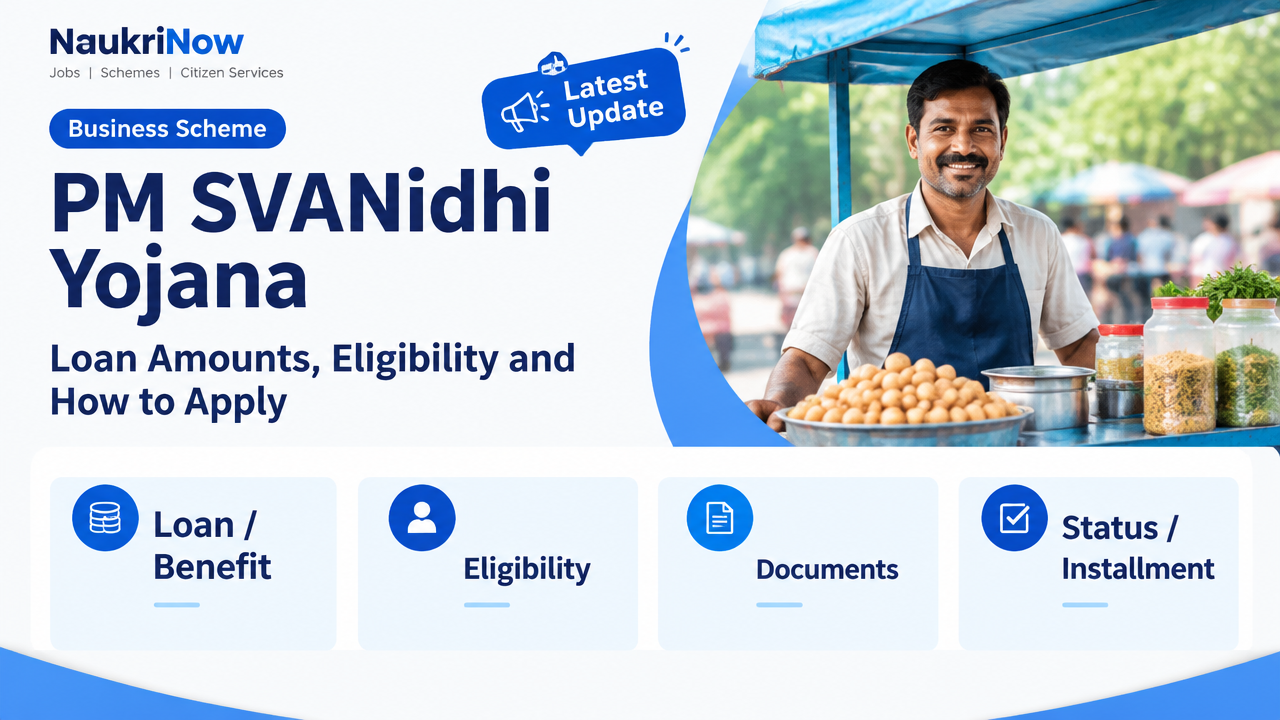
PM SVANidhi Yojana, officially called the PM Street Vendor’s AtmaNirbhar Nidhi scheme, provides collateral-free working capital loans to eligible street vendors. The Ministry of Housing and Urban Affairs launched it on 1 June 2020 to help vendors access formal credit for their businesses. The restructured scheme has three loan stages, an interest subsidy for timely repayment and incentives for eligible digital transactions. It has been extended until 31 March 2030. Check the official portal or your lender for current rules.
Scheme overview
| Scheme detail | Summary |
|---|---|
| Official name | PM Street Vendor’s AtmaNirbhar Nidhi (PM SVANidhi) |
| Purpose | Provide collateral-free working capital loans to eligible street vendors for their businesses |
| Ministry | Ministry of Housing and Urban Affairs |
| Launch date | 1 June 2020 |
| Loan structure | Three successive stages, with current ceilings of up to Rs. 15,000, Rs. 25,000 and Rs. 50,000 |
| Conditional benefits | 7% per annum interest subsidy for timely repayment and incentives for eligible digital transactions, subject to scheme rules |
| Scheme validity | Extended until 31 March 2030 |
| Official portal | pmsvanidhi.mohua.gov.in |
Why was it introduced?
The scheme is intended to help eligible street vendors access formal working capital for their businesses. A collateral-free loan can provide a route to credit without requiring the borrower to pledge collateral under the scheme. The staged loan structure also gives eligible vendors the possibility of seeking a higher ceiling after repaying an earlier loan on time and meeting lender checks.
Its conditional interest subsidy and digital transaction incentives are separate from the loan itself. Vendors still need to repay the principal according to the lender’s schedule, and the lender’s terms continue to apply. These distinctions matter when assessing whether borrowing is suitable: a loan is not a grant, and conditional benefits should not be treated as guaranteed income.
Key features and benefits
| Feature | Details |
|---|---|
| Purpose | Collateral-free working capital loans for eligible street vendors |
| Loan stages | Up to Rs. 15,000, Rs. 25,000 and Rs. 50,000 across three successive stages |
| Interest subsidy | 7% per annum for timely repayment, subject to scheme rules |
| Digital transaction incentive | Cashback incentives of up to Rs. 1,600 under the restructured scheme; conditions apply |
| Scheme validity | Extended until 31 March 2030 |
| Official portal | pmsvanidhi.mohua.gov.in |
These features describe the scheme structure, not a promise that every applicant will receive a loan or every benefit. The loan amount sanctioned depends on the application and the lender’s review. The interest subsidy and digital cashback also depend on applicable conditions, so confirm the current rules with the portal or lender before relying on either benefit.
The three loan tranches explained
Applicants do not generally begin with the largest loan. A vendor may progress to a higher limit after repaying the previous loan on time and meeting the lender’s checks. Each amount is a maximum, not a guaranteed sanction. The first stage is the starting point in the three-stage structure; the later stages are linked to repayment of the earlier loan.
| Loan stage | Maximum amount | Progression |
|---|---|---|
| First loan | Up to Rs. 15,000 | Starting working capital loan for an eligible applicant |
| Second loan | Up to Rs. 25,000 | May be available after timely repayment of the first loan |
| Third loan | Up to Rs. 50,000 | May be available after timely repayment of the second loan |
Why the amount increases in steps
The staged design means that the maximum available amount depends on progression through the loan stages rather than simply being selected by a first-time applicant. Repayment history is relevant to moving forward, and the lender still reviews the application. Vendors should therefore plan using the ceiling for the stage they are applying for and avoid assuming that a later-stage amount will be available immediately.
Old loan amounts vs. restructured amounts
The first two limits increased under the restructuring announced from August 2025. Older information may show the original limits.
| Loan stage | Original ceiling | Restructured ceiling |
|---|---|---|
| First loan | Up to Rs. 10,000 | Up to Rs. 15,000 |
| Second loan | Up to Rs. 20,000 | Up to Rs. 25,000 |
| Third loan | Up to Rs. 50,000 | Up to Rs. 50,000 |
A first-time applicant should plan around the first-loan limit rather than assume they can borrow Rs. 50,000 immediately. The lender makes the sanction decision. If you see a different limit on an older page or document, compare it with the current information on the official portal and confirm the applicable amount with your lender.
Who can apply? Eligibility categories
The scheme is intended for street vendors working in urban areas and, where covered, nearby peri-urban areas. The application route depends on whether the vendor has been surveyed or holds official vending documents. To apply under PM SVANidhi Yojana, first identify which vendor category and evidence route applies to your circumstances.
| Vendor category | Typical eligibility route or proof |
|---|---|
| Category A | Holds a Certificate of Vending (CoV) or identity card issued by the Urban Local Body (ULB) |
| Category B | Appears in the ULB survey but has not received a CoV or identity card; a provisional certificate may be generated through the portal where applicable |
| Category C | Was missed in the survey or began vending later; may apply using a Letter of Recommendation (LoR) from the ULB or Town Vending Committee (TVC) |
| Category D | Vends within ULB limits but comes from a surrounding peri-urban or rural area; may apply using an LoR |
General conditions
- The applicant must be engaged in street vending and establish the relevant vendor category.
- A vendor who needs an LoR or other supporting confirmation may need to resolve that requirement with the ULB or TVC.
- Meeting category conditions does not guarantee a loan. The lending institution reviews the application and makes the credit decision.
Ask your ULB, TVC, participating bank or authorised Common Service Centre (CSC) which route applies to your case. Do not rely on an agent’s promise of automatic eligibility. If your vending document is missing or your survey status is unclear, resolve that question with the relevant local authority before submitting details under a category that may not fit.
Documents and details to prepare
Requirements can vary by applicant category and lender. Check the live application instructions before applying. Preparing the relevant details in advance can help you enter consistent information, but it does not replace the portal’s current instructions or any additional verification requested by the lender.
| Document or detail | Why it may be needed |
|---|---|
| Aadhaar number and mobile access | Identity and OTP-based verification |
| CoV or vendor identity card | Evidence of vending status, if issued |
| Letter of Recommendation | Vendor-status support for applicants using the LoR route |
| Bank account details and IFSC | Loan disbursal and account-related processing |
| Additional identity proof, such as voter ID, PAN or driving licence | May be requested for verification |
| Passport-size photograph and active mobile number | Application and updates |
Use the same accurate details throughout the application and keep copies of submitted information for your own reference. If a requested document is not available, check with the portal, CSC, lender or local authority about the correct route rather than uploading an unrelated document or relying on an intermediary’s assurance.
How to apply for a PM SVANidhi Yojana loan online
Apply through the official portal or seek assistance from a CSC or participating lender. Portal labels may change, so follow the current on-screen instructions. A careful application starts with confirming the vendor category and ends with saving the reference details needed to follow up.
- Check your vendor category and gather the relevant CoV, identity card or LoR.
- Keep your Aadhaar-linked mobile, bank details and other requested documents ready.
- Visit the official portal and choose the loan application option.
- Enter your mobile number and complete the OTP or other verification shown.
- Select the appropriate vendor category and complete the Loan Application Form with accurate personal, vending and bank details.
- Upload the documents requested for your category and review the form before submitting.
- Save your application or reference number and keep a screenshot or printout for follow-up.
- Track the application and respond if the lender or local authority requests clarification.
Before you submit the form
Review the vendor category, contact details, bank information and uploaded documents for accuracy. Follow the portal’s current prompts, since the labels and sequence shown online may change. Saving the reference number or a copy of the submission gives you information to use when checking the application later. Submission itself is not approval, so wait for the status update and any lender communication.
How the loan approval process works
Submitting an application does not mean it has been approved. It may go through vendor-detail checks and lender review. Participating lenders can include banks and other eligible financial institutions. If the loan is sanctioned, the lender completes documentation and disbursal. Confirm the repayment schedule, applicable interest, due dates and payment method directly with the lender. No fixed processing time is stated here because timelines can depend on verification and the lender.
Collateral-free does not mean interest-free or that the loan does not have to be repaid. Before accepting a sanction, make sure you understand the amount offered and the repayment terms given by the lender. If the amount differs from what you expected, ask the lender to explain the sanctioned amount and its assessment rather than assuming that the scheme’s maximum ceiling is an automatic entitlement.
Interest subsidy and digital cashback
Interest subsidy
The lender charges interest according to the loan terms. Eligible vendors who repay on time can receive an interest subsidy of 7% per annum, subject to applicable rules. The subsidy reduces the effective borrowing cost; it does not cancel the principal or replace scheduled repayments. Ask the lender how the subsidy is credited and how your repayment record is assessed.
Keep track of your repayment schedule and retain payment records. If you are unsure whether a payment has been recorded or how the subsidy applies to your loan, confirm with the lender. Do not treat the subsidy as a reason to delay an instalment: timely repayment is the condition described for eligibility, and the loan remains repayable.
Digital transaction cashback
Eligible digital transactions associated with the vendor’s business, including UPI transactions, may qualify for cashback of up to Rs. 1,600 under the restructured scheme. Check current transaction conditions and crediting rules through the portal or lender. A digital payment record does not guarantee a larger future loan.
The stated amount is an upper limit for the incentive, not a guaranteed payment to every applicant. Check what types of transactions qualify and how the benefit is credited under current rules. Keep the loan repayment conditions separate from the cashback conditions; receiving or expecting a transaction incentive does not replace a scheduled loan payment.
How to get a Letter of Recommendation
If you do not have a CoV or vendor identity card and your category uses an LoR, contact the ULB or TVC about the process. The portal may provide an LoR request facility; follow its current instructions.
- Check the portal or ask your ULB/TVC how to request an LoR.
- Submit the vendor and location details requested.
- Keep any acknowledgement or reference number supplied.
- After your vendor status is confirmed, continue with the loan application route for your category.
An LoR is relevant to the vendor-status route for categories that use it; it does not by itself guarantee loan approval. The lender still reviews the loan application. If you are uncertain whether an LoR is needed, ask the local authority or check the current portal instructions before proceeding.
How to check your application status
- Open the official portal and choose the tracking or status option currently available.
- Enter the requested reference number and registered mobile details.
- Read the latest update. If action is pending, contact the lender or local authority handling that stage.
A submitted or forwarded application is still being processed; sanctioned means approved; and disbursed means the lender has released the loan. If an application is rejected, check the reason shown or ask the lender before applying again.
Keep the reference number available when following up and use the lender or authority responsible for the stage shown. A status update can indicate that a step is still under review rather than that a decision has been made. If you receive a request for clarification, respond through the channel identified by the portal, lender or local authority.
Common problems and practical fixes
| Problem | What to check or do |
|---|---|
| OTP does not arrive | Check network coverage and that the number used for verification can receive messages. Confirm Aadhaar-mobile linkage if required by the portal. |
| No CoV or vendor card | Ask the ULB/TVC whether your survey record is available or whether you should use the LoR route. |
| Application remains under review | Check the stage on the portal, then contact the lender or CSC with your reference number. |
| Expected loan amount is not offered | Check which tranche you are applying for and ask the lender to explain the sanctioned amount and eligibility assessment. |
| Portal is unavailable | Retry later or seek help from a CSC or participating lender. Never share your OTP or PIN with someone offering to apply for you. |
Tips to avoid fraud
- Use the official portal or seek assistance from a CSC or participating lender.
- Do not share your OTP or PIN with anyone offering to submit an application for you.
- Be cautious of claims that approval or a particular loan amount is guaranteed; the lender makes the sanction decision.
- Check your application status using your reference details and confirm questions about the application with the lender or local authority handling it.
- Read the lender’s repayment terms before accepting a loan, including the applicable interest, instalments and due dates.
PM SVANidhi and PM Kisan Samman Nidhi are different schemes
This scheme provides working capital loans for eligible street vendors. PM Kisan Samman Nidhi is a separate scheme associated with eligible farmer families. The schemes have different purposes and official portals. For farmer income support, check the PM Kisan website rather than applying under this vendor scheme.
Pros and Cons: Advantages and Limitations
| Pros | Cons |
|---|---|
| Provides access to formal working capital without collateral. | It is a repayable loan, not a grant or debt waiver. |
| Offers higher loan ceilings through successive tranches. | The maximum is not guaranteed; applications are subject to eligibility and lender review. |
| Timely repayment can qualify for an interest subsidy. | The subsidy is conditional and does not remove repayment obligations or the lender’s interest terms. |
| Eligible digital transactions can attract incentives and create a payment record. | Cashback depends on transaction rules, and a digital record does not guarantee future credit. |
| Vendors without a CoV may have an LoR route where applicable. | Vendor confirmation or an LoR can require local verification. |
The scheme may be useful for an eligible vendor who needs working capital and can meet the lender’s repayment terms. Its limits are equally important: eligibility does not ensure sanction, higher tranches depend on progression and lender checks, and conditional benefits do not remove the obligation to repay. Consider the amount actually offered and its repayment schedule before deciding whether to borrow.
Simple action plan for vendors
- Confirm that you are a street vendor covered by the scheme and identify your category.
- Arrange a CoV, vendor identity card or LoR route as applicable.
- Check the current loan ceiling and required documents on the official portal.
- Apply through the portal, a CSC or a participating lender, and save your reference number.
- Before accepting the loan, understand the lender’s interest rate, instalments and due dates.
- Repay on time, keep payment records and check the applicable subsidy, cashback and later-tranche rules.
For PM SVANidhi Yojana, the most practical preparation is to resolve your vendor category and supporting-document route first, then apply using the current instructions and keep your reference number. Once the lender provides its decision, review the offered amount and repayment terms before accepting. Use the portal, lender or local authority for any status or eligibility questions that remain.
Conclusion
PM SVANidhi Yojana can help eligible street vendors access collateral-free working capital and build a formal repayment record. Current ceilings are up to Rs. 15,000, Rs. 25,000 and Rs. 50,000 across three stages, with conditional benefits for timely repayment and digital transactions. Confirm your category, application requirements and lender terms through official channels before borrowing.
Frequently Asked Questions
What is PM SVANidhi Yojana?
It is a scheme that provides collateral-free working capital loans to eligible street vendors. It also includes conditional benefits for timely repayment and eligible digital transactions.
What are the current loan amounts?
The current ceilings are up to Rs. 15,000 for the first loan, Rs. 25,000 for the second and Rs. 50,000 for the third. The lender decides the amount sanctioned.
Can I apply for the Rs. 50,000 loan first?
The scheme is structured in tranches. The third-stage ceiling is linked to progressing through earlier loans and repayment conditions, so a first-time applicant should not assume they can receive Rs. 50,000 immediately.
Do I need collateral or a guarantor?
The scheme loans are described as collateral-free. Confirm the lender’s documentation and loan terms before accepting an offer; do not pay anyone who promises guaranteed approval.
Can I apply without a Certificate of Vending?
Possibly. Depending on your category, you may be able to use a Letter of Recommendation from the ULB or TVC. Check the portal or ask the local authority which route applies.
How much is the interest subsidy?
The scheme provides a 7% per annum interest subsidy for timely repayment, subject to applicable conditions. The loan remains repayable, and the lender’s interest terms still apply.
How much digital cashback can I receive?
The restructured scheme provides digital transaction cashback incentives of up to Rs. 1,600. Check current qualifying transaction and credit rules on the official portal or with your lender.
How can I track my application?
Use the tracking option on the official portal and enter the requested application details. If the application is awaiting review, contact the lender or authority handling that stage.
Is PM SVANidhi the same as PM Kisan Samman Nidhi?
No. This is a loan scheme for street vendors. PM Kisan Samman Nidhi is a separate scheme for eligible farmer families.
Where can I check the latest rules?
Use the official portal or ask your participating lender, ULB or TVC. Figures and application instructions can be revised.
Official links
| Resource | Link |
|---|---|
| Official portal for applications, updates and tracking | Visit the portal |
| PM Kisan Samman Nidhi official website | Visit PM Kisan |

Comments