Table of ContentsClick to view all sections
- Bank PO Guide: What does a bank PO do?
- First, identify the right recruitment route
- Check eligibility before you begin an application
- Understand the selection process, then prepare for it
- A practical study plan you can sustain
- Prepare for an interview or further assessment
- Application and exam-day checklist
- Mistakes that waste time or create avoidable risk
- Conclusion
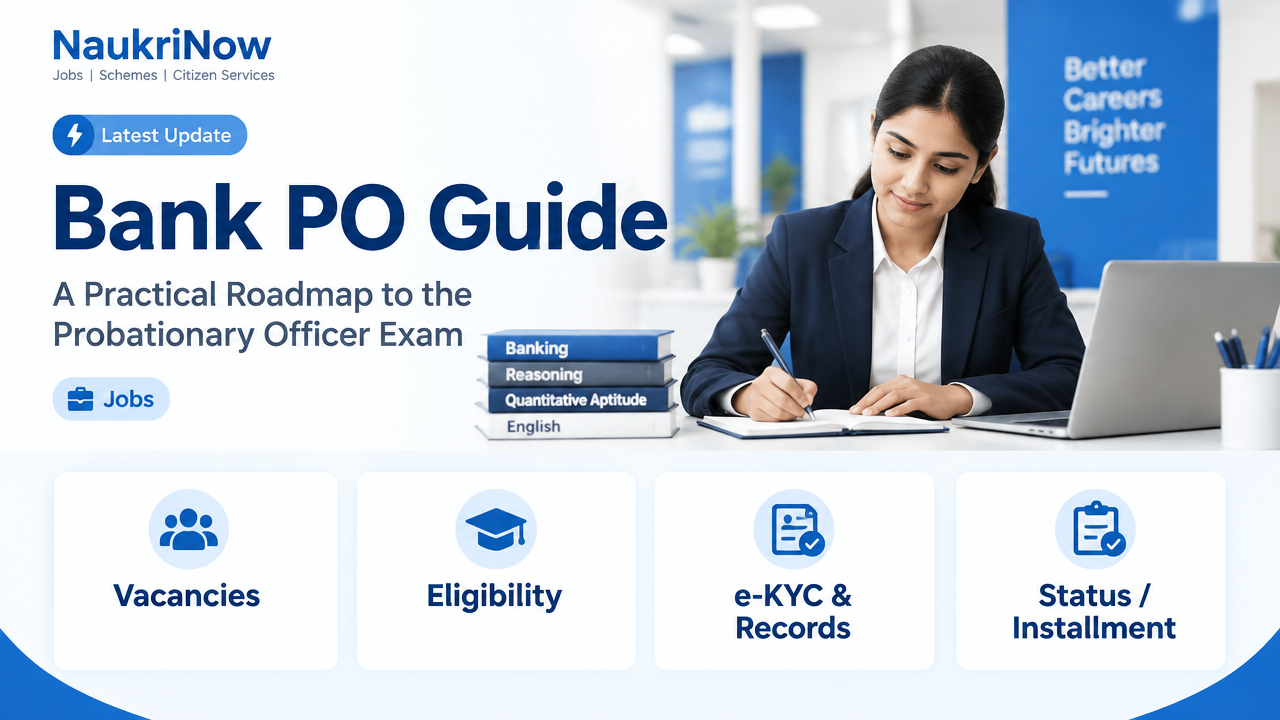
A bank probationary officer (PO) role can lead to a varied career in banking, combining customer service, operations, credit work and team responsibilities. Getting selected takes more than memorising facts: you need to understand the job, read the recruitment notice carefully and prepare for the specific selection process announced by the recruiting bank or exam authority.
This Bank PO Guide explains how to approach those decisions without relying on details that can change from one recruitment cycle to another. Use it to build a preparation plan, then confirm current eligibility, exam structure, dates, fees, vacancies and instructions in the relevant official notification.
Bank PO Guide: What does a bank PO do?
A PO is generally recruited into an officer-level position and receives training or a probationary period, as described by the employer. The role is not limited to sitting at a desk or approving loans. Depending on the bank, branch, posting and stage of a career, an officer may work with account services, digital banking, customer complaints, payment operations, lending documentation, compliance checks, business development or branch administration.
Early work can involve learning procedures and supporting day-to-day branch activity. Over time, responsibilities may include reviewing proposals, managing operational risks, supervising staff or helping deliver services to customers and businesses. Transfers, work schedules and the balance between customer-facing and administrative duties depend on the employer and posting. Read the career information in the official recruitment notice if these factors matter to your decision.
The role may suit graduates who are comfortable working with numbers and rules, communicating clearly, handling time-sensitive tasks and learning new systems. It may be less suitable if you expect a fixed desk location, identical duties every day or no interaction with customers.
First, identify the right recruitment route
Bank PO recruitment is not one single, identical process. Recruitment may be organised by a bank itself or through a common recruitment body, and the participating employers and selection arrangements can differ. A familiar exam name does not guarantee that every year’s process will have the same stages or conditions.
- Choose the employer or recruitment process. Decide which banks or recruitment notices you want to follow. Do not assume one application covers every PO opportunity.
- Find the official notice. Use the recruiting bank’s official careers page or the official website of the named exam authority. Treat coaching sites, social posts and forwarded messages as leads, not final confirmation.
- Check the post name and recruitment year. Make sure the notice is for the officer role you intend to apply for, not a clerical, specialist or different officer position.
- Save the notice and key instructions. Keep a copy of the complete notification, not only a summary or screenshot. Recheck the official page for any later notice or correction.
Official notices are the authority for changing facts such as application windows, fees, age conditions, eligible qualifications, exam stages, document requirements, vacancies and result updates. Do not rely on old articles or previous-year figures for these details.
Check eligibility before you begin an application
Many PO recruitments ask for a degree, but the accepted qualification, the date by which it must be completed and the evidence required are determined by the specific notice. Do not assume that being in the final year, awaiting results or holding a particular qualification will be accepted without checking the wording.
Age limits and any permitted relaxations also vary by recruitment and category. Read the notice’s definition of the relevant date and how age is calculated. If you claim a relaxation, confirm which certificate is needed, who must issue it and when it must be valid. General guidance from a friend or an older recruitment notice may not fit your case.
Before applying, compare your details against the notice: name and date of birth on identity documents, education records, category or other claims, and any photo, signature or certificate specifications. If something is unclear, use the official communication channel named in the notice rather than guessing. A technically completed form is not proof that the application meets the eligibility rules.
Understand the selection process, then prepare for it
Recruitment may include more than one written examination stage and may also include an interview or another assessment. Some processes use a preliminary test as a screening stage; the treatment of scores, qualifying requirements and final merit can differ. The subject areas, number of questions, timing, marking rules and permitted tools should be checked in the current notice. Avoid building a plan around a remembered pattern until you have verified it.
Once you have the official structure, prepare in three connected strands:
- Reasoning and problem-solving: Practise interpreting conditions, spotting relationships and completing questions accurately under time limits. Review why an answer works, not just the answer itself.
- Quantitative skills: Strengthen arithmetic and data interpretation. Focus on choosing a sensible method, estimating where useful and checking calculations rather than rushing through every question.
- English and communication: Build reading comprehension, vocabulary in context, grammar and clear written expression where required. Regularly read well-edited material and summarise the main point in your own words.
Depending on the announced format, preparation may also need to cover general, banking or economic awareness, computer knowledge, descriptive writing or other areas. Use the syllabus and instructions in the current notice to decide what belongs in your plan. For awareness topics, maintain brief notes and revise them; collecting headlines without understanding them is rarely an efficient strategy.
A practical study plan you can sustain
Start with a diagnostic test or a small set of timed questions across the listed areas. Record your accuracy, time taken and the type of error: a concept gap, misread instruction, calculation slip, weak vocabulary or poor question selection. This gives you a starting point more useful than simply counting study hours.
- Set weekly targets. Assign time to each tested area and reserve sessions for revision and practice. Make the plan fit your work, study or family commitments so you can follow it consistently.
- Learn before you accelerate. If fundamentals are weak, study a concept and solve untimed examples before attempting fast sets. Speed without sound methods can reinforce mistakes.
- Practise in focused sets. Work on one question type at a time, then mix topics to practise switching between them. Keep a record of questions you guessed or left unfinished.
- Use timed mocks as evidence. Take full-length practice tests based on the official format once you have covered the basics. Review each test carefully; the review is where you identify what to change.
- Revise repeatedly. Revisit formulas, error patterns, vocabulary and awareness notes at planned intervals. Short, regular revision is easier to retain than a last-minute pile of material.
For example, if a mock shows that you can solve a data set accurately but spend too long on it, the problem may be selection and pacing rather than arithmetic. Practise deciding quickly whether to attempt, skip and return. If errors come from misreading conditions, slow down briefly to mark the information given before calculating. The remedy should match the cause.
Do not measure readiness only by one mock score. Look for improving accuracy, more consistent timing, fewer repeated errors and the ability to recover after a difficult section. Practice tests are diagnostic tools, not predictions of a final outcome.
Prepare for an interview or further assessment
If the recruitment includes an interview, prepare to explain your choices clearly rather than memorise scripted answers. Be ready to discuss your education, work or project experience, strengths, areas you are improving and reasons for choosing banking. Connect your examples to qualities relevant to the role, such as accuracy, responsibility, service and sound judgement.
Build a basic understanding of how banks serve individuals and businesses, why documentation and risk checks matter, and how customers use branch and digital channels. Follow reliable news and official institutional material, but distinguish a confirmed fact from opinion. You are not expected to bluff; if you do not know an answer, respond calmly and honestly.
Practise speaking in a structured way: make your main point, give a brief example and explain what you learned. A mock interview with a teacher, colleague or friend can help you notice rushed speech or unclear answers. Keep your tone professional without trying to sound artificially formal.
Application and exam-day checklist
- Read the full current notification, including eligibility, instructions and any corrigendum or update.
- Enter personal and educational details exactly as required, and review the completed form before submission.
- Prepare image files and certificates to the specifications stated by the recruiting authority.
- Use only the official application route. Keep the submitted form, confirmation and permitted payment record safely.
- Check the official source for the admit card, reporting time, venue, permitted items and identity-document instructions.
- Plan travel in advance and carry only what the official instructions allow. Do not assume that rules from another exam apply.
If a result, interview schedule or other update is important, check the official recruitment page directly. Search snippets and unofficial messages can be incomplete or out of date.
Mistakes that waste time or create avoidable risk
- Preparing from an old pattern: Use previous papers for practice, but confirm the current structure and syllabus in the relevant notice.
- Applying before checking eligibility: Verify qualification, age calculation and certificate conditions first. A rushed application can cost time and money.
- Collecting too many resources: Choose a small set of dependable books, lessons or practice sources and finish them systematically instead of switching every week.
- Taking mocks without reviewing them: Repeating tests without analysing errors can repeat the same weaknesses.
- Chasing attempts instead of accuracy: Question selection matters. Follow the marking rules published for the exam and practise a sensible attempt strategy.
- Ignoring communication and awareness: A written-test plan should not crowd out any other component included in the announced process.
- Trusting unofficial promises: Be wary of anyone guaranteeing selection, asking for confidential credentials or claiming special access. Recruitment updates and applications should be verified through the responsible official source.
Frequently Asked Questions
1. What is a bank PO?
A bank PO is an officer-level recruit who undertakes training or probation and may take on a range of banking responsibilities. The exact title, duties and employment conditions depend on the recruiting bank and its notice.
2. Is a degree required for every Bank PO recruitment?
Many recruitments specify a degree, but accepted qualifications and completion deadlines can vary. Check the current official notification for the exact education requirement and supporting documents.
3. Are all Bank PO exams conducted by the same organisation?
No. Recruitment may be conducted by a bank or by a recruitment body for specified employers. Confirm who is responsible for the particular vacancy and apply through the route stated in its official notice.
4. Is the exam pattern the same every year?
Not necessarily. Stages, subjects, question formats, scoring rules and the role of each stage can change. Use the current notification as the final reference and treat older papers as practice material.
5. How long should I prepare?
There is no single preparation period that suits everyone. Take a diagnostic test, assess your available study time and gaps, then make a realistic weekly plan. Review progress regularly and adjust the plan rather than copying another candidate’s timetable.
6. Do I need coaching to clear a Bank PO exam?
Coaching is a personal choice, not a universal requirement. A disciplined self-study plan with suitable explanations, timed practice and detailed error review may work well for some candidates; others may benefit from structured classes or feedback.
7. Where should I check current application and result information?
Use the official careers page of the recruiting bank or the official website of the exam authority named in the notification. Verify notices, application links, schedules, admit cards and results there rather than relying on forwarded messages.
Conclusion
A strong Bank PO preparation plan begins with the job and the official recruitment notice, not with a stack of practice papers. Confirm your eligibility and the current selection structure, build skills steadily, use mock tests to diagnose specific weaknesses and prepare to communicate your experience clearly. For every changing detail—from application instructions to results—return to the responsible official source. Consistent preparation and careful verification will help you make informed decisions at each stage.
Comments