Table of ContentsClick to view all sections
- Bank Clerk Guide: What does a bank clerk do?
- Is this kind of work a good fit?
- Recruitment routes and selection stages
- Eligibility: what to check before applying
- How to prepare for a bank clerk exam
- Useful examples: turn mistakes into decisions
- Application and document checklist
- Mistakes to avoid
- Conclusion
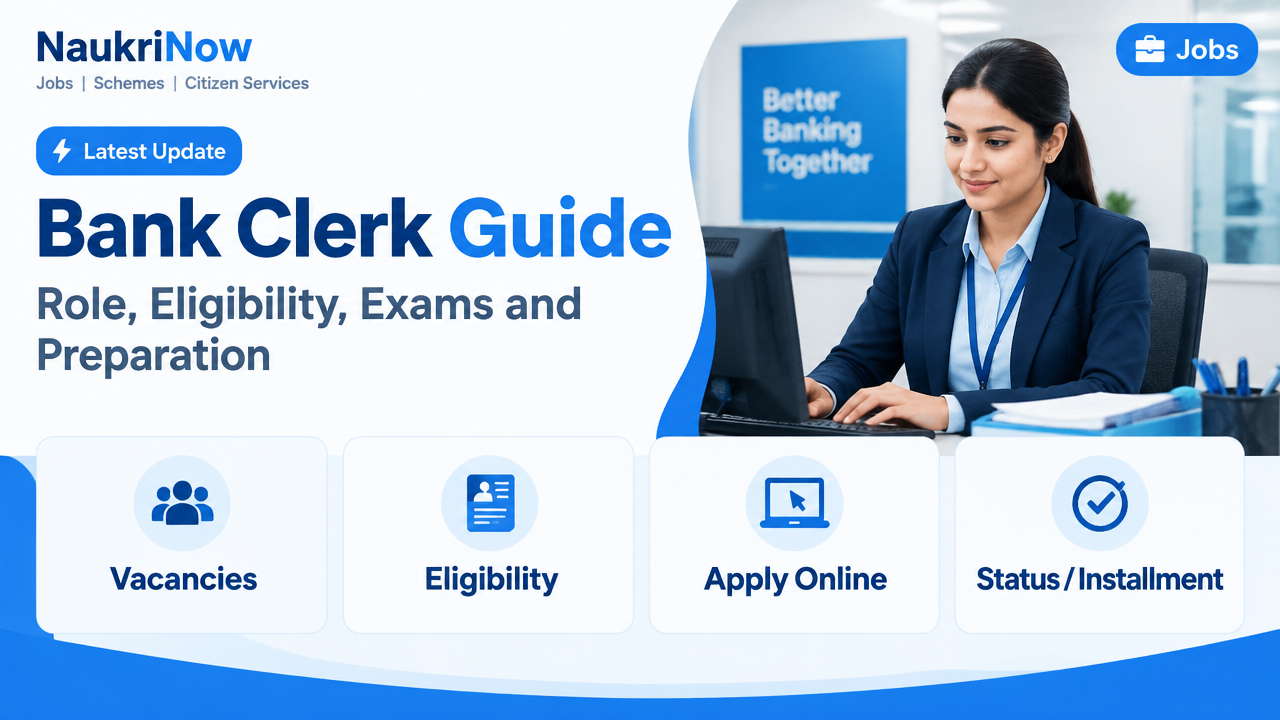
Bank Clerk Guide: Role, Eligibility, Exams and Preparation
A bank clerk is often one of the first people a customer speaks to when visiting a branch. The job combines customer service with careful handling of transactions, records and routine banking processes. It can suit candidates who are comfortable with numbers, communicate clearly and can stay accurate during busy periods.
There is no single recruitment process or set of eligibility rules for every bank clerk job. Public-sector banks may recruit through shared or bank-specific processes, while private banks may hire directly. Job titles also differ. Use this guide to understand the work and plan your preparation, then rely on the relevant bank’s official recruitment notice for current requirements, dates, fees and selection stages.
Bank Clerk Guide: What does a bank clerk do?
The exact duties depend on the bank, branch and role. Clerical staff commonly support everyday branch operations and help customers use banking services. Work may include:
- Responding to routine account, deposit, payment and service enquiries, or directing customers to the right channel.
- Processing transactions and requests according to the bank’s procedures and the employee’s assigned responsibilities.
- Checking forms and supporting documents for completeness, and entering or updating information in banking systems.
- Maintaining records, handling correspondence and helping resolve straightforward service issues.
- Explaining how to use digital banking services and referring complex or sensitive matters to the appropriate staff member.
Accuracy, confidentiality and following procedure matter as much as speed. A small data-entry error or a missed verification step can create extra work or affect a customer. Some positions involve more counter service; others may focus more on operations. Read the job description rather than assuming every clerk role is identical.
Is this kind of work a good fit?
Consider the day-to-day demands, not just the attraction of working in a bank. Branches can be busy, and staff may need to switch between customer queries and careful processing. You may be expected to follow set procedures even when someone is impatient or a queue is growing.
The role may suit you if you can stay composed, explain information in plain language, check details consistently and handle routine computer-based work. Basic numerical confidence helps, but careful checking is more valuable than rushing through calculations. If you strongly dislike public-facing work, ask about the actual duties of a particular vacancy before applying.
Recruitment routes and selection stages
Recruitment depends on the employer. Public-sector bank vacancies may be advertised through an authorised common recruitment body, an individual bank, or another official channel named in the notice. Private banks generally publish vacancies and instructions through their own recruitment channels. A familiar exam name or an old advertisement is not proof that a new recruitment is open.
Where an examination is used, the process may include an online test, one or more stages of assessment, document checks and a language-related assessment. The order, names and requirements vary. Some recruitment routes do not use the same stages at all. A test pattern seen in one bank’s previous cycle should not be treated as a guarantee for another bank or a later cycle.
Before applying, find the notice on the responsible organisation’s official website. Confirm the post title, recruiting authority, application method, eligibility conditions, selection stages and any instructions about the examination centre or language. If an advertisement links to a separate application portal, follow the link from the official notice rather than a forwarded message.
Eligibility: what to check before applying
Do not rely on a general online summary to decide whether you qualify. Recruitment notices set the rules for that specific post and cycle. Check each of the following against the original notice:
- Education: Confirm the required qualification, how it must be recognised and whether it must be completed by a specified point in the process.
- Age: Read the stated age limits, the date used to calculate age and any applicable relaxation rules. Do not calculate eligibility using a different cycle’s dates.
- Nationality or citizenship: Check the categories permitted by the notice and whether supporting documents are needed.
- Language: Some vacancies specify a local language requirement or assessment. Verify the language, the level expected and how proficiency is assessed.
- Computer skills: Look for any stated computer knowledge, certificate or experience requirement; do not assume the same condition applies everywhere.
- Other conditions: Review document, category, experience or other requirements mentioned for the post, including the instructions for certificates.
If a requirement is unclear, seek clarification from the recruiting organisation using contact details published on its official website or in the notice. Keep a copy of the advertisement you applied under. Eligibility is determined by the stated rules and documents, not by a coaching-centre estimate or a social-media post.
How to prepare for a bank clerk exam
Start with the current official notification or information bulletin, if the recruitment uses an exam. Note the subjects, question format, marking rules, language options and timing. Treat any study plan as adjustable: the official pattern should shape your preparation, not the other way round.
- Check your starting point. Try a timed diagnostic set in the relevant subjects. Record not just your score but also which questions took too long, where you guessed and what you misunderstood.
- Build core skills. Practise arithmetic and numerical reasoning, reading comprehension and vocabulary, and logical or analytical reasoning where these appear in the syllabus. If a computer-awareness component is specified, study its listed topics rather than trying to memorise unrelated material.
- Learn methods before chasing speed. Work through examples carefully. For calculation questions, practise estimation and checking; for reasoning, draw a small table or diagram when it makes the conditions easier to follow; for reading questions, answer from the passage rather than outside assumptions.
- Use timed practice gradually. Begin with short sets and add time pressure as accuracy improves. Full-length mocks are useful for pacing and concentration, but only if you review them afterwards.
- Keep an error log. Label mistakes as concept gaps, misreading, calculation slips, poor time choices or unsupported guesses. Review the log regularly and redo selected questions without looking at the solution.
- Practise the language requirement early. If the notice requires familiarity with a local language, check what the assessment involves and make a steady practice plan. Do not leave an unfamiliar script or reading task until the end.
- Plan the final stretch sensibly. Revise reliable methods, review common errors and protect time for sleep and logistics. Starting entirely new material at the last moment can distract from skills you have already built.
A workable weekly routine might include several focused study sessions, short daily calculation or reading practice, and one mock test followed by a detailed review. Adapt the workload to your other responsibilities. Consistent, analysed practice is usually more useful than collecting large numbers of questions without learning from them.
Useful examples: turn mistakes into decisions
Example 1: A slow but accurate calculation. Suppose you answer a set correctly but leave several questions blank because each calculation takes too long. Do not immediately sacrifice accuracy to speed. Check whether you are using an unnecessarily long method, then practise a few similar questions with a reasonable time target. Compare both accuracy and time across attempts.
Example 2: A tempting guess. In a reasoning question, two answer choices may look plausible if you have not accounted for one condition. Before selecting an answer, list every condition and check that the choice satisfies them all. If the exam’s marking rules make guessing costly, use the instructions in the current notice when deciding whether to attempt uncertain questions.
Example 3: A language requirement discovered late. A candidate may prepare for written subjects but overlook a stated local-language assessment. Make a separate eligibility and selection-stage checklist as soon as you find the notice. Practise the required language alongside exam preparation if the notice calls for it.
Application and document checklist
Before submitting an application, compare your details with the official instructions and keep a personal record of what you submitted. The required documents differ by recruitment, but this checklist can help you prepare:
- Use the application link reached from the authorised recruitment notice.
- Enter your name, date of birth, education and other personal details exactly as instructed and consistent with your supporting records.
- Check the photograph, signature, certificates and file formats against the portal’s specifications.
- Review category or eligibility claims carefully and ensure you can provide the prescribed evidence when asked.
- Save the submitted application, confirmation and any permitted payment record securely.
- Keep checking the official recruitment page for notices about later stages. Do not rely solely on messages from unofficial groups.
Never send passwords, one-time codes or banking credentials to someone claiming they can secure a job or change an application. Be cautious of unofficial agents, guaranteed-selection claims and payment requests made outside the authorised process. When in doubt, verify the instruction through the bank or recruiting body’s official website.
Mistakes to avoid
- Preparing from an old pattern: Use past papers for practice, but compare their format with the current official information before treating it as current.
- Applying without checking every condition: A degree alone does not establish eligibility if other requirements apply.
- Practising only strong subjects: A weak section can hold back overall performance. Use your diagnostic results to divide study time sensibly.
- Taking mocks without reviewing them: A score cannot tell you whether errors came from knowledge, pace or avoidable carelessness. Analyse the paper.
- Confusing a clerk role with every banking job: Duties and recruitment can differ across banks and job titles. Read the actual description.
- Trusting unofficial vacancy claims: Do not act on a viral post, a forwarded link or an unverified promise. Confirm the recruitment on the responsible official site.
- Rushing the application: Mistyped details or incorrectly uploaded files can cause problems. Check the completed form before final submission.
Frequently Asked Questions
What is the difference between a bank clerk and a bank probationary officer?
The titles generally refer to different roles and recruitment tracks, but responsibilities and structures depend on the employer. Compare the duties and eligibility in the specific notices rather than relying on broad assumptions about seniority or workload.
Is a particular degree required for every bank clerk vacancy?
No single educational rule should be assumed to cover all banks and recruitment cycles. Check the qualification, recognition and completion-date requirements in the official notice for the post you want.
Do all bank clerk exams have the same syllabus and stages?
No. Exam subjects, language options, selection stages and assessment rules can differ by recruiting organisation and cycle. Use the current notice and official exam information as your reference.
Is local-language knowledge compulsory?
It depends on the vacancy. Some recruitment processes specify a local language condition or assessment, while others may set different rules. Confirm the exact requirement and how it is tested in the notice.
Can I apply to public-sector and private banks?
You can explore both, provided you meet the requirements of each vacancy. Their application channels, role descriptions and selection methods may differ, so apply separately through each employer’s authorised process.
How should I decide which study material to use?
Start with the current official syllabus or exam information, then choose clear material that covers those topics and offers questions with explanations. Use previous papers as practice, not as a promise of what a future paper will contain.
Where can I verify current dates, fees and results?
Check the official website of the recruiting bank or the authorised recruitment body named in the notice. Those details can change between recruitment cycles and should not be taken from an old article or an unofficial message.
Conclusion
A bank clerk role calls for reliable customer service, care with information and steady attention to procedure. To pursue one, first understand the actual duties, then check eligibility and selection details in the relevant official notice. Build preparation around the stated exam requirements, review mistakes instead of merely counting practice questions, and keep your application records organised. Official recruitment sources are the final authority for current vacancy information and instructions.

Comments