Table of ContentsClick to view all sections
Exam City Slip Guide: How to Check Your Exam City and Plan Ahead
When an exam authority publishes an exam city slip, candidates can use it to learn which city has been allotted for their test and begin planning their journey. The slip is useful, especially if you need to travel, but its name and purpose can differ between examinations. It may not show your exact centre, reporting time or room, and it is not necessarily permission to enter the exam venue.
Use this guide to understand what the document usually means, find it through the right channel, check its details and decide what to do next. For the current status, dates, instructions and document requirements for your particular examination, rely on the responsible exam authority’s official website and notices.
What is an exam city slip?
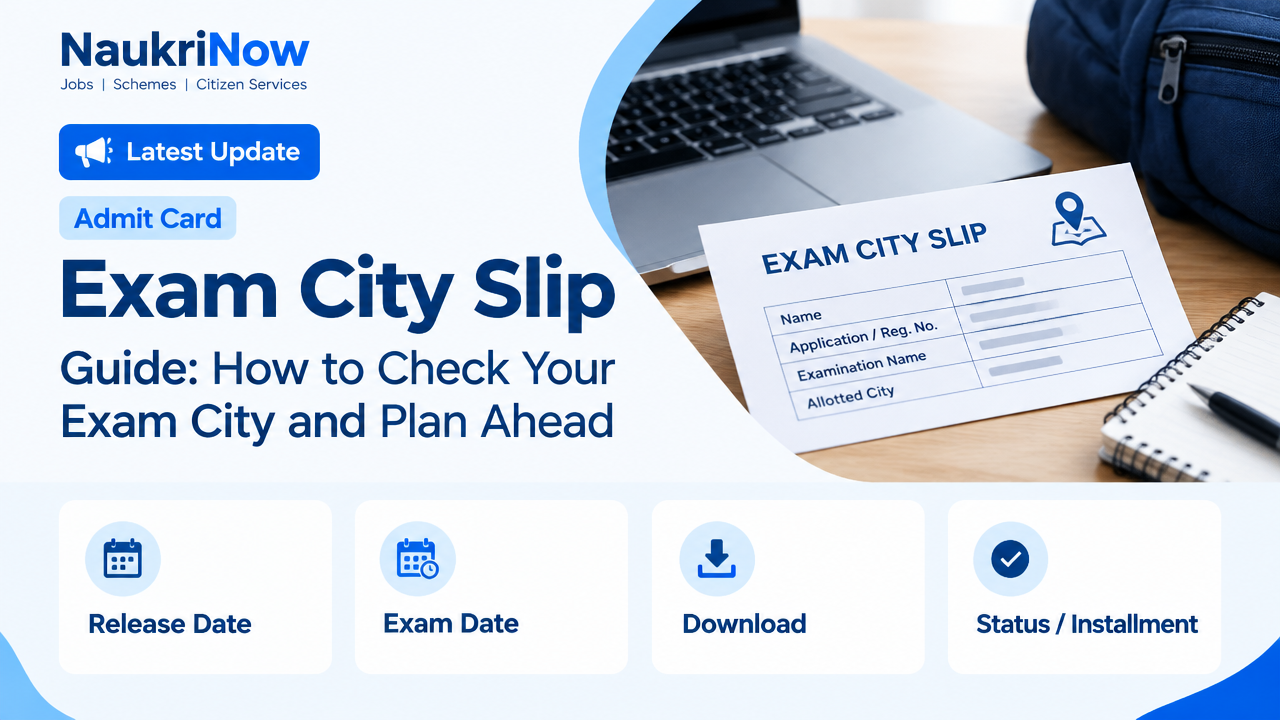
An exam city slip, sometimes called an advance city intimation slip or exam city intimation, is a candidate-specific document that may tell you the city selected or allotted for an examination. Its main practical purpose is to give you advance location information so you can make travel or accommodation plans.
The exact information on it depends on the exam. It may display details such as your name, application or registration number, examination name, allotted city, or a note about the next stage of the process. Some authorities may use a different name or provide location information in another format. Read the instructions printed on your own document rather than assuming every exam follows the same process.
City slip versus admit card
Do not assume a city slip and an admit card are interchangeable. In many examination processes, a city slip provides advance city-level information, while the admit card or hall ticket is the document that gives the candidate’s exam-day instructions. The admit card may include the exact centre address, date, shift, reporting time and entry requirements, but the details vary by examination.
A city slip alone may not be accepted for entry. Unless the official instructions explicitly say otherwise, wait for the required admit card and take the documents specified there. Check whether the city slip says that a separate admit card will be issued, and follow the authority’s directions about when and how to obtain it.
How to check your exam city slip safely
- Find the responsible authority’s official website. Start with the examination body or recruitment agency named in your application, notification or confirmation email. Use its official website and follow the link to the relevant examination page or candidate portal. Avoid relying on search-result snippets, forwarded messages or unofficial download pages.
- Check the notice before trying to log in. Look for an announcement about the city slip and read its scope and instructions. A notice may explain who can access it, how to sign in and whether a separate admit card will follow. Availability and procedures differ, so do not assume a document is missing just because you cannot see it before an official announcement.
- Use the candidate login provided by the authority. Enter the requested details on the official portal only. These might include credentials or identifying information associated with your application; the specific fields vary. Follow the portal’s prompts, and do not share your password, one-time password or other login codes with another person.
- Open the correct examination record. If your account contains more than one application or test, confirm that the exam name and application details match the examination you intend to check. A slip for another exam or application will not answer questions about your current test.
- Review the document before saving it. Check the visible particulars, especially your name, application or registration details and the city information. Read any notes about the document’s purpose or the next step. If the portal offers a download or print option, save a copy in a secure place.
- Keep a backup you can access. Store the downloaded file on a device you control and, if useful, keep a second copy in a secure location. Make sure the file opens and the text is legible. A screenshot can be a quick reference, but it may not replace the original document if the authority later requires a particular format.
- Check the portal again for the next official update. A city slip does not necessarily contain all the information needed for exam day. Follow the authority’s instructions about the admit card, centre details and any later notices. Do not rely on an assumed release sequence or an unofficial prediction.
What to check on the slip
- Candidate details: Compare your name and application identifiers with your application record. Small formatting differences may occur, but do not dismiss a substantial mismatch.
- Exam details: Make sure the document relates to the correct examination or stage. If the authority has listed a particular session or paper, check that it matches your application.
- City information: Note the allotted city exactly as shown. A city is not necessarily the same as a locality, venue or exam-centre address.
- Instructions and disclaimer: Read the full document, including text below the main details. It may explain what the slip can be used for and what document to check later.
- File quality: Confirm that the downloaded file is complete and readable. If the text is cut off or the file does not open, try downloading it again from the official portal.
How to plan when only the city is known
A city-level indication can help with early planning, but avoid making non-refundable arrangements until you understand what has and has not been confirmed. The exact centre may be on a later document, and a centre’s distance from a station, bus terminal or accommodation can differ considerably across a city.
Start by checking practical travel options to the allotted city and considering how much time you may need to reach it. If you are comparing accommodation, look for flexible booking terms and wait for the official centre address before choosing a location where possible. Keep an eye on the authority’s portal for the admit card or further instructions, then plan the local journey using the confirmed address and the time stated in the official documents.
For example, suppose a candidate sees a city name on an advance slip but no venue address. The candidate can begin comparing routes to that city, but should not treat a guessed coaching-centre location or a map search as the exam venue. Once the official admit card or other authorised instruction gives the centre address, the candidate can plan the final local journey.
If the allotted city is far from your home, check the official instructions promptly and assess your options. Do not assume that a city can be changed simply because travel is inconvenient. Whether a correction or change is possible is specific to the examination, and only the authority’s published instructions can confirm it.
If your details look wrong or the slip will not download
First, compare the slip with the application record and the information in the official notice. Check that you are viewing the right exam and candidate account. If a detail still appears incorrect, use the correction or contact process stated by the exam authority. Describe the issue clearly and include only the information requested through its official channel.
Do not edit the downloaded slip yourself, even if the change seems minor. A modified document may not be accepted and can make it harder to verify the original record. Keep the unaltered file and any relevant confirmation of your application. If you contact the authority, retain a copy of your message or the reference it provides, if applicable.
For a technical problem, try opening the portal in a current browser, checking your internet connection and downloading the file again. You can also try a different device or browser if available. If the official portal is temporarily unavailable, wait and check the authority’s website or notices for an update rather than entering your credentials on a look-alike page.
Common mistakes to avoid
- Treating the city slip as the admit card: Check the wording on the slip and the exam authority’s instructions. Carry the required entry document, not just the first document you receive.
- Assuming the city is the exact venue: A city name alone does not identify a centre. Wait for the authorised venue details before planning the last part of your journey.
- Waiting until the last moment to read the notice: Read instructions when you access the document. This gives you time to notice a problem and use the official process.
- Relying on unofficial links or messages: A forwarded link can lead to an outdated page or a fake login. Navigate from the official authority’s site instead.
- Sharing login codes or personal documents: Do not send your credentials, one-time passwords or identity documents to people who offer to retrieve a slip for you. Use the official portal yourself.
- Changing the document or ignoring a mismatch: Never alter a downloaded slip. Report a significant error through the official process and keep the original copy.
- Booking based on guesses: Avoid treating an unverified venue, date or travel claim as final. Confirm relevant details in the official notice or admit card before making firm arrangements.
A simple preparation checklist
- Confirm that the city slip belongs to the correct examination and application.
- Read every instruction and disclaimer on the document.
- Save a legible, unaltered copy somewhere secure.
- Use the official website to check for later notices and the required admit card.
- Plan travel in stages: city-level planning first, exact-centre planning after the venue is confirmed.
- Follow the admit card and official instructions for what to bring, when to report and where to go.
Frequently Asked Questions
Is an exam city slip the same as an admit card?
Not necessarily. A city slip often gives advance information about the allotted city, while an admit card or hall ticket may provide the exam-day details and entry instructions. Follow the terminology and directions used by the authority for your exam.
Can I enter the exam centre with only the city slip?
Do not assume so. Unless the official instructions clearly state that the slip is an accepted entry document, obtain and carry the required admit card or other specified documents. Check the exam authority’s instructions for the exact requirements.
Does the city slip show the exact exam centre?
It may not. Some documents give only a city or broad location. Check your later official exam document for the venue address, and do not rely on a guessed centre.
Can I request a different exam city?
Possibilities, if any, depend on the examination’s rules and process. Check the official notice and candidate portal. Do not assume a change will be accepted, and do not pay an intermediary who promises to arrange one.
What should I do if my name or application details are incorrect?
Compare the information with your application, then follow the authority’s official correction or contact instructions. Keep the original slip and do not edit it yourself. Act promptly, since the process and any applicable time limits are set by the authority.
What if I cannot find the city slip on the portal?
Confirm that an official notice says it is available, and check that you are using the correct examination portal and login. If the problem continues, follow the contact or technical-support directions published on the authority’s official website. Do not use an unverified download site.
Should I book travel as soon as I see the city?
You can compare travel options, but consider waiting for the exact centre and exam-day instructions before making inflexible bookings. If you need to book early, review the cancellation or change terms and keep checking official updates.
Conclusion
An exam city slip is a planning aid, not a reason to guess about the exam venue or entry requirements. Access it through the responsible authority’s official portal, check the details carefully, save the original and follow up for the admit card and later instructions. For current information about your particular examination, the official website and notices are the final reference.



Comments