Table of ContentsClick to view all sections
- What to expect at Bank Document Verification
- Bank Document Verification checklist
- Prepare a document set without overlooking details
- Steps to prepare for Bank Document Verification and attend verification
- How to handle a name or date mismatch
- What to confirm in the recruitment notice
- Advantages and limitations of preparing with a checklist
- Selection stages and what verification does not confirm
- Avoid verification-day problems and scams
- After the appointment: follow up carefully
- Final takeaway
Bank Document Verification is a key checkpoint in many bank recruitment processes. Preparing your records early can help you avoid delays, but the required documents, verification date and rules depend on the recruiting organisation, post and recruitment notice. Use this guide to get organised, then follow the latest instructions issued for your specific vacancy. A general checklist can help you plan, but it cannot replace the requirements in your own call letter.
What to expect at Bank Document Verification
For Bank Document Verification, recruiters use document checks to compare the details in your application with supporting records and confirm that you meet the conditions for the post. Verification may take place after an examination or interview, or at another point specified in the recruitment process. The process may include checking original records, reviewing copies, asking questions about information in your application or requesting clarification. The exact steps depend on the recruiting organisation and its instructions.
Being called for verification does not by itself guarantee appointment. It is one part of the recruitment process, and applicants may still need to satisfy other eligibility, assessment or selection conditions. Wait for an official result or appointment communication before treating the recruitment as complete.
There is no single national checklist, age limit, qualification rule, fee or salary that applies to every bank job. Different posts and recruitment cycles can have different requirements. Check the notification and call letter for the relevant post, including any later update. If an instruction is unclear, ask the recruiting organisation through a contact channel published on its official recruitment website. Do not rely on an old notice or advice intended for a different vacancy.
Bank Document Verification checklist
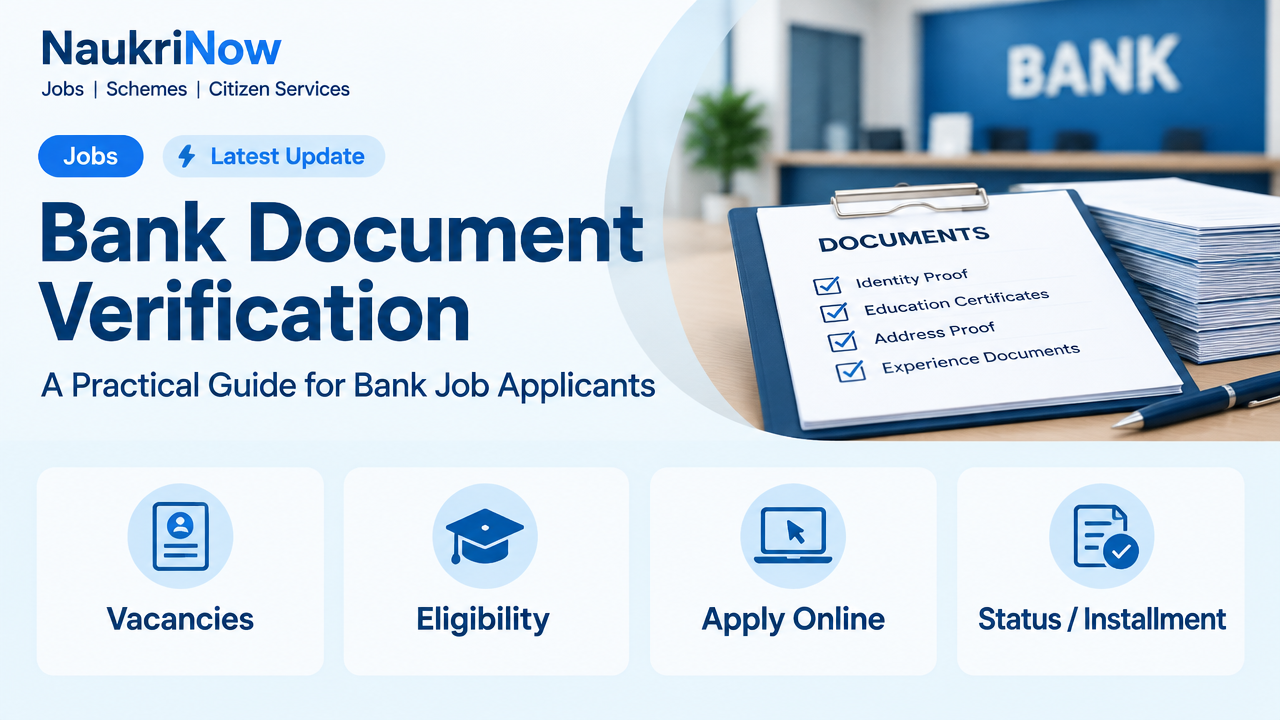
Use this as a preparation list, not a substitute for the recruiter’s instructions. Carry only the records requested, and take originals and the required number of copies if the call letter asks for them. The examples below are categories of records that may be relevant; they are not a universal list of required documents. A document is relevant when the notification, call letter or your particular application claim calls for it.
| Record | When it may be needed | What to check |
|---|---|---|
| Verification call letter and application details | For most recruitment verification appointments, if requested | Confirm your name, registration details, reporting time, venue and any instructions on copies or photographs. Keep a copy of your application details available for comparison. |
| Photo identity and date-of-birth proof | As specified in the notice or call letter | Make sure the details are legible and consistent with your application. The accepted ID types and proof requirements are determined by the recruiter. |
| Educational certificates and mark sheets | To establish the qualification claimed for the post | Organise certificates and marks records for the relevant courses. Check that names, dates and results are clear and that you have included the records asked for. |
| Category, disability or other claim-related certificates | Only if you claimed a benefit or status and the notice requires proof | Check the required format, issuing authority and any date or validity conditions stated in the notification. Do not assume that a document for one purpose automatically meets another requirement. |
| Experience, language or other post-specific evidence | Where the post or your application requires it | Bring evidence that supports the particular claim, following the notice’s wording. If you are unsure whether a record is relevant, seek clarification from the recruiter. |
| Photographs, declarations or additional forms | Only as instructed | Check quantity, format, signature requirements and whether a form must be completed before reporting. Follow the call letter rather than assuming a standard format. |
Before packing, use the call letter as your final checklist. If it gives an order for the documents, arrange them in that order. Keep originals separate from photocopies so you can identify each quickly, and retain a personal copy of your application and submitted records. If the instructions ask for self-attested copies or a signed declaration, follow the exact wording; do not add requirements based on another recruitment notice.
Prepare a document set without overlooking details
A useful way to prepare is to make a simple list with three columns: the information claimed in your application, the record that supports it, and any instruction that applies to that record. This makes it easier to spot a missing item before the appointment. It also helps you distinguish documents you need to carry from records that are unrelated to your application or not requested.
Compare each supporting record with the information you submitted. Look at the spelling and order of your name, date of birth, qualification details and any category or other status you claimed. Check that copies are readable and include the relevant information on every page. If a record has more than one page, avoid separating pages in a way that could make the record difficult to review. These are preparation checks, not a substitute for any copying or attestation instructions in the call letter.
Keep the document set secure and easy to retrieve. You might place the call letter and application details at the front, followed by records in the sequence requested by the recruiter. Store originals so that they are not mixed with copies. If you make a personal inventory, use it to check the set before leaving and again after the appointment. Do not leave original certificates behind unless an authorised process requires this; if they must be retained, ask how and when they will be returned.
Steps to prepare for Bank Document Verification and attend verification
| Step | Action |
|---|---|
| 1. Read the current instructions | Review the recruitment notice, verification call letter and any later update from the recruiting organisation. Check the venue, reporting time and document requirements. Make sure you are looking at instructions for your post and recruitment cycle. |
| 2. Match records to your application | Compare your name, date of birth, category and qualification details against the information submitted in your application. Make a note of any difference that may need an explanation or supporting evidence. |
| 3. Organise the requested set | Prepare originals, copies, photographs and forms only in the quantities and formats specified. Keep documents secure and easy to retrieve. Avoid adding sensitive records that were not requested unless the recruiter asks you to bring them. |
| 4. Plan your attendance | Check the reporting time and venue in the latest official communication. Allow time to follow the stated reporting instructions. If the venue or date appears inconsistent across communications, seek confirmation using the recruiter’s official contact route before travelling. |
| 5. Report as instructed | Arrive at the stated place and time with the required records. Follow directions from the verification team and answer questions accurately. If you do not understand a request, ask for clarification rather than guessing. |
| 6. Keep a record of follow-up | If the team asks for clarification or further evidence, note what is required and the deadline. Use the official communication route provided by the recruiter, and keep copies of any response or submission for your records. |
How to handle a name or date mismatch
A small difference between records can lead to questions or a request for further proof. Do not alter a certificate or submit an explanation that is not supported by evidence. If you find a mismatch, identify the affected records and compare them with the details in your application. Contact the recruitment authority before the appointment if the discrepancy could affect your eligibility or identity check. Ask what evidence it accepts rather than assuming that a particular document will resolve the issue.
| Issue | Practical response |
|---|---|
| Different spelling or order of names | Identify which records differ and ask the recruiter what supporting evidence it accepts. Carry relevant official records and any supporting document requested. Do not make a handwritten correction on a certificate. |
| Different date of birth | Check the date entered in your application against the proof specified in the notice. Seek written guidance from the recruiting organisation; do not assume one record will automatically override another. |
| Category or certificate details do not match | Review the category conditions and certificate requirements in the notification. Ask whether the document meets the stated format and issuing-authority rules. Avoid relying on a general example from a different recruitment. |
| Missing or delayed certificate | Tell the recruiter promptly and ask whether an alternative or later submission is permitted. Do not rely on an informal assurance from an unauthorised person, and do not assume that a substitute will be accepted. |
| Correction needed in application information | Use only a correction process expressly allowed by the recruiting organisation. Do not make handwritten changes to an application unless instructed. Ask the authority how to proceed and keep any official response. |
When asking for help, make your question specific. Identify the recruitment and post, describe the discrepancy without changing or obscuring the original record, and ask what action the recruiter permits. Use contact information from the official notice or recruitment website. Keep your message and any reply so that you can refer to the guidance later. If you receive conflicting advice, seek confirmation through an official channel rather than choosing the answer that seems most convenient.
What to confirm in the recruitment notice
Document verification is connected to the requirements of a particular vacancy. Before travelling, confirm these details in the applicable notification and call letter rather than relying on advice for a different bank or recruitment cycle. The notification is also the place to check whether later updates have changed an earlier instruction.
| Recruitment detail | Where to verify it | Why it matters |
|---|---|---|
| Vacancies and post | The current recruitment notification | Post titles and vacancy details vary by recruitment. Make sure advice and instructions you use relate to the post you applied for. |
| Qualification and eligibility | The eligibility section of the notification | Required qualifications and any other conditions are post-specific. Check the stated requirements rather than inferring them from another role. |
| Age limit and relaxation | The age and relaxation rules in the notification | Applicable limits, reference dates and permitted relaxations can differ. Use the rules and dates stated for your recruitment. |
| Dates and selection stages | The recruitment schedule and later official updates | Exam, interview and verification arrangements may change; follow the latest published instruction. Check that you have not mistaken an earlier date for a current one. |
| Fee and pay | The fee section and post-specific pay details | Do not assume one application fee or salary applies across banks or roles. Check whether any payment is required at a particular stage and follow only the official payment instructions. |
Advantages and limitations of preparing with a checklist
| Pros | Cons |
|---|---|
| A checklist can turn a broad preparation task into a series of checks and help you notice missing records. | A general checklist cannot determine whether you are eligible or whether a particular certificate meets the notification’s rules. |
| It can help you compare documents with your application and keep the requested set organised. | Requirements may differ between posts and recruitment cycles, and the call letter may include instructions not shown on a general list. |
| Preparing early with a written list may give you time to ask the recruiter about a mismatch or missing certificate. | A checklist cannot confirm that an alternative document will be accepted or guarantee a selection outcome. |
| Using a checklist can help you keep track of instructions while gathering documents or travelling to the venue. | Taking extra, unrequested personal records can mean unnecessary handling of sensitive information without resolving your question. |
Use a checklist to organise the documents the recruiter requests, not to replace official instructions or guarantee a selection outcome.
Selection stages and what verification does not confirm
Depending on the post and recruiting body, selection may involve one or more tests, an interview, document checks and other conditions stated in the notification. The exact sequence and assessment details are not universal. Read the selection section for the vacancy you applied for, and check later official updates if the schedule or instructions change.
Verification checks the evidence submitted against the recruiter’s requirements. It is not a substitute for meeting the qualifying marks, eligibility rules or any other selection condition. A document check also does not, by itself, confirm that the recruiting organisation has made a final appointment decision. Wait for an official result or appointment communication before treating the recruitment as complete. If you are asked to submit further evidence, follow the stated process and deadline rather than assuming that an informal conversation completes the requirement.
Avoid verification-day problems and scams
- Use the recruiting organisation’s official website and communications to confirm dates, venues and document rules. Check for later updates close to the appointment.
- Be cautious of anyone promising selection, a faster verification slot or a job in exchange for money. Do not pay an individual or share banking credentials on that basis.
- Do not send identity documents to an unverified email address or messaging account. Share personal information only through a channel the recruiter has confirmed.
- Keep your original certificates with you; hand them over only if an authorised process requires it, and ask how they will be returned.
- Check every page before leaving and keep a note of any document the verification team asks you to provide later.
- If someone gives you an instruction that differs from the official notice, do not assume it is valid. Confirm it through the recruiting organisation’s published contact route.
- Keep copies of official messages about your appointment and any follow-up request. Avoid sharing those records publicly if they contain personal details.
After the appointment: follow up carefully
Once the verification appointment is over, review any instructions you received. If the team requested additional evidence, note the exact record, submission method and deadline stated by the recruiter. Use the official route and retain evidence of what you sent. If you were told that the recruiter would contact you, monitor the official communication channels associated with your application and follow the instructions given in the notice.
If you are uncertain whether a follow-up request is genuine, compare it with the details in the official recruitment communication and contact the organisation using a published channel. Do not send sensitive records in response to an unexpected request until you have verified the route. Keep expectations measured: completing a document check does not guarantee a result or appointment, and the recruiting organisation’s official decision remains controlling.
Final takeaway
Successful Bank Document Verification preparation starts with the exact notification and call letter for your post. Match your records to your application, organise the requested originals and copies, and raise discrepancies with the recruiting authority in advance. Requirements for eligibility, dates, fees, selection and pay vary, so treat general checklists as preparation aids—not official instructions. Keep your documents secure, follow up only through confirmed channels, and wait for official communication about the recruitment outcome.
Frequently Asked Questions
What should I do before Bank Document Verification?
Use the list in your notification and verification call letter as the final checklist. A general list can help you organise, but it cannot confirm that a document is mandatory or acceptable for your vacancy.
Should I take original documents or photocopies?
Follow the call letter. If it asks for originals and copies, bring both and arrange them as instructed. Do not assume a particular number of copies is required unless stated. Keep originals secure and separate from copies so that you can identify them easily.
What if my name is spelt differently on two documents?
Contact the recruiting organisation through its official recruitment channel and ask what evidence it accepts. Bring supporting records requested by the recruiter; do not alter certificates. If you can, raise the question before the appointment so you have time to follow the guidance.
Does a verification call mean I have been selected?
Not necessarily. Verification is one part of the recruitment process. Appointment depends on the selection outcome and all conditions in the notification. Wait for an official result or appointment communication.
Can I correct a mistake in my application during verification?
Only if the recruiting organisation permits a correction or gives you instructions to do so. Ask the authority how to proceed rather than changing the application yourself. Keep any official response that explains the permitted process.
Are age limits and relaxations the same across bank recruitments?
No. Age conditions, reference dates and any applicable relaxation depend on the specific notification and post. Check the eligibility rules for your recruitment rather than relying on a general example.
Is a fee payable at the document verification stage?
There is no universal verification fee. Check the official notice for any fee and the stage at which it is payable. Be wary of unofficial payment requests, especially promises of selection or special treatment in exchange for money.
What should I do if I cannot obtain a required certificate in time?
Contact the recruiting organisation as early as possible and ask whether it permits an alternative or later submission. Do not assume an extension will be granted without confirmation, and do not rely on an informal assurance from someone who is not authorised.
Where can I confirm the venue or a changed verification date?
Check the latest call letter and updates on the recruiting organisation’s official website. If details remain unclear, use the contact information published in the official recruitment notice. Confirm any conflicting information before travelling.
What should I do if I am asked to submit more evidence after the appointment?
Note exactly what the verification team has requested, including any stated deadline and submission route. Follow the recruiter’s official instructions and keep a copy of your submission or confirmation. If you are unsure whether a request is genuine, verify it through a published contact channel before sending personal records.

Comments