Table of ContentsClick to view all sections
- CCRAS Fellowships Online Form 2026: At a Glance
- Vacancy Details and Research Streams
- Who Can Apply: Eligibility Requirements
- Pay and Tenure
- How to Apply for the JRF Fellowship
- Selection and Interview
- Important Date
- Common Application Mistakes to Avoid
- Applicant’s Final Review
- Final Takeaway
- Official Links
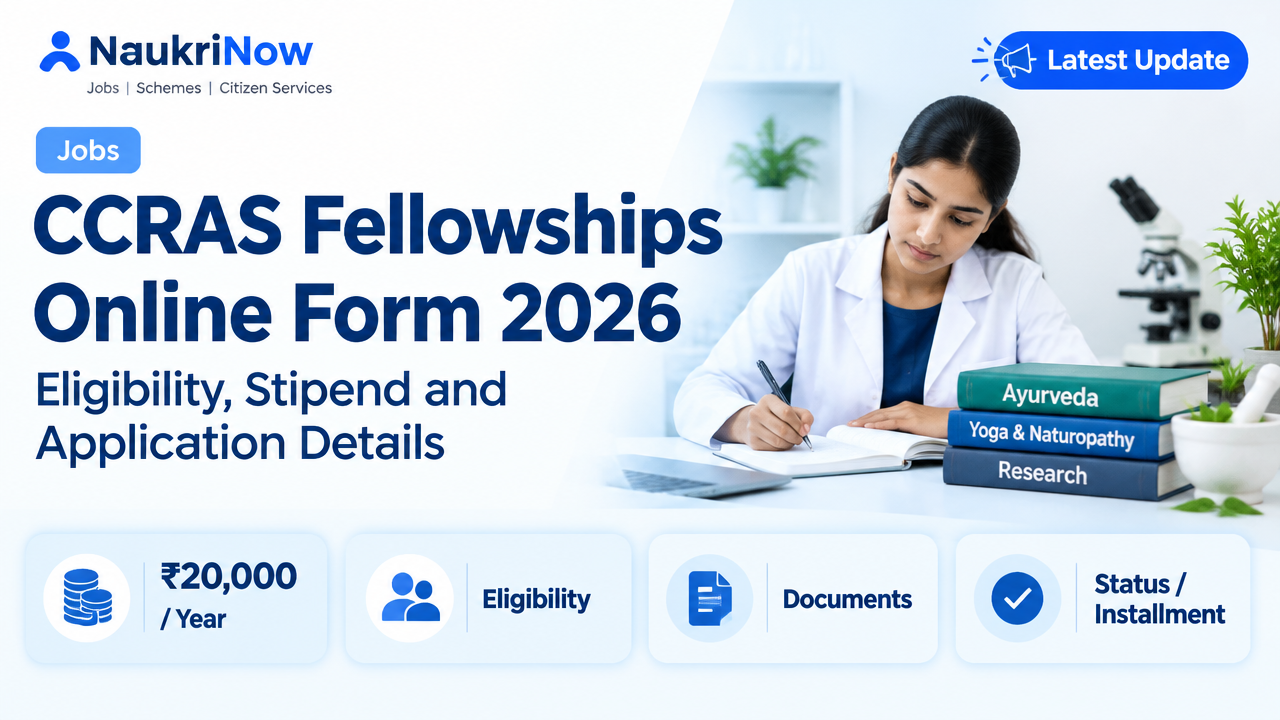
The CCRAS Fellowships Online Form 2026 notice covers 20 Junior Research Fellowships (JRFs) for non-Ayush candidates seeking to pursue Ph.D. research in Ayurveda or Yoga & Naturopathy. The notice identifies postgraduate study in Biomedical Sciences and an eligible, valid National Eligibility Test (NET) qualification as key requirements. The stated application deadline is 8 December 2026. Applicants should read Advertisement No. 05/2026/Ph.D. and the portal instructions carefully because the available details do not settle every question about subject matching, documents, hard-copy submission or fees.
This guide brings together the stated vacancy split, eligibility information, fellowship amounts, tenure and application steps. For the CCRAS Fellowships Online Form 2026, applicants should also note points to verify in the original notice rather than treating incomplete summary information as a final rule. Where the notice details do not provide an answer, that uncertainty is identified below.
CCRAS Fellowships Online Form 2026: At a Glance
| Particular | Details |
|---|---|
| Recruiting organisation | Central Council for Research in Ayurvedic Sciences (CCRAS) |
| Advertisement number | No. 05/2026/Ph.D. |
| Department | Ministry of Ayush, Government of India |
| Fellowship | Junior Research Fellow (JRF) for Ph.D. research |
| Total fellowships | 20 |
| Research streams | Ayurveda, and Yoga & Naturopathy |
| Application mode | Online, through the CCRAS Ph.D. portal |
| Last date stated | 8 December 2026 |
| Application fee | Not stated in the available notice details; check the official notification and portal |
| Research location | A recognised university or institution of the candidate’s choice |
The recruitment is a fellowship opportunity connected with Ph.D. research, not simply an application for a general-purpose job opening. The stated aim is to support qualifying non-Ayush candidates undertaking research on AYUSH-related projects. An applicant should therefore consider both whether they meet the academic and NET requirements and whether their proposed research fits the stream they intend to select.
Vacancy Details and Research Streams
The 20 fellowships are divided between two research councils and streams. CCRAS lists the Ayurveda stream, while the Central Council for Research in Yoga & Naturopathy (CCRYN) lists the Yoga & Naturopathy stream. Applicants should select the stream that corresponds to their proposed research and follow the associated instructions on the portal.
| Research council | Stream | Fellowships |
|---|---|---|
| CCRAS | Ayurveda | 16 |
| Central Council for Research in Yoga & Naturopathy (CCRYN) | Yoga & Naturopathy | 4 |
| Total | — | 20 |
The difference in the number of places does not establish which stream is more suitable for an individual applicant. That decision should be based on the subject and scope of the proposed research and the conditions in the advertisement. Do not choose a stream solely by comparing the number of listed fellowships. If the project could appear relevant to more than one area, consult the notice and the portal’s stream-specific guidance before completing the application.
Who Can Apply: Eligibility Requirements
The available notice details describe the fellowship as intended for non-Ayush (Non-Medical) candidates. Applicants are expected to have a postgraduate qualification in Biomedical Sciences, meet the applicable NET requirement and be willing to undertake research on AYUSH-related projects while pursuing a Ph.D. at a university or institution of their choice. The exact interpretation of subject eligibility should be checked against the full advertisement; a broadly related degree should not automatically be assumed to qualify.
| Requirement | What the notice specifies |
|---|---|
| Academic qualification | Postgraduate qualification in Biomedical Sciences, with emphasis on the listed research areas |
| NET qualification | An eligible National Eligibility Test certificate within its validity period |
| Candidate background | Non-Ayush (Non-Medical) candidates |
| Research intent | Willingness to undertake research on AYUSH-related projects and pursue a Ph.D. at a university or institution of choice |
| Maximum age | 28 years, calculated on the date the advertisement is issued in Employment News, as specified in the notice |
Postgraduate subjects and research areas
The notice details refer to Biomedical Sciences and describe a range of related research areas. These include life sciences, chemical sciences, physical sciences, social sciences and biostatistics. Examples identified in the available information include microbiology, physiology, molecular biology, genetics, bioinformatics, biotechnology, immunology, pharmacology, zoology, environmental science, botany, veterinary sciences, pharmacy, biochemistry, chemistry, biophysics, psychology and sociology.
This range is useful when considering whether an academic background may be relevant, but it is not a substitute for the complete subject and project conditions in Advertisement No. 05/2026/Ph.D. The list should not be treated as a promise that every qualification within a named subject area is accepted. Check the precise wording, any conditions attached to the qualification, and the stream-specific requirements before deciding to apply.
NET qualifications and validity
The listed qualifying tests include the Joint CSIR-UGC test for JRF and LS (NET), DBT-JRF in Biotechnology, the Biotechnology Eligibility Test (BET), ICAR’s AICE-SRF (PGS), and ICMR JRF. The notice refers to an eligible validity period. Candidates should therefore confirm that their test and certificate meet the conditions in the detailed notification, including whether the certificate remains valid for the relevant application requirements.
Having taken one of the named examinations should not be confused with satisfying every eligibility condition. Applicants should check that the qualification route is listed, that the certificate is acceptable for this fellowship and that its validity meets the notice’s rule. If the status or validity of a result is unclear, do not rely on an assumption; consult the original advertisement or official portal guidance.
Age limit and reported relaxations
The stated maximum age is 28 years. The notice specifies that age is calculated on the date the advertisement is issued in Employment News. Applicants should use that reference point rather than substituting the online application date or another date. The available notice summary also reports relaxations of up to five years for candidates belonging to SC, ST and OBC categories, persons with disabilities (described in the summary as lower cooperative disability only), and female applicants.
The precise category wording and the conditions for claiming a relaxation should be verified in Advertisement No. 05/2026/Ph.D. before relying on it. In particular, applicants should not assume that a general description of a category or disability is sufficient to establish eligibility for a relaxation. The full advertisement is the appropriate source for the exact terms.
Applicants who should verify the notice especially carefully
- Applicants whose NET certificate may be close to expiry or whose certificate status is uncertain.
- Applicants who are unsure whether their postgraduate subject fits the Biomedical Sciences requirement.
- Applicants relying on an age relaxation or interpreting the disability-related wording.
- Applicants deciding whether their proposed project belongs in Ayurveda or Yoga & Naturopathy.
- Applicants who need to establish whether their intended university or institution meets the notice’s requirements.
Pay and Tenure
The listed support includes a monthly fellowship at the JRF stage, a higher monthly amount at the Senior Research Fellow (SRF) stage after the stated JRF period and extension, annual contingency support to the university or institution, and a possible one-time research grant. The amounts and durations reported in the available notice details are set out below.
| Stage or support | Amount or duration stated |
|---|---|
| Junior Research Fellow (JRF) | ₹37,000 per month, plus House Rent Allowance (HRA) |
| Senior Research Fellow (SRF) | ₹42,000 per month, plus HRA, after the stated JRF period and extension |
| Annual contingency | ₹20,000 per year to the university or institution |
| Possible one-time research grant | Up to ₹1,00,000, subject to a project proposal and the stated conditions |
| Fellowship tenure | JRF for 2 years, with possible extension as SRF for 2–3 years; maximum total tenure of 5 years |
The stated JRF period is two years. The fellowship may then be extended as SRF for two to three years, with a maximum total tenure of five years. The wording describes a possible extension; applicants should not interpret the maximum tenure as an automatic guarantee of five years of support. The conditions for continuation and progression should be checked in the official notification.
The amounts shown are the rates stated in the available details. HRA is mentioned in addition to the monthly fellowship, but the available summary does not provide a rate or explain all applicable conditions. Likewise, the annual contingency is described as payable to the university or institution, rather than as an additional monthly payment directly to the fellow. Confirm the applicable terms and payment arrangements in the official notice.
The one-time research contingency grant of up to ₹1,00,000 is described as something a fellow may apply for by submitting a project proposal within three months of joining. It is subject to the stated conditions and is not presented as an automatic payment. Applicants should distinguish this potential grant from the annual contingency amount and check the notification for the applicable proposal and approval requirements.
How to Apply for the JRF Fellowship
To submit the CCRAS Fellowships Online Form 2026, use the stated online route through the CCRAS Ph.D. portal. Follow the relevant instructions for the stream you intend to apply for and the sequence shown by the portal. The steps below summarise the application process described in the available information without adding document requirements that have not been specified.
| Step | Action |
|---|---|
| 1 | Open the CCRAS Ph.D. application portal and review the instructions for the relevant stream. |
| 2 | Register on the portal and complete the online application with the requested details. |
| 3 | Submit the research proposal and required documents online, selecting the appropriate stream. |
| 4 | Check the completed application and retain its registration or submission record. |
| 5 | Follow the notification’s instructions about physical documents. Confirm the exact timing and dispatch procedure in the full advertisement and portal before sending anything. |
Before starting the online application
Review the eligibility rules first, including the postgraduate qualification, NET route and certificate validity, candidate background and age calculation. Then consider whether the proposed research matches the chosen stream. This order can help an applicant identify questions that need resolving before entering information into an online form. It does not replace the portal’s own requirements, and it does not imply that a particular document format or upload method applies unless the portal says so.
Prepare the details and materials specifically requested by the portal, including the research proposal and qualification and NET information where required. The available information does not provide a complete document checklist. For that reason, do not treat this general preparation advice as an exhaustive list or assume that documents not mentioned here are unnecessary. Follow the live application instructions and the advertisement.
Reviewing and submitting the form
Before final submission, review the entered information against the source documents and the selected research stream. Check that the application is complete according to the portal and that the research proposal has been included in the required manner. After submission, keep the registration or submission record referred to in the process instructions. The available details do not specify a particular confirmation format, so follow whatever confirmation the portal provides.
The available summary mentions hard-copy submission but does not clearly establish when it is due, what must be sent or how it must be dispatched. Do not guess these details. Check the full advertisement and portal before sending physical documents, and follow their instructions if they require a hard copy. Similarly, the application fee is not stated in the available notice details. An unstated fee should not be treated as proof that no fee applies; look for fee instructions in the official notice and portal.
Selection and Interview
The available recruitment details state that shortlisted candidates will be informed and invited for an interview by the respective council. They do not specify a separate written examination or provide a written-test pattern. Candidates should therefore rely on the official notice and portal for confirmed selection stages rather than assume that a written exam will or will not take place beyond what the published information says.
The summary does not set out the shortlisting criteria, interview format, schedule or further assessment instructions. Applicants should monitor the official information sources for updates and read any communication issued to them carefully. The reference to an interview invitation applies to shortlisted candidates; it is not a guarantee that every applicant will be invited.
Important Date
| Event | Date or deadline |
|---|---|
| Last date to submit the application | 8 December 2026, stated as 60 days from the Employment News advertisement |
Applicants completing the CCRAS Fellowships Online Form 2026 should check the original advertisement and application portal for the applicable schedule and any correction or revised date before applying, because the deadline is linked to publication in Employment News. Do not rely solely on a copied date if an official update changes the instructions. Applicants should also allow time to review the form and resolve questions about eligibility or physical-document requirements before the stated closing date.
Common Application Mistakes to Avoid
- Overlooking NET validity: A listed examination alone may not be enough if the certificate does not meet the notice’s validity condition.
- Assuming a subject automatically qualifies: The research-area examples do not replace the complete postgraduate subject and project rules in the advertisement.
- Selecting a stream without checking project fit: Review whether the proposed research belongs with Ayurveda or Yoga & Naturopathy before making the selection.
- Relying on an assumed age date: The stated calculation refers to the date the advertisement is issued in Employment News.
- Claiming a relaxation without checking its terms: Confirm the exact category wording and supporting conditions in the full notice.
- Submitting an incomplete proposal or application: Use the portal’s instructions to determine what must be provided.
- Assuming the fee is zero: The available details do not state a fee, so check the official notification and portal.
- Guessing about hard copies: The summary mentions physical submission but does not establish the timing or dispatch procedure.
- Failing to check submission status: Review the completed application and retain the portal’s registration or submission record.
- Waiting until the last day: Allow time to address eligibility questions and complete any required online steps before the stated deadline.
Applicant’s Final Review
Before submitting, confirm that you have checked the source notice for the exact postgraduate subject rules, eligible NET routes and validity, age calculation and any relaxation conditions. Make sure that the stream selected corresponds to the proposed research and that the university or institution arrangements are consistent with the notice. Check the portal for the required application details, research proposal and documents, and verify whether it provides any fee or physical-submission instructions.
Keep the limits of the available summary in mind: it does not provide a complete document checklist, a confirmed fee amount, a full selection pattern or the exact procedure for any hard-copy submission. Those details should be taken from Advertisement No. 05/2026/Ph.D. and the official portal, not inferred from general guidance. Checking these items directly helps applicants avoid treating an example or incomplete summary as a formal eligibility decision.
Final Takeaway
These fellowships provide eligible non-Ayush postgraduates a route to Ph.D. research in Ayurveda or Yoga & Naturopathy, with 20 places across the two streams. Before submitting the CCRAS Fellowships Online Form 2026, verify your subject and NET eligibility, age calculation, research proposal requirements and any physical-document instructions against the official advertisement. The stated application deadline is 8 December 2026.
Frequently Asked Questions
How many fellowships are available under CCRAS Recruitment 2026?
There are 20 fellowships: 16 in Ayurveda under CCRAS and 4 in Yoga & Naturopathy under CCRYN.
What is the upper age limit for the JRF fellowship?
The stated upper age limit is 28 years, calculated on the date the advertisement is issued in Employment News. The available notice summary also reports certain relaxations. Check the full advertisement for the exact category wording and conditions.
Which candidates are eligible to apply?
The fellowship is intended for non-Ayush (Non-Medical) candidates with a postgraduate qualification in Biomedical Sciences and an eligible NET certificate. The detailed subject, certificate-validity and other conditions are set out in the official notice.
Which NET examinations are listed?
The listed routes include the Joint CSIR-UGC test for JRF and LS (NET), DBT-JRF in Biotechnology, BET, ICAR’s AICE-SRF (PGS), and ICMR JRF, subject to the notice’s eligibility and validity rules.
What is the last date to apply?
The stated deadline is 8 December 2026, described as 60 days from the Employment News advertisement. Confirm the date on the official portal and in the original notice.
Is an application fee required?
The available notice details do not state an application fee. Check the official notification and portal for fee instructions rather than assuming that the application is free.
Where should candidates submit their applications?
Applications are stated to be submitted online through the CCRAS Ph.D. portal. Follow the portal’s instructions for the appropriate stream and check the advertisement for any physical-document requirements.
What are the streams available under CCRAS Recruitment 2026?
The two streams are Ayurveda, with 16 fellowships under CCRAS, and Yoga & Naturopathy, with 4 fellowships under CCRYN.
How much is the monthly fellowship?
The stated amount is ₹37,000 per month for JRF and ₹42,000 per month for SRF, plus HRA. The notice details also mention annual contingency support of ₹20,000 to the university or institution.
Will candidates have to take a written examination?
The available details mention interview invitations for shortlisted candidates but do not specify a written examination. Follow the official notice for the confirmed selection process.
Do applicants need to send hard copies?
The available summary mentions hard-copy submission but does not clearly explain its timing or procedure. Check Advertisement No. 05/2026/Ph.D. and the portal instructions before dispatching documents.
Official Links
| Resource | Link |
|---|---|
| CCRAS Ph.D. application portal | Open the application portal |
| CCRAS official website | Visit CCRAS |





Comments