Table of ContentsClick to view all sections
- Start with your admit card and official notice
- Exam Day Instructions: documents to check and pack
- Plan your journey and arrival
- What to expect at the exam centre
- Items and conduct: check before you leave home
- Manage your time and stay composed
- If something goes wrong
- Common exam-day mistakes to avoid
- Advantages and limitations of general Exam Day Instructions
- Final takeaway
Exam Day Instructions can differ by examination, session and venue, so treat your latest admit card and the relevant official notice as the final authority. Use this guide to organise your documents, plan your journey and prepare for common last-minute problems. It offers general planning advice, not a replacement for instructions issued for your particular exam. When a rule is unclear, check the relevant official source rather than assuming that another exam follows the same process.
A little preparation can make the day easier to manage. The aim is not to predict every centre procedure, but to know what has been confirmed, keep the required items accessible and leave enough time to respond to ordinary travel or document issues. Read the complete instructions before exam day, and revisit them if the examining authority publishes an update.
Start with your admit card and official notice
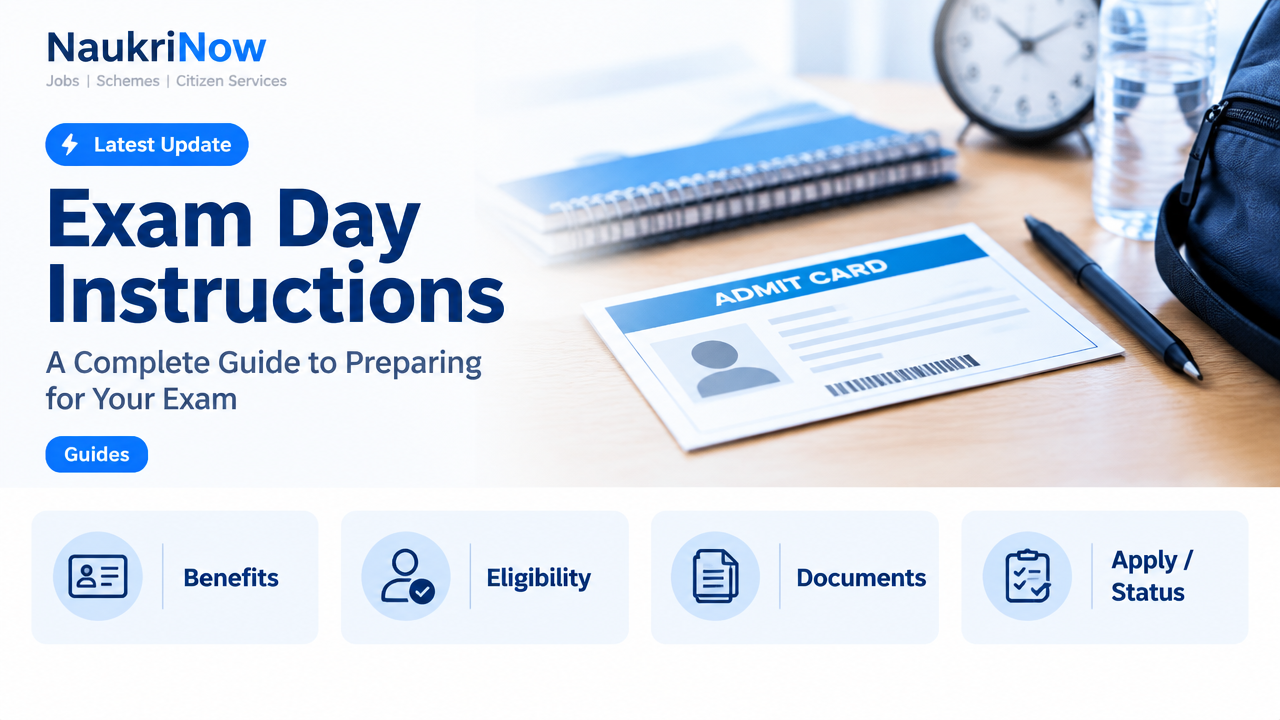
Begin with the admit card or hall ticket issued for your examination and any current notice published by the examining authority. Read all pages, including instructions that may appear below the main candidate details. Check the exam name, paper or stage, date, session and centre address against your application and any relevant official update. Make sure you understand what action, if any, you must take before arriving. Use these Exam Day Instructions as a planning aid while checking each detail against your current official documents.
Pay particular attention to the difference between the exam start time and any reporting or entry time. If the notice gives a gate-closing time or other cut-off, record it and plan around it. Do not assume that reaching the centre at the advertised start time is acceptable. If documents or general guidance seem to conflict, check the latest official information for your exam and contact the authority through its published channel if the issue remains unresolved.
| Check | What to confirm | What to do |
|---|---|---|
| Exam and session | Exam name, paper or stage, date and session. | Make sure the details match the examination you registered for. |
| Reporting instructions | Reporting time, entry arrangements and any stated gate-closing time. | Plan to reach the centre with a reasonable buffer; do not rely on arriving at the last minute. |
| Venue | The full centre name and address shown on your admit card. | Check the route and estimated travel time in advance. Do not assume the centre is near the exam authority’s office. |
| Documents and items | Required identification, photographs, stationery or other specified items. | Pack only what the current exam instructions allow. |
| Candidate actions | Any stated declaration, signature, attendance or other pre-exam procedure. | Understand when and where the action is required, and follow the centre’s directions. |
Exam Day Instructions: documents to check and pack
Document requirements vary. Carry only the documents named in your admit card or official exam notice, and check whether originals, photocopies or a particular identification document are required. A document accepted for another examination may not meet this exam’s rules. If a document needs a photograph, signature or other candidate action, check the format and timing stated in the official instructions rather than relying on memory.
| Item | How to handle it | Important check |
|---|---|---|
| Admit card or hall ticket | Download it from the official source and keep it readable and undamaged. | Check whether a printed copy, a particular format or any candidate action is required. |
| Photo identification | Carry the identification document specified for your exam. | Confirm which document is accepted and whether the original must be shown. |
| Photograph or additional paperwork | Pack these only when the current instructions ask for them. | Check any stated size, format, number or signing requirements. |
| Writing materials | Take only the stationery permitted for your exam. | For computer-based tests, do not assume that personal stationery or rough sheets are allowed. |
| Approved accommodation documents | If you have an approved accommodation, carry supporting paperwork only as directed by the exam authority. | Check the process and reporting arrangements in advance; do not assume that a request made at the centre will be approved. |
Pack documents together the night before, but keep them in a place where you can retrieve them without unpacking everything at the entrance. If you use a folder or envelope, make sure it does not contain extra papers that could be mistaken for restricted material. Keep documents dry and legible. Avoid writing on or altering an admit card unless the official instructions specifically tell you to complete a field.
If you discover that a required document is missing, do not assume that a digital image, photocopy or alternative document will be accepted. Recheck the official instructions and contact the authority through its published route when possible. On arrival, explain the issue to authorised staff and follow their directions; do not present an altered document as though it were the original.
Plan your journey and arrival
Check the centre address carefully and plan how you will reach the exact venue. If it is unfamiliar, review the route before exam day and consider how you will recognise the correct entrance or building using the details provided in the official instructions. Save or print the address in a form you can access without relying on a last-minute search. These Exam Day Instructions support planning, but they do not replace checking that the centre details match your admit card.
- Use the reporting time and entry directions, not just the exam start time, to plan your departure.
- Allow a reasonable buffer for travel delays, finding the venue and completing any entry procedure stated in the notice.
- Where practical, identify a backup travel option. Keep the plan realistic and do not take unsafe risks to make up lost time.
- If travelling a long distance, think through the journey in advance and make sure you know when you need to leave.
- Pack documents the night before and set alarms if useful, so the morning is not spent searching for essentials.
- Keep phones and valuables out of your plan if the centre does not permit them or does not provide storage. Do not assume staff will look after personal belongings.
On the day, follow signs and directions to the entry point stated for your exam. If you are unsure whether you are at the right building or entrance, ask authorised centre staff rather than entering an examination area based on guesswork. Arriving early does not guarantee that the centre will admit candidates before its stated arrangements allow, so be prepared to follow staff directions while you wait.
What to expect at the exam centre
Centre procedures depend on the examination. Exam Day Instructions may help you prepare for common checks, but staff may check your admit card and identification, verify details, direct you to a room or workstation, and explain attendance or entry procedures. The precise sequence is not universal. Follow instructions from authorised staff, and ask a supervisor if you are unsure about a procedure. Keep your documents accessible until the checks are complete, then put them away as directed.
| Stage | Practical action | Keep in mind |
|---|---|---|
| Arrival | Go to the venue and entry point stated in your exam instructions. | Do not enter another building or examination area based on guesswork. |
| Verification | Present the documents requested and follow identity-check instructions. | Keep documents accessible, but do not hand them to anyone who is not authorised. |
| Security and seating | Follow the centre’s directions for permitted belongings, checks and seating. | Rules may restrict electronic devices, watches, bags or other items; check the exam-specific list. |
| Before the test | Listen to the invigilator and read on-screen or printed instructions carefully. | Ask for clarification before the exam begins if a permitted procedure is unclear. |
| During the test | Follow the stated rules for communication, movement, rough work and submitting answers. | Do not use an item or take an action unless the instructions permit it. |
| Leaving | Wait for instructions before finishing or leaving the room. | Follow the exam’s rules on submission, answer sheets and permitted exit time. |
Centre staff are responsible for explaining the procedures that apply at that venue, but candidates remain responsible for reading the exam-specific notice. If you have a question, ask it at an appropriate time and follow the answer from an authorised person. Do not rely on another candidate’s interpretation when the official instructions or staff can clarify the procedure.
Items and conduct: check before you leave home
Prohibited and permitted items are not identical across examinations. The admit card or official instructions may restrict phones, smart devices, calculators, notes, bags, watches or particular accessories. Even if an item is allowed in one test, that does not mean it is allowed in another. Check the current list and avoid carrying unnecessary belongings, especially where the centre has not confirmed that storage is available.
- Do not assume a calculator, watch, personal stationery or rough paper is permitted.
- Do not bring electronic devices or written material unless the official instructions expressly allow them.
- Do not photograph, share or reproduce exam material where the rules prohibit it.
- Follow directions from centre staff and avoid behaviour that could disrupt other candidates or the examination.
- Do not conceal a restricted item or leave it unattended at the venue. Ask staff what to do if you arrive with something that may not be allowed.
Conduct rules can cover more than the objects you bring. Read directions about talking, movement, requests for assistance and handling exam materials. If you need help, use the procedure provided by the invigilator rather than communicating with another candidate. During a test, an action that seems convenient may still breach the rules if it has not been permitted.
Manage your time and stay composed
Once the exam begins, first understand the instructions on the paper or screen. Note any rules about sections, navigation, answer changes, marking or submission before starting. These details can vary, so do not assume that the format is the same as a previous exam. Give yourself a moment to confirm that you have the correct paper or session and that the materials or workstation appear usable. Apply the Exam Day Instructions for your specific test rather than relying on a familiar format from another exam.
- Read the directions before answering, including any instructions about the order of sections or how to record responses.
- If the exam has sections or a time limit for each part, make a quick plan based on the instructions actually provided.
- Keep track of time without using an unauthorised device. Use only a clock or timer provided or permitted by the centre.
- If you notice a technical or printing problem, raise your hand and report it to the invigilator promptly.
- Do not try to resolve a technical issue by accessing unauthorised material or equipment, changing seats or leaving without permission.
- Before submitting, follow the stated process and check that you have completed any required confirmation on screen or on paper.
Feeling nervous does not mean you have forgotten how to prepare. If you feel rushed, pause briefly, read the next instruction and take one permitted step at a time. Avoid spending the exam period trying to interpret informal advice from other candidates. For a procedural concern, seek help from authorised staff; for the test itself, follow the instructions provided with the paper or on screen.
If something goes wrong
Problems are easier to handle when you know which official route to use. Keep the examining authority’s published contact information available before the exam, but understand that a message or call does not guarantee a particular outcome. At the centre, raise an issue promptly with an invigilator or authorised staff member and follow the procedure they give you.
| Problem | What to do | Avoid |
|---|---|---|
| Admit card will not download | Use the official exam portal, check the published instructions and try again with the required details. If the issue continues, use the authority’s official contact route. | Do not rely on an unofficial download page or share login details with strangers. |
| A detail on the admit card appears incorrect | Compare it with your application and the current official notice, then contact the authority promptly through its published channel. | Do not alter the admit card yourself. |
| You may reach the centre late | Travel as safely and quickly as possible, and follow any published instructions for late arrival. | Do not assume entry will be allowed after a stated gate-closing time. |
| You have brought an item that may not be allowed | Ask centre staff where to proceed and follow their directions. | Do not conceal the item or leave it unattended at the venue. |
| A technical or seating issue occurs | Notify the invigilator or authorised centre staff immediately and follow the procedure they provide. | Do not leave your seat or operate equipment in a way the instructions do not permit. |
| You are unsure about a procedure | Ask an authorised staff member at an appropriate time and follow the answer given. | Do not rely on guesswork or another candidate’s assumptions. |
For problems discovered before exam day, check the official portal and notice first, then use the contact channel published by the examining authority. Keep your communication focused on the issue and use the information requested by the official process. Avoid sharing application credentials or personal details with unofficial accounts or people offering unverified assistance.
Common exam-day mistakes to avoid
- Reading only the exam start time and missing reporting or entry instructions.
- Going to a familiar venue instead of the exact centre printed on the admit card.
- Assuming documents or items accepted for a different examination will be accepted again.
- Waiting until exam morning to discover a download, travel or document problem.
- Carrying restricted belongings without checking whether the centre provides storage.
- Ignoring instructions on the question paper, screen, answer sheet or from the invigilator.
- Sharing admit-card details, application credentials or personal information with unofficial accounts.
- Changing information on an official document instead of contacting the examining authority.
- Trying to solve a centre or technical problem without first notifying authorised staff.
Advantages and limitations of general Exam Day Instructions
A general guide is useful for organising preparation, but it cannot replace exam-specific directions. Keeping both points in mind helps you use a checklist appropriately.
| Pros | Cons |
|---|---|
| A checklist can help you review the admit card, reporting details, venue and documents before exam day. | A general guide cannot confirm the current rules for a specific exam, session or centre. |
| Planning travel and packing in advance can reduce avoidable last-minute searching and uncertainty. | It cannot determine which identification documents, stationery or personal items a particular authority will accept. |
| Thinking through possible problems can remind you to use official contact channels and ask authorised staff for help. | It cannot guarantee entry, storage for belongings, late admission, a particular accommodation or a remedy for a technical issue. |
| General reminders about permitted items and conduct encourage you to check the rules instead of relying on habits from another exam. | Procedures may be updated, so an older checklist or a previous candidate’s experience may not reflect the current official notice. |
Use this guide as a planning aid, then check the details against the current official instructions. Where a general suggestion and an exam-specific rule differ, follow the current rule for your examination or seek clarification from the authority.
Final takeaway
Good exam-day preparation starts with the correct, current instructions—not assumptions based on another exam or an older admit card. Verify your session, venue, reporting arrangements, documents and permitted items; plan your travel; and follow the centre’s directions throughout the test. Use Exam Day Instructions as a checklist to organise these steps, but only the examining authority can confirm the rules for your exam. When a detail is unclear, check the relevant official source before exam day.
Frequently Asked Questions
Which instructions should I follow if general advice differs from my admit card?
Use the current instructions issued for your specific exam as the primary reference. If the information is inconsistent or unclear, contact the examining authority through the contact route published in its official notice or portal. Do not assume that a general article or instructions for another exam resolve the difference.
How early should I reach the examination centre?
Follow the reporting time and entry directions on your admit card. Plan your journey so you can arrive with a reasonable buffer, allowing for local travel delays and the arrangements stated in the notice. Do not treat the exam start time as the reporting time, and do not assume that entry will be allowed after a stated cut-off.
Is a digital admit card enough?
That depends on the exam instructions. Check whether a printed copy, a particular format or any additional candidate action is required. Do not assume that a phone display will be accepted at the centre, especially if phones or other devices are restricted.
Which identity document should I carry?
Carry the document specified by the exam authority and check whether it must be an original. Accepted identification can vary by examination, so do not rely on rules from another test. If the instructions are unclear, contact the authority through its published channel before exam day.
Can I bring a phone, watch or calculator?
Check the permitted and prohibited items listed for your exam. Rules differ, and some centres may not offer storage. Do not bring an item unless the instructions allow it; if you arrive with something that may be restricted, ask centre staff what to do.
What should I do if I find an error on my admit card?
Do not change the document yourself. Compare the details with your application and the official notice, then contact the exam authority through its published channel as soon as possible. Follow any further instructions the authority provides.
What if I have an approved accommodation?
Review the exam authority’s instructions for your approved accommodation, including any documents, reporting arrangements or advance coordination it requires. Carry supporting paperwork only as directed. Do not assume that a request first made at the centre will be approved.
What should I do if a computer or question paper has a problem?
Notify the invigilator or authorised centre staff promptly and follow their instructions. Do not attempt to fix equipment, change seats or leave the room unless permitted. Reporting the problem promptly allows staff to explain the procedure that applies at the centre.
Can I rely on advice from someone who took the exam previously?
Past experience may help you think of questions to check, but it cannot confirm current rules. Reporting arrangements, permitted items and procedures may differ by exam, session or venue. Verify details using the current admit card and official notice.




Comments