Table of ContentsClick to view all sections
- What a merit list tells you
- Merit List Guide: how to check the official result
- How to read names, ranks, marks and cut-offs
- Selection list versus waiting list
- What to do after your name appears
- How to handle a mismatch or result concern
- Advantages and limitations of published merit lists
- Common mistakes to avoid
- Final takeaway
This Merit List Guide explains how to find an official result, interpret your name or rank, and work out what to do next. Recruitment bodies, colleges and other selection authorities use different formats and rules, so the notice and information bulletin for your specific process are the final authority. Use this guide to help you read the material; do not treat general explanations as a substitute for the rules of your recruitment, examination or admission process.
A result may be published as a downloadable list, an individual scorecard in a candidate login, or a notice that links to one or more result files. Whatever the format, first confirm that it relates to your application and the correct selection stage. Then read the accompanying instructions before deciding what your result means or what action is required.
What a merit list tells you
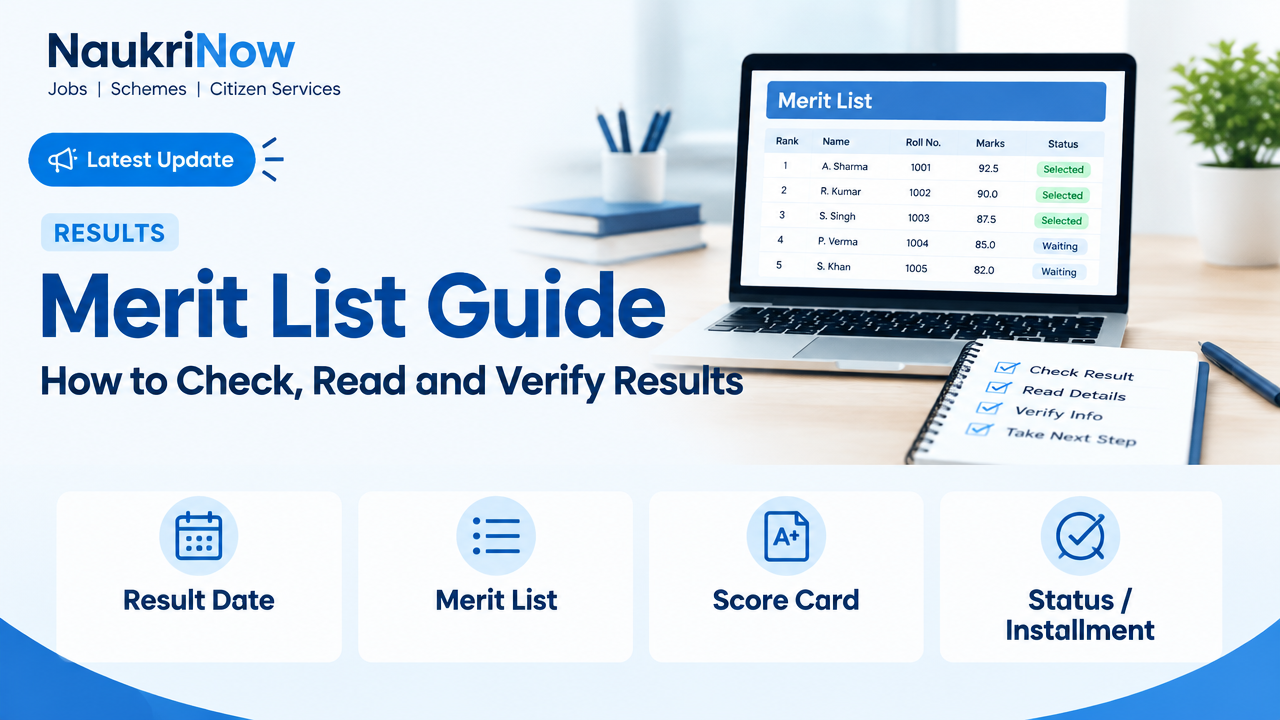
A merit list records candidates who have been ranked, shortlisted or selected under the rules of a particular process. Depending on the authority and the stage, it may show names, application or roll numbers, marks, ranks, categories or a selection status. Some processes publish separate overall and category-wise lists, or issue a waiting, reserve or supplementary list. Other processes may provide only an individual result. There is no single format used by every authority.
The list must be read in context. A candidate’s position might relate to a particular post, course, subject, category, examination stage or selection cycle rather than the process as a whole. A number shown as a rank may be a relative position under a stated ranking method, while a score may be raw, normalized, weighted or calculated in another way. The result notice should explain the terms and identify the stage covered.
Being named on a list does not always mean that a job offer, appointment, admission or seat has been finally confirmed. Further steps may be required, such as document verification, an interview, a medical or fitness examination, fee payment, counselling or seat acceptance. The authority’s notice determines which steps apply and whether your status is provisional, final or conditional.
Merit List Guide: how to check the official result
Use the official website named in the relevant recruitment, examination or admission notice. Search for the result through that authority’s results, recruitment, admission or notices section, and check the document itself rather than relying on an unofficial summary. This Merit List Guide provides a careful way to verify that you have found and understood the relevant result.
| Step | Action | What to check |
|---|---|---|
| 1 | Open the official website of the recruiting, examining or admitting authority. | Use the website named in the relevant notification or information bulletin. Avoid relying on forwarded files or unofficial result pages as your source of truth. |
| 2 | Find the result, recruitment, admission or notices section. | Match the post, course, examination, recruitment cycle and selection stage to your application. Similar titles may refer to different processes. |
| 3 | Open the result notice and its attached list, scorecard or instructions. | Check the notice date, reference number, list type and any revised or corrigendum notice. Read the notice as well as the list. |
| 4 | Search the file using your roll number, application number or name, as applicable. | Check spelling and digits carefully. If the file is searchable, try more than one identifier where permitted. A name search may return similar names. |
| 5 | Read the instructions published with the result. | Note deadlines, required documents, reporting arrangements and whether a separate individual login result is available. |
| 6 | Save a copy of the notice and your result records. | Keep the original file, relevant application details and any official communication accessible for later stages. |
If a result is presented as a PDF, check that the file title and notice match the process you applied for. Search within the document using the identifier requested or used by the authority. If the file is not searchable, examine the relevant pages carefully and make sure you have not overlooked a separate annex, category list or supplementary notice. If the result is available through a login, use the official login route and follow its instructions; do not enter credentials on an unverified page.
Keep the result notice and any individual scorecard together with your application information. If you need to ask the authority a question or complete another stage, those records can help you identify the exact process and result being discussed. Saving a copy is useful, but it does not make an older document current if the authority later issues a revised notice.
How to read names, ranks, marks and cut-offs
Do not infer more than the document states. A name or roll number appearing in a list establishes that the candidate is included in that particular published list, but the list’s heading and instructions determine what inclusion means. Likewise, a rank or mark should be understood using the method and scope described by the authority.
| List detail | What it may mean | What to verify |
|---|---|---|
| Name or roll number | The candidate appears in the published list for the stated stage. | Confirm that the list is for your post, course, category and selection stage. Check that the identifier matches your application. |
| Rank or merit position | Your relative position under the authority’s ranking method. | Check whether ranks are overall, category-wise, subject-wise or tied to a specific stage. Look for tie-break rules and explanatory notes. |
| Marks or score | A score used or reported for the selection process. | Read the notice to learn whether it is raw, normalized, weighted or a final merit score. Do not assume different score types are directly comparable. |
| Category-wise list or cut-off | A list or threshold associated with a category, where the process provides one. | Use the category recorded in your application and check the applicable rules and any document-validation conditions. |
| Cut-off | A qualifying or selection threshold defined for that process or stage. | Do not assume that a cut-off from another year, category, post, course or stage applies to your result. |
| Selected, shortlisted or provisionally selected | A status indicating progress under the wording and rules of that authority. | Look for conditions, remaining assessments and instructions before treating the outcome as final. |
A list may use terms such as “qualified,” “shortlisted,” “selected” or “provisionally selected.” These labels are not interchangeable in every process. For example, a result may indicate that a candidate can move to another stage without confirming final appointment or admission. Read the definition in the official notice and check whether more eligibility checks or selection steps remain.
A rank also does not explain the full outcome by itself. Vacancies or seats, category rules, preferences, eligibility checks, later assessments and tie-break provisions may affect how a process proceeds. Some authorities publish a PDF list, while others provide individual results through a login. A rank may not be the same as a final selection position if later stages, preferences or document validation affect the outcome. Read the methodology and tie-break rules in the official notice rather than inferring them from the list alone.
Selection list versus waiting list
A selection list and a waiting, reserve or supplementary list describe different kinds of outcomes, but the labels and their effect depend on the authority. Inclusion in either list must be interpreted according to the notice that issued it. In particular, do not assume that a waiting-list position will automatically lead to an offer.
| Result type | How to understand it | Practical next step |
|---|---|---|
| Selection or provisional selection list | The authority has included candidates for the stated stage, sometimes subject to conditions. | Follow the next-stage notice, meet every deadline and complete the required checks. Confirm whether the result is provisional or final. |
| Waiting, reserve or supplementary list | The candidate may be considered if the authority’s rules allow vacancies or seats to be filled from that list. | Check the list’s validity, movement rules and communication method. Do not assume that inclusion guarantees an offer. |
| Not listed or not qualified | Your identifier does not appear in that list, or you have not met the stated requirement for that stage. | Check whether a separate category, stage or individual scorecard applies, and read the authority’s instructions on representations or further updates. |
Waiting-list movement depends on the relevant authority’s rules and circumstances. There is no universal sequence, timeline or guarantee. Monitor official notices and your registered communication channels, but do not make financial, educational or employment decisions based only on an anticipated waiting-list offer. If the notice gives a validity period or explains how the list may be used, keep that information with your result records.
What to do after your name appears
Once you find your name or identifier, move from checking the result to following the process. Do not rely on the result table alone: the notice may contain deadlines, conditions and instructions that are essential to completing the next step. This Merit List Guide recommends using a simple record of what the authority requires, when it is due and how completion must be shown.
- Read the full notice: Check whether your status is provisional and identify all conditions, deadlines and required actions. Read any linked instructions or annexes as well.
- Identify the next stage: The process may require verification, an interview, a medical or fitness assessment, counselling, admission formalities or another step. Follow only the steps that the authority specifies for your case.
- Prepare the documents requested for your process: Use the authority’s own checklist. Depending on the case, it may ask for identity, education, application, category or other supporting records. Requirements are not the same everywhere, so avoid assuming that a checklist from another process applies.
- Check each record against your application: Confirm that names, dates and other details are consistent with your evidence and the instructions. If you notice a discrepancy, use the official correction or query route. Do not alter official documents.
- Plan for the stated deadline: Note the date, time, location or submission method given in the notice. If instructions are unclear, seek clarification through contact details published by the authority rather than relying on unofficial advice.
- Complete the next stage as directed: Follow the specified procedure for verification, assessment, counselling, reporting or acceptance. A candidate’s obligations can differ between authorities and between stages of the same process.
- Keep proof of completion: Save submitted forms, acknowledgements, receipts and official messages. Retain copies in a way that lets you retrieve them if the authority asks for follow-up information.
- Continue checking official updates: Look for revised lists, schedule changes, document instructions or corrigenda from the authority. Check whether a later notice changes or replaces earlier instructions.
Where a result is provisional, treat it as conditional until the authority confirms the outcome under its rules. Complete each required step on time, but avoid assuming that submitting documents or attending an assessment guarantees final selection. Keep a clear record of both the result and the actions you take afterward.
How to handle a mismatch or result concern
First identify the specific issue: an identifier that cannot be found, a detail that looks incorrect, a score that seems unexpected or a technical problem opening the result. Then use the authority’s published instructions for that issue. A general query route may not be the same as a formal representation or correction process, and a deadline may apply.
| Issue | What to do |
|---|---|
| Your number or name is not found | Check the correct list and stage, search using the exact identifier, and confirm whether the result is provided through a separate candidate login. Check whether another relevant list or notice was published. |
| Details appear incorrect | Compare the result with your application and supporting records. Follow the correction or representation process and deadline stated by the authority. |
| Marks or rank differ from your expectation | Read the scoring, normalization, tie-break and objection rules for that process. Use the official scorecard or answer-key process if one is provided. |
| A file or result page will not open | Try the official site again later, use another browser or device, and avoid submitting personal details on an unverified page. Look for an official notice if the site indicates a technical issue. |
| You receive a message asking for money or sensitive information | Verify it independently through the authority’s official website and contact details stated in its notice. Do not act on unsolicited payment links or share passwords and one-time codes. |
When contacting an authority, describe the issue clearly and refer to the relevant recruitment, examination or admission process. Provide only the information requested through the official channel. Keep a copy of your message and any acknowledgement, and follow the published response or representation procedure rather than repeatedly submitting the same request through unrelated channels.
Advantages and limitations of published merit lists
A published list can make an outcome easier to check, but it is only one part of the selection process. Its usefulness depends on the information it contains and the instructions published with it. The points below are general considerations, not a claim that every authority publishes the same details or uses the same format.
| Advantages | Limitations |
|---|---|
| A shared result reference: A published list or notice gives candidates a common official document to consult for the stated process and stage. | Limited context: A list may not explain every eligibility condition, calculation method or next step. The accompanying notice may be essential. |
| Candidate details may be searchable: Where a file supports search, candidates can look for an identifier without reading every entry manually. | Formats vary: Some results are provided in a PDF, others through an individual login, and some use more than one format. A search result alone may not settle a question about status. |
| Rank or status can show progress: If the authority defines the terms, the result can help a candidate understand their position at a particular stage. | A rank is not necessarily a final outcome: Later checks, conditions, preferences or assessments may still affect selection or admission. |
| Separate lists can clarify different stages: An authority may issue selection, waiting or supplementary lists where its process provides for them. | Lists can be misunderstood: The labels do not have one universal meaning, and waiting-list inclusion does not guarantee an offer. |
| Saved records help with follow-up: Keeping the notice and result available can help when preparing for a later stage or making an official query. | A saved copy may become outdated: A later revised notice or corrigendum may change the current instructions or result. |
The practical takeaway is to use the list as an official record of the stated result, not as a complete explanation of every possible outcome. Pair it with the notice, verify whether it has been revised and follow the authority’s instructions for any remaining stage.
Common mistakes to avoid
- Relying on a screenshot, social-media post or old result file instead of the latest official notice.
- Confusing a shortlist, provisional selection or waiting-list entry with a final appointment or admission.
- Comparing your result with a cut-off from a different category, post, course, stage or year.
- Assuming that a rank or score means the same thing across different authorities or selection processes.
- Missing a verification, counselling, reporting or response deadline because you checked only the list and not its instructions.
- Assuming every authority uses the same ranking, tie-break or waiting-list rules.
- Entering personal details on an unverified result page or sharing application credentials, passwords or one-time codes with unofficial agents or websites.
- Ignoring a later revision or corrigendum after saving an earlier copy of the result.
- Preparing documents from a general checklist without confirming the requirements stated for your specific process.
Final takeaway
Use the authority’s official result notice as your source of truth. Confirm that the list matches your selection process, interpret your rank and status in the context of its rules, and act promptly on any next-stage instructions. This Merit List Guide can help you navigate the result, but only the relevant authority can confirm what your particular status means. Keep the notice, check for updates and use the published official route if you have a question or concern.
Frequently Asked Questions
Does appearing on a merit list mean I am finally selected?
Not necessarily. The list may show shortlisting or provisional selection, with further eligibility checks or stages still required. Read the result notice for the exact status and conditions, and complete the next steps stated by the authority.
What is the difference between a merit list and a selection list?
The terms can overlap, and authorities may use them differently. A merit list generally presents candidates ranked or assessed under stated rules; a selection list identifies candidates chosen or advanced for a stated stage. Follow the definitions in the specific notice rather than assuming that one label has the same meaning everywhere.
Does a higher rank always guarantee selection?
No universal rule applies. Vacancies or seats, category rules, preferences, eligibility checks, tie-break provisions and later stages may affect the outcome. Check the official selection criteria and any conditions linked to your status.
Is a waiting-list place a confirmed offer?
No. It usually indicates possible consideration under the authority’s rules, not a guaranteed appointment or admission. Check whether the list is valid, how it may be used and how updates will be issued.
Where can I find the official merit list?
Start with the official website named in the recruitment, examination or admission notice. Search its results or notices section and verify that the document matches your post, course, cycle and stage. If the notice directs candidates to an individual login, use that official route.
What should I do if my name is missing?
Confirm that you opened the correct list, searched the right identifier and checked any separate login-based result. If you still have a concern, use only the representation or query route and deadline stated by the authority.
Can the merit list or cut-off be revised?
An authority may issue a revised notice or corrigendum where its rules and circumstances permit. Check the official website for updates and do not treat an older file as current if a later notice replaces it.
What documents should I take for verification?
There is no single checklist for every process. Follow the official verification instructions and take the documents and copies specifically requested for your recruitment or admission. If a requirement is unclear, seek clarification through the official contact route stated in the notice.
How should I use a Merit List Guide if the notice uses unfamiliar terms?
Use a general guide to identify the questions to check, such as whether your status is provisional, whether another stage remains and whether a deadline applies. For the meaning of a specific term in your result, rely on the definitions and instructions issued by the authority for that process.





Comments