Table of ContentsClick to view all sections
- What scheme eligibility means
- Start by identifying the right scheme
- How to check scheme eligibility step by step
- Common eligibility criteria to review
- Documents and information to prepare
- Apply carefully and keep a record
- Common mistakes and how to troubleshoot
- What to verify in the latest official instructions
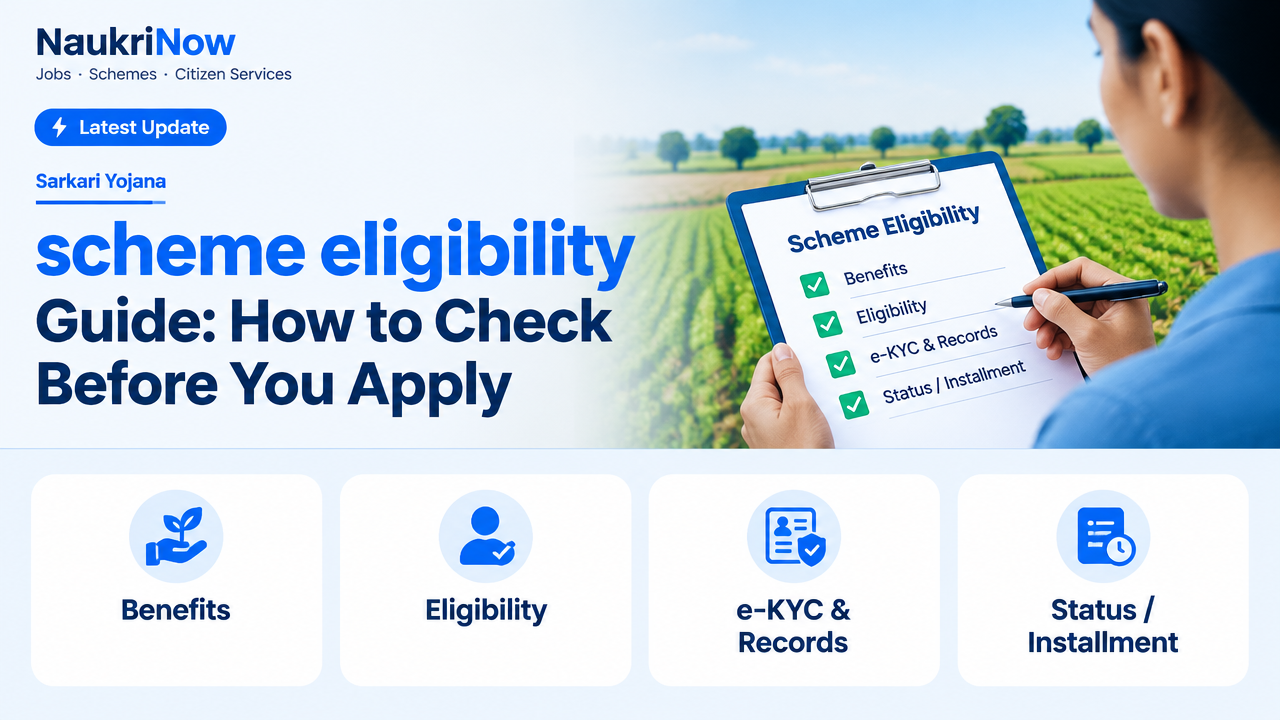
Government schemes can support education, healthcare, housing, livelihoods, agriculture and other needs. But a scheme that sounds suitable may not be open to every person in the same circumstances. Eligibility can depend on factors such as residence, household income, age, occupation, family status or an existing benefit. The rules also vary between central, state and local programmes.
This guide explains how to assess scheme eligibility in a careful, practical way. It is an educational resource, not a live notification or a substitute for the current official guidelines. Before acting, confirm the latest criteria, documents, application route and other instructions with the department or authorised portal responsible for the scheme.
What scheme eligibility means
Eligibility is the set of conditions an applicant must meet to be considered for a particular scheme. Depending on the programme, these conditions may apply to an individual, a household, a business, a farmer, a student or another defined group. They may also apply at different stages: when you submit an application, when officials verify it, or when a benefit is renewed.
Meeting the stated eligibility criteria does not always mean that a benefit will be approved automatically. An application may still need to be complete, supported by acceptable evidence and checked by the responsible authority. Some schemes may also have selection, prioritisation or funding processes. Read the official material to understand which of these applies; do not treat a general description as a promise of approval.
It helps to distinguish three ideas:
- Eligibility: whether you meet the scheme’s stated conditions.
- Application completeness: whether the required form, declarations and evidence have been provided in the accepted way.
- Approval or selection: the outcome after the authority reviews the application and follows its process.
These are related but not interchangeable. If you appear to qualify, check the full instructions rather than relying only on a short summary, advertisement or third-party post.
Start by identifying the right scheme
Begin with the need you want to address, not just a scheme name circulating online. Similar names can refer to different programmes, and benefits with similar purposes may have different eligibility rules. Identify the department, state or administering body and make sure you are looking at the programme that applies to your situation.
As you research, record the official scheme name, the level of government responsible for it, the intended beneficiary group and the type of support described. Check whether the programme is intended for an individual or a household, and whether it covers your state, district or other area. A central scheme may still have state-level processes or implementation arrangements, so confirm where applications are handled.
| What to identify | Why it matters | Question to ask |
|---|---|---|
| Scheme and department | Helps distinguish the official programme from similarly named offers. | Which department or authority publishes the rules? |
| Beneficiary group | Shows whether the scheme is meant for people in your circumstances. | Is it for individuals, households, students, workers, farmers or another group? |
| Area covered | Some programmes apply only in specified states, districts or locations. | Does the current notice cover where I live or work? |
| Type of support | Different benefits may have different conditions and evidence. | What support is described, and what conditions are attached? |
| Application channel | Using the wrong route can delay or invalidate a submission. | Does the official guidance direct applicants to a portal, office or authorised service? |
How to check scheme eligibility step by step
- Find the official source. Start with the website or published instructions of the responsible department, government or authorised programme administrator. If you find a scheme through a news story, social post or private website, use it only as a lead and locate the official material before sharing personal information or applying.
- Read the complete eligibility section. Look for every condition, including definitions and exclusions. A brief description may omit details about the applicant, household, location, type of work or other circumstances.
- Separate mandatory conditions from supporting preferences. The notice may describe essential requirements as well as priorities, categories or selection factors. Do not assume a priority factor is an eligibility condition—or that an eligibility condition is optional. Follow the wording in the current official instructions.
- Compare each condition with your situation. Make a simple list with one row per criterion. Note whether you meet it, what evidence could show it, and whether you need clarification. If a condition is unclear, seek guidance from the administering authority rather than guessing.
- Check who is assessed. A rule may refer to the applicant, a parent, a spouse, a household or a business. Confirm the scheme’s definitions. Do not assume that income, residence or other details are assessed in the same way across programmes.
- Review exclusions and existing-benefit rules. Some schemes may define people who cannot apply or set conditions relating to another benefit. Check the official wording and ask the responsible office if you are unsure whether a previous or current benefit affects your application.
- Confirm the application route and evidence rules. Check where to apply, how documents must be submitted, whether originals may need to be shown, and whether verification is part of the process. A document that is generally valid may not meet a scheme-specific requirement.
- Recheck before submission. Use the latest instructions available on the official channel. Rules, forms and processes can change, so a saved guide or old application may not reflect the current requirements.
A comparison checklist is especially useful when more than one person in a family may apply or when two schemes appear similar. It turns a vague question—“Do I qualify?”—into specific points that can be checked and evidenced.
Common eligibility criteria to review
There is no universal eligibility test for Indian government schemes. The following are common areas to check, not a list of rules that applies to every programme.
Residence and location
A scheme may be linked to a state, district, community, workplace or place of study. Check how the official instructions define residence and what evidence they accept. Current address, permanent address and place of work may not be treated as identical. If you have moved, ask whether the scheme uses your present location, an earlier record or another defined connection.
Income and household circumstances
Where income is relevant, find out whose income is considered and how the scheme defines a household or family. Check the period, evidence and method specified in the current instructions. Do not apply a threshold or interpretation found in an unrelated scheme. If income varies, documents conflict or your household circumstances have changed, ask the department how to report the situation accurately.
Age, education, occupation or life stage
Some programmes are designed for a particular age group, course, type of work, business activity or life event. Confirm how the relevant condition is measured and which supporting record is accepted. For example, a scheme may define its own way of establishing a course, occupation or applicant status. Avoid assuming that a general identity document alone proves every criterion.
Category, disability or other status
Where a scheme includes a recognised category or status, check the exact definition and the authority or document specified for verification. Terminology and evidence requirements can differ between programmes. Never rely on a certificate or label without checking whether it is accepted for the scheme and whether it must meet any current conditions.
Existing benefits, assets or other exclusions
Some schemes may consider an existing benefit, an asset, a prior application or another circumstance. Read the exclusions and declarations carefully. If the wording is broad or does not clearly cover your case, obtain an answer from an official source and keep a note of the guidance. Do not omit information because you think it is unlikely to matter.
Documents and information to prepare
There is no single document set for all schemes. Prepare only what the current official instructions request, and confirm the format, issuing authority, validity and submission method. The table below is a planning checklist, not a universal requirement list.
| Information or record | May help establish | Check before using it |
|---|---|---|
| Identity details | The identity of the applicant or another person named in the application. | Which identity evidence is accepted and whether details must match other records. |
| Address or residence evidence | A connection to a stated place or service area. | Whether the scheme asks for current, permanent or another form of residence evidence. |
| Income or household evidence | Income or family circumstances, if relevant. | Whose details are needed, what period is covered and which issuing authority is accepted. |
| Education, occupation or activity records | Student, worker, farmer, business or other beneficiary status. | Whether the record must be recent, certified or issued by a particular institution. |
| Category or status certificate | A specific status named in the scheme rules. | Whether the document meets the scheme’s definition and is in the required form. |
| Bank or payment details | A payment route, where the scheme requires one. | Whether the account-holder details and any linked information meet the current instructions. |
| Photographs, declarations or forms | Application identification and required statements. | File type, size, signature, language and whether a prescribed format is required. |
Before applying, check that names, dates and other details are consistent across the application and supporting records. If there is a spelling difference, a changed address or a missing document, do not alter an official record yourself. Find out whether the scheme permits an explanation, correction or alternative proof, and follow the prescribed process.
Apply carefully and keep a record
Once you have checked the criteria, follow the application route stated by the responsible authority. Some schemes use an online service; others may direct people to an office or an authorised assistance point. Do not assume that an online search result, agent or messaging-group link is an official application channel. Navigate from the department’s official site where possible, and verify that any service centre is authorised for the task.
Complete the form using accurate information and the scheme’s definitions. Read declarations before agreeing to them. Upload or submit documents in the requested format, and retain copies of the form and evidence for your own records. If the application produces a reference number, acknowledgement or receipt, save it securely. Do not publish it or send it to an unverified person.
Where a form does not accept an accurate answer, or the instructions do not cover your circumstances, pause before submitting. Ask the administering authority how to proceed. A guessed answer may create a mismatch at verification, while an incomplete submission can make it harder to understand what happened later.
Common mistakes and how to troubleshoot
- Relying on an old post or forwarded message: Return to the official notice and check that its instructions are current. A screenshot without a source or publication context is not enough to establish a rule.
- Assuming one scheme’s criteria apply to another: Similar names or benefits do not mean the rules are identical. Check each programme separately.
- Confusing a document with eligibility: Having a certificate does not by itself prove that every other condition is met. Match each document to a specific requirement.
- Using inconsistent personal details: Compare the form with supporting records. If details differ, ask about the official correction or explanation process instead of submitting contradictory information without comment.
- Leaving required fields blank or guessing: Review the form instructions. If a question does not fit your case, seek an authorised explanation rather than entering information that is not true.
- Assuming submission means approval: Save the acknowledgement and follow the official status-check process, if one is provided. An application may still require review or further information.
- Paying an unverified intermediary: Check whether a service charge or assistance route is officially stated. Do not share passwords, one-time codes or sensitive account credentials with anyone claiming they can guarantee approval.
If an application is delayed, marked incomplete or returned, first read the status message and identify the specific issue. Compare it with the relevant instruction, note any requested correction and use the official channel to respond. Keep a record of communication and reference details. If the explanation is unclear, contact the scheme’s responsible office or authorised support route shown in current official material; avoid relying on contact details supplied only by an unknown caller or website.
What to verify in the latest official instructions
Before relying on any scheme information, confirm the items below directly with the administering department or an authorised channel. This is particularly important if you saved an older guide or received information from someone else.
- The scheme’s correct name, responsible department and area of operation.
- The current eligibility conditions, definitions, exclusions and any selection process.
- The accepted evidence, required formats and any rules for certificates or declarations.
- The approved application route and whether assistance centres are authorised.
- Any current process for tracking, correcting, updating or appealing an application, if provided.
- Any dates, charges, benefit details or other time-sensitive information stated in the current official notice.
Do not assume a deadline, benefit amount, fee, helpline or application status from a general guide. These details can change and must be checked in the current official notice. If different official pages appear to conflict, look for a newer instruction from the responsible department and ask that authority to clarify which process applies.
Good preparation is straightforward: identify the right programme, test every stated condition against your circumstances, collect evidence that the scheme actually accepts, and use only a verified application channel. This does not guarantee approval, but it helps you make an informed application and reduces avoidable errors.
Frequently Asked Questions
How can I know if I am eligible for a government scheme?
Read the scheme’s current official eligibility section and compare every condition with your circumstances. Check definitions, exclusions and the evidence required. If anything is unclear, ask the administering authority rather than relying on a general summary.
Does meeting the eligibility criteria guarantee approval?
No. Eligibility means you appear to meet the stated conditions. The authority may still check the application, documents and any selection or prioritisation process described in the official instructions.
Are scheme eligibility rules the same across India?
No. Rules may differ between central, state and local programmes, and a scheme may have location-specific implementation instructions. Confirm the rules for the exact programme and area relevant to you.
Can I apply if one of my documents has a different address or spelling?
Do not assume the mismatch will be accepted or automatically disqualify you. Check the scheme’s instructions and ask the responsible authority whether correction, an explanation or alternative evidence is allowed. Do not change an official document yourself.
Which documents are required for scheme applications?
There is no universal list. Requirements depend on the scheme and the condition being verified. Use the latest official checklist, including any instructions about document format, issuing authority and validity.
Can I apply for more than one scheme?
That depends on the rules of each programme. Check whether either scheme has an exclusion or condition relating to other benefits, and answer all declarations accurately. Ask the relevant authorities if the instructions do not address your situation.
What should I do if my application is marked incomplete?
Read the official status message, identify the missing or incorrect item and follow the stated correction process. Keep your acknowledgement and a record of any response. If the reason is unclear, contact the authorised scheme office using details from an official source.
Where should I verify scheme information?
Use the website or published instructions of the responsible government department, scheme administrator or authorised service channel. Treat third-party articles and forwarded messages as leads, not final proof of current rules.
Comments