Table of ContentsClick to view all sections
- What is a farmer scheme?
- Types of support to look for
- How to choose a scheme that fits your situation
- Eligibility: questions to answer before applying
- Documents and details to prepare
- How to apply: a careful step-by-step process
- Common mistakes and how to avoid them
- Checking status, fixing problems and staying safe
- Practical tips and what to verify officially
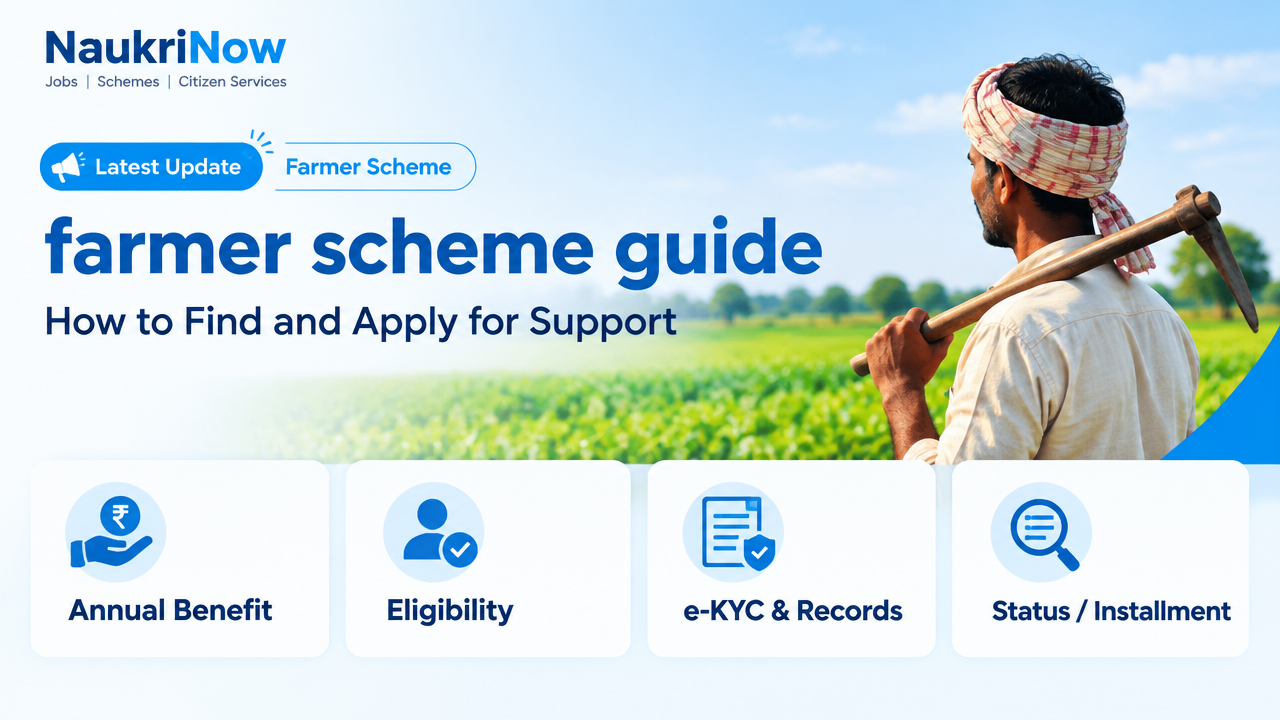
Government support for farmers in India comes through many different programmes. Some offer income support, while others focus on crop insurance, credit, irrigation, equipment, soil health, marketing or state-specific needs. There is no single application that covers every benefit, and eligibility, documents and application routes differ from scheme to scheme.
This farmer scheme guide explains how to identify relevant support, check the current rules and apply carefully. It is an educational overview, not a live notification. Scheme names and broad purposes can help you begin your search, but always confirm current eligibility, benefit details, deadlines and procedures through the responsible government department before acting.
What is a farmer scheme?
A farmer scheme is a government programme intended to support agricultural households, cultivators or people working in related activities. The word “farmer” can have a specific meaning in each programme. One scheme may require land records in the applicant’s name; another may serve tenant cultivators, sharecroppers, livestock owners or members of a farmer group. Never assume that qualifying for one programme automatically qualifies you for another.
Support may be delivered as a payment, an insurance service, access to institutional credit, a subsidy, training, equipment assistance or improved access to markets and infrastructure. Some programmes operate across India, while others are designed and administered by individual states. A central programme may also have state-level implementation steps, so the local agriculture office can be important even when the scheme itself is national.
For example, farmers commonly look into PM-KISAN for income support, the Kisan Credit Card (KCC) for eligible agricultural credit, Pradhan Mantri Fasal Bima Yojana (PMFBY) for crop insurance, and irrigation or soil-related programmes such as PM Krishi Sinchayee Yojana and the Soil Health Card programme. These are examples of distinct types of support, not a guarantee of present availability or eligibility. Their operational rules can change, and some components may be implemented differently across states.
Types of support to look for
Start with the need you want to address rather than applying for every scheme you find. This makes it easier to identify the right department and avoid confusing benefits that have different conditions.
| Support area | What it may help with | What to check |
|---|---|---|
| Income support | Financial assistance for eligible farming households or landholders. | Who counts as eligible, land-record requirements, exclusions, identity verification and payment status procedures. |
| Farm credit | Access to institutional credit for eligible crop or allied-activity needs. | Participating bank, eligible activities, credit assessment, required records and repayment terms. |
| Crop insurance | Coverage for specified crop losses or risks under the applicable policy. | Notified crops and areas, enrolment route, cut-off dates, premium terms, reporting requirements and claim process. |
| Irrigation and equipment | Support for water-use improvements, machinery or other approved assets. | Whether applications are open, approved equipment, subsidy conditions, vendor rules and whether prior approval is required. |
| Soil, seeds and extension | Soil information, technical guidance, training or access to approved inputs. | Local availability, service centre, recommended process and any farmer-group or land-record conditions. |
| State-specific assistance | Support tailored to local crops, regions, farming communities or emergencies. | State department notice, district coverage, eligibility, application window and authorised implementing office. |
The table is a starting point, not a statement of current scheme terms. The official notice for the relevant programme and location takes precedence.
How to choose a scheme that fits your situation
- Write down the need. Decide whether you are seeking credit, crop-risk coverage, irrigation support, equipment, income assistance, soil guidance or another service.
- Describe your farming situation accurately. Note your state and district, crops, landholding or cultivation arrangement, and whether you farm independently or through a group. Mention allied activities, such as dairy or fisheries, if relevant.
- Search official sources first. Check the central ministry or scheme portal, your state agriculture department and, where appropriate, the district agriculture office, bank or authorised service centre. A news story or social-media post can point you towards a scheme, but it should not be your final source for rules.
- Read the eligibility section in full. Look for who can apply, who is excluded, which locations or crops are covered, whether land or cultivation records are required, and whether an applicant must meet other conditions.
- Check the application route and timing. Confirm whether applications are accepted online, through a department office, bank, insurer, cooperative or authorised centre. For time-sensitive services such as insurance or seasonal assistance, verify the current window directly.
- Compare the practical terms. For credit, understand repayment and charges. For insurance, understand what risks are covered and how losses must be reported. For a subsidy, check whether approval must come before buying equipment.
If a scheme’s name appears in several places, use the official department or implementing agency to confirm that the version you found applies to your state and current season.
Eligibility: questions to answer before applying
Eligibility is programme-specific. The applicant may need to be an individual cultivator, a landholder, a member of a farmer producer organisation, a tenant, a women’s group, or another defined category. A person’s role in farming, the location of the land and the records available can all matter. Some programmes also set conditions relating to the crop, activity, size of holding, bank account or other factors.
Before starting an application, find clear answers to these questions:
- Does the scheme cover your state, district, village, crop or agricultural activity?
- Does it accept your type of cultivation arrangement, including tenancy or sharecropping where relevant?
- Which person or entity must apply: the cultivator, recorded landholder, household, group or organisation?
- Are there exclusions or conditions that could affect your application?
- Must your identity, land or bank details be verified in a particular way?
- Is assistance subject to a budget, selection process, inspection or approval before purchase?
Land ownership and cultivation are not always treated as the same thing. If you cultivate land that is not recorded in your name, do not submit another person’s details as though they are yours. Ask the scheme’s local implementing office what evidence, if any, is accepted for your circumstances. If the published rules do not address your case, request clarification before applying.
Documents and details to prepare
There is no universal farmer-scheme document list. Requirements depend on the programme, applicant type and state. Preparing common records in advance can still make the process easier, provided you submit only what the official application asks for.
- Identity and contact details: the identity documents accepted by that scheme, a working mobile number and current address.
- Bank details: account information and any verification requested for receiving a payment or managing credit. Check the account holder’s name and details carefully.
- Land or cultivation records: relevant land-record extracts, parcel details, tenancy evidence or other records if required by the programme.
- Farm information: crop, season, location, area cultivated or details of an allied activity, where requested.
- Photographs and declarations: these may be required by particular applications; follow the specified format and make truthful declarations.
- Group or business records: an organisation’s registration, authorisation or bank records where the applicant is a group or entity.
Carry originals when an office asks to inspect them, but avoid handing over original documents unless the official process specifically requires it and provides a receipt. Keep copies or clear digital scans in a secure place. Do not share passwords, one-time passcodes, bank PINs or full payment credentials with an agent or caller.
How to apply: a careful step-by-step process
- Get the latest official instructions. Find the current application form or portal page for your state and scheme. Check the notice date, season, covered locations and issuing department. If the information is unclear or appears old, ask the department whether it is still applicable.
- Confirm the correct application channel. Use the official portal, designated bank, insurance channel, agriculture office or authorised service centre named in the instructions. Do not rely on a search advertisement or a forwarded link.
- Match your details to your records. Enter your name, identity, land, crop and bank information consistently with the documents the scheme accepts. If records contain a genuine error, find out how to correct it rather than changing information to force a match.
- Complete every relevant field honestly. Do not guess at a category, area or declaration. Ask the help desk or implementing office what a field means if its wording is unclear.
- Review and submit. Check spelling, account digits, contact information, uploaded files and declarations before submitting. A small error can delay verification or prevent communication.
- Save proof of application. Keep the acknowledgement, application or reference number, date of submission and a copy of the form. Save payment receipts only where an authorised process legitimately requires a fee; verify any fee in the official instructions first.
- Track the application through the stated channel. Follow official status instructions and respond to requests for clarification within the stated process. A status such as “under verification” is not the same as approval.
- Follow the next step. This could involve document verification, a bank decision, field inspection, correction of a record or a claim procedure. Keep a note of whom you contacted and when.
Where an application is submitted offline, ask for a dated acknowledgement or other proof. If an authorised operator submits it on your behalf, review the completed form before it is sent and keep the receipt and reference number.
Common mistakes and how to avoid them
- Assuming a scheme is open because an old page is online. Check the latest official notice for the relevant year, season and location.
- Applying under the wrong programme. Income support, insurance, credit and equipment assistance solve different problems. Confirm the benefit and conditions before submitting details.
- Using mismatched records. Differences in names, account details, land information or contact numbers can trigger verification issues. Ask the responsible office which record needs correction.
- Giving inaccurate land or crop information. Incorrect declarations can cause rejection, recovery of assistance or other consequences under the applicable rules. Report your circumstances honestly.
- Waiting until the last moment. Seasonal services may have a limited application or reporting window. Check timing early, especially for crop insurance or applications tied to a season.
- Buying equipment before checking approval conditions. Some assistance programmes may require prior application, inspection or approval. Confirm the sequence before spending money.
- Paying an unverified intermediary. Do not pay someone who promises guaranteed approval or asks for an OTP, PIN or password. Verify authorised service charges, if any, with the issuing office.
- Discarding the acknowledgement. Without the reference number or receipt, it can be harder to check progress or show that you applied.
Checking status, fixing problems and staying safe
If an application is delayed, rejected or shown as incomplete, start with the acknowledgement and the official status channel. Note the exact message and any reason given. Then contact the listed implementing office, bank or service provider with your reference number. Ask what action is needed, which document is missing or inconsistent, and how to submit a correction. Keep copies of any response or updated acknowledgement.
For a payment-related issue, verify the bank account details and the status shown by the responsible programme before sharing financial information. For an insurance issue, use the insurer or official scheme channel and follow the loss-reporting and claim instructions that apply to your policy and area. For a land-record mismatch, approach the appropriate state revenue or land-record office; a scheme operator may not have authority to alter those records.
Use contact details published on a government department, official scheme portal, bank or insurer website, or printed on an authorised notice. Be cautious of messages claiming that a payment is blocked unless you click an unfamiliar link, pay an “unlocking” fee or reveal a one-time code. Government support is not made certain by a private agent’s promise. If you suspect fraud, contact your bank promptly and report the incident through the appropriate official channel.
Practical tips and what to verify officially
Keep a simple folder—paper or digital—with the scheme notice, application copy, acknowledgements, submitted documents and communication records. Write down the name of the programme and the department handling it; similar names can refer to different services or components. Use a mobile number and bank account that you can access, and tell the relevant office if your contact details change.
Before relying on any scheme information, confirm these points from the latest official source:
- Whether the programme or component is operating in your state and location.
- Who may apply, who is excluded and what evidence is accepted for your farming arrangement.
- The current benefit, coverage, credit terms or subsidy conditions—if applicable.
- The application channel, any genuine fee, required documents and verification steps.
- For seasonal support, the applicable crop, season, application window and loss-reporting procedure.
- How to check status, correct errors, appeal or make a complaint.
Useful starting points include the relevant Union ministry or scheme portal, your state agriculture department, district agriculture office, land-record authority, participating bank or authorised insurer. If two sources disagree, ask the department responsible for implementation to confirm the rule in writing or direct you to the current official notice. Rules can be revised, so treat older articles and saved screenshots as background—not as proof of current eligibility.
Frequently Asked Questions
Is there one application for all farmer schemes?
No. Programmes have different purposes, eligibility rules and application channels. You generally need to apply separately through the route specified for each scheme.
Can a tenant farmer apply for government support?
It depends on the particular scheme and the rules in your state. Some programmes may rely on land records, while others may recognise different forms of cultivation or group participation. Confirm accepted evidence with the implementing office before applying.
Are central schemes available in every state?
Not necessarily in the same way. A central programme may depend on state implementation, local coverage or a particular component being active. Check the current notice for your state, district and season.
What documents should I keep ready?
Commonly requested details can include identity and contact information, bank details, land or cultivation records and crop information. The official checklist is the authority; do not assume every programme requires the same documents.
Can I apply through a private agent?
Use only an agent or service centre expressly authorised for that application. Review the form before submission, keep an acknowledgement and never disclose an OTP, PIN or password. A private intermediary cannot guarantee approval.
What should I do if my application is rejected?
Read the stated reason and contact the official implementing channel with your reference number. Ask whether the issue can be corrected, what evidence is accepted and whether there is a review or appeal process under the current rules.
How can I tell whether a farmer-scheme message is genuine?
Verify the scheme and any application link through the responsible government department, bank or insurer. Treat urgent messages asking for money, passwords, PINs or one-time codes as warning signs.
Where should I confirm current benefit amounts or deadlines?
Check the latest official scheme notice or contact the responsible department or authorised implementing agency. Do not rely on old articles, social posts or figures that are not confirmed for your state and application period.
Comments