Table of ContentsClick to view all sections
- SSC CGL Guide: What to know before choosing SSC CGL
- Eligibility: check the details post by post
- How the examination is organised
- A practical preparation plan
- Application checklist
- Choosing preferences with care
- Mistakes to avoid
- Useful examples of planning
- Where to verify current information
- Conclusion
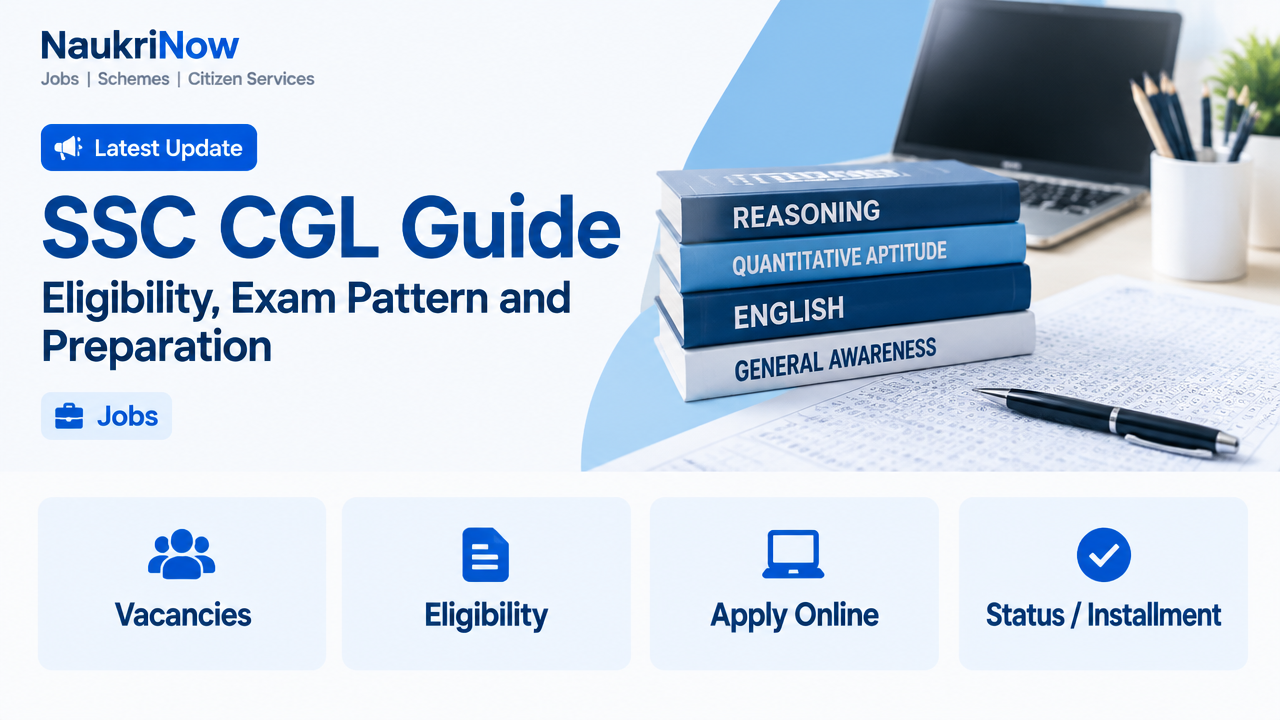
The Combined Graduate Level examination, commonly called SSC CGL, is a recruitment examination conducted by the Staff Selection Commission for a range of Group B and Group C posts in central government departments and organisations. It can lead to different kinds of work, from administration and accounts to audit, statistics and investigation. The role, service conditions and eligibility requirements depend on the post.
This SSC CGL Guide explains how to assess the opportunity, plan your preparation and avoid common application mistakes. Exam schemes, age limits, vacancies, dates, fees and post-specific conditions can change between recruitment cycles. Treat the current SSC notification and any official updates as the final authority rather than relying on an older guide, coaching advertisement or social media post.
SSC CGL Guide: What to know before choosing SSC CGL
SSC CGL is not a single-job examination. A recruitment cycle may include several posts with different duties, age limits, qualifications or physical standards. Read the post descriptions in the notification and consider what the work involves, not just the post title. For example, a candidate interested in desk-based accounts work may have different preferences from someone drawn to an enforcement or field-oriented role.
Before investing time in preparation, check three things: whether you meet the basic eligibility conditions, whether you are comfortable with the possible duties and location requirements, and whether you can prepare consistently for a competitive computer-based exam. Selection should not be assumed simply because you qualify to apply.
Eligibility: check the details post by post
A bachelor’s degree is the usual educational foundation for SSC CGL, but some posts may require a particular subject, qualification or combination of study and experience. The notification specifies which qualification is needed and the date by which it must be obtained. A degree that satisfies the general requirement may not meet the additional requirement for every post.
Age limits also vary by post. The notice sets out the relevant age calculation date, eligible date-of-birth range and any applicable relaxation provisions. Do not calculate your eligibility from a previous year’s notice or from a general statement about SSC CGL. Check the exact post code or post name you intend to select.
Nationality and other conditions are defined in the official notice. Some posts may also have medical, physical or other suitability requirements. If a condition is unclear, consult the detailed notification and official clarification or corrigendum. Do not assume that eligibility for one post automatically means eligibility for all the others.
How the examination is organised
SSC notifies the examination stages, subjects, question format, marking rules and any post-specific papers or skill tests for each cycle. In recent cycles, the selection process has used computer-based examination tiers, with later-stage performance playing an important role in merit and post allocation. The exact structure and the role of each paper can be revised, so use the current scheme in the notification as your preparation blueprint.
Commonly tested areas include quantitative aptitude, reasoning, English and general awareness. Depending on the notified scheme and the post, candidates may also encounter additional subject papers, computer-related assessment or a data-entry or other skill test. Some assessments may be qualifying in nature while others may contribute to ranking. That distinction matters: prepare for every required stage, but understand which scores count towards final merit.
Read the instructions on negative marking, sectional or paper-wise requirements, qualifying standards and post preferences carefully. A familiar subject list does not guarantee that the number of questions, time limits or test structure will remain the same.
A practical preparation plan
1. Start with the official syllabus and a baseline test
Download the syllabus and exam scheme from the SSC website for the cycle you are targeting. Attempt a diagnostic paper or a selection of timed questions before starting full preparation. Note your accuracy, speed and weak topics. This gives you a more useful starting point than trying to study every subject with equal intensity.
Build a topic checklist for each subject. For example, in quantitative aptitude, track areas such as arithmetic, algebra, geometry and data interpretation according to the notified syllabus. In reasoning, group practice by question type. Use the syllabus as a boundary: deepen your understanding of included topics before chasing obscure questions from unverified sources.
2. Strengthen concepts before increasing speed
Learn the basic method for a topic, solve a small set of untimed questions, and then move to timed practice. If you repeatedly miss questions on percentages, ratios or averages, revisit the underlying concept rather than memorising isolated shortcuts. Shortcuts are most useful after you understand when they apply and when they do not.
For English, regular reading can help with comprehension and vocabulary, but it should be paired with deliberate grammar and question practice. For general awareness, use a manageable revision system: organise notes by subject, keep facts concise and revisit them at planned intervals. Avoid collecting more notes than you can review.
3. Use mocks to diagnose, not just to measure
Take full-length mocks under realistic time conditions as your preparation develops. After each test, review every wrong answer, every guess and every question that took too long. Label the cause: a concept gap, careless reading, calculation error, weak recall or poor time choice. Then decide on one corrective action for each pattern.
For instance, if you solve a question correctly but spend too long on it, practise a faster method or learn when to move on. If you get a general-awareness question wrong because you confused two similar terms, revise the distinction and test yourself again later. A mock score without review is only a snapshot; a reviewed mock can shape the next week of study.
4. Practise accuracy and time management together
Do not equate speed with rushing. A sensible attempt strategy depends on the marking rules in the current notice and your own accuracy. Practise deciding whether to answer, flag for review or skip a question. In a timed section, a difficult problem should not consume the time needed for several questions you can solve confidently.
Keep an error log with the question type, the reason for the error and the follow-up practice required. Review it weekly. If the same mistake appears repeatedly, make it a priority even if it seems like a small detail.
5. Prepare for every required stage
Do not postpone a notified skill test or computer-related assessment until after the main examination. Find out whether it is required for your chosen post, how it is assessed and whether it is qualifying or merit-bearing. Practise the relevant skill regularly if the notification requires it. For any post-specific paper, include its syllabus in your plan from the beginning rather than treating it as an optional extra.
Application checklist
- Open the latest SSC CGL notification on the official SSC website and check for later notices, corrigenda or updates.
- Confirm the post-wise qualification, age limit, age-calculation date and any other eligibility conditions before selecting preferences.
- Enter personal, educational and category details exactly as supported by your records. Check spelling, dates and identification details before submitting.
- Follow the current instructions for the photograph, signature and any required documents. Image rules and submission procedures can change.
- Review the application preview carefully. Save the submitted form and any confirmation or payment record you are instructed to retain.
- Check the official website for updates on the application, examination stages, admit-card arrangements and results. Do not rely on an unofficial message as proof of an update.
Use only the official application route named by SSC. If the portal indicates an error or a correction window is available, follow the cycle-specific instructions rather than trying to amend details through an unofficial intermediary.
Choosing preferences with care
Post preferences can affect the outcome of allocation, so make the choice deliberately and in the format required by the notification. Consider the work profile, location expectations, eligibility conditions and any additional assessment attached to each post. A preference list based only on a post’s perceived status may not suit your interests or circumstances.
Read the rules for preference submission and any required declaration. Check whether preferences can be changed, when they become final and how allocation is made under the current process. Never assume that a preference entered in one recruitment cycle will carry over to another.
Mistakes to avoid
- Using old rules: Previous notifications, answer keys and preparation videos can help with practice, but they are not proof of this cycle’s eligibility or exam scheme.
- Applying before checking post-specific conditions: A broad degree requirement may not cover a post with an additional subject or suitability requirement.
- Studying without the syllabus: Random question practice can leave important areas untouched and spend too much time on material outside the notified scope.
- Taking mocks without analysis: Repeating tests without fixing recurring errors can make preparation feel busy without improving performance.
- Ignoring accuracy: Attempting every question is not automatically a good strategy. Apply the current marking rules and practise making informed decisions.
- Leaving skill or specialist papers too late: A required assessment can become a weak link if it receives no preparation until the final stage.
- Trusting unofficial claims: Be cautious of guaranteed-selection promises, paid shortcuts, fabricated notices and requests for login credentials.
Useful examples of planning
If you are a final-year student: check the notification’s qualification date and proof requirements. Being enrolled in a degree programme does not necessarily mean you meet the condition by the date specified for a particular cycle.
If you work or study full-time: set a realistic weekly schedule rather than copying a full-day timetable. You might assign short weekday sessions to revision and practice, then use a longer weekend block for a mock and detailed review. Consistency and review matter more than an ambitious plan you cannot maintain.
If your mock scores are uneven: separate subject knowledge from test execution. A low score in one area may call for concept revision; a generally slow paper may call for timed sets and better question selection. Use your error log to identify which problem is actually affecting performance.
Where to verify current information
For eligibility, application instructions, dates, fees, vacancies, exam scheme, answer keys, results and any changes to the process, consult the latest notice and updates published by the Staff Selection Commission on its official website, ssc.gov.in. Use an official SSC regional website only when the central notice directs you to it. If two sources disagree, follow the latest applicable official notice or clarification.
Frequently Asked Questions
Is SSC CGL open only to candidates with a particular degree?
A bachelor’s degree is the usual general requirement, but certain posts can have additional subject or qualification conditions. Check the current notification for the exact post and the required qualification date.
Are the age limits the same for every SSC CGL post?
No. Age limits and applicable relaxations can differ by post and category. The notification also specifies the date used to calculate age, so check the relevant entry rather than relying on a general summary.
Does SSC CGL have a fixed exam pattern every year?
No pattern should be treated as permanent. SSC publishes the stages, papers, subjects, marking rules and skill-test requirements for each cycle. Prepare from the current notification.
How should I begin if I have not prepared before?
Read the official syllabus, take a baseline test and list your strengths and gaps. Then study core concepts, practise topic-wise questions and add timed mocks as your understanding improves.
Are mock tests enough to prepare?
Mocks are useful for timing and diagnosis, but they do not replace learning the syllabus. Combine concept study, targeted practice, revision and careful mock analysis.
Can I apply for every post listed in a cycle?
Only if you meet the conditions for each post and follow the application and preference rules. Some posts may have distinct qualifications or other requirements, so check them individually.
Where should I check dates, vacancies and results?
Check the latest SSC notice and updates on the official SSC website. These details change by cycle and should not be taken from an older article or an unverified message.
Conclusion
SSC CGL preparation works best when it begins with accurate information and continues with consistent, measurable practice. Check eligibility post by post, follow the current syllabus, build concepts before chasing speed, and use mocks to identify what needs attention. Read every application and preference instruction carefully. Above all, verify changing facts through SSC’s official notices: a reliable plan can be evergreen, but recruitment details are cycle-specific.
Comments