Table of ContentsClick to view all sections
- What happens during SSC document verification?
- Start with the notice, not a generic checklist
- SSC document verification checklist
- How to prepare your documents
- Pay special attention to certificates and personal details
- What to expect at the venue
- Examples of issues to resolve before you go
- Mistakes to avoid
- Conclusion
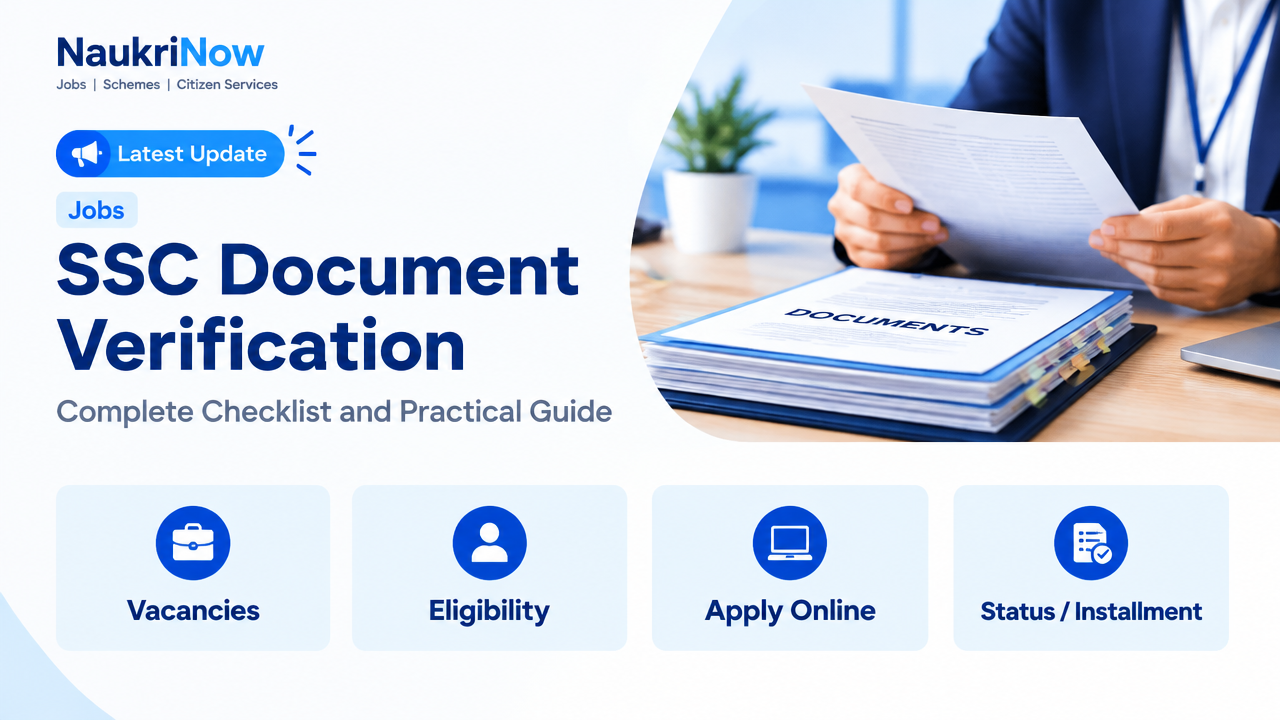
SSC document verification is the stage at which the details in your application are checked against your certificates and other records. The exact process is not identical for every examination or post: the documents required, the venue, the schedule and the authority conducting the check can vary. A careful preparation routine can help you avoid preventable delays, but the notice for your examination and your official candidate communication are the final authority.
Use this guide to organise your records and plan ahead. For current instructions, check the relevant notice and updates on the official Staff Selection Commission (SSC) website, the relevant SSC regional website where applicable, and any official communication from the department or organisation responsible for the post.
What happens during SSC document verification?
At verification, officials may compare your application and claim details with your original certificates and supporting documents. This can include your name, date of birth, educational qualification, category, nationality or other eligibility details. The process may also involve checking certificates against the requirements in the examination notice. Some recruitment processes have additional checks or a later stage handled by the user department. Follow the instructions for your particular examination rather than assuming that one SSC process applies to all posts.
Being called for verification does not, by itself, guarantee final selection or appointment. The outcome can depend on eligibility, document scrutiny, merit, vacancies, applicable rules and any further stages specified for that recruitment. If officials ask for a clarification or additional record, use the official channel and deadline given to you.
Start with the notice, not a generic checklist
Before collecting documents, read the relevant examination notice and every official instruction issued for your verification. Look for the required documents, certificate formats, eligibility cut-off dates, reporting time, venue, number of copies and any instructions about photographs, identification or forms. Requirements can differ even between examinations conducted by the same commission.
Check whether a document must establish a fact by a particular date. For example, an educational qualification may need to have been obtained by the cut-off date specified in the notice. Category-related eligibility can also depend on conditions and dates set out for that recruitment. Do not rely on an older exam notice, a coaching site, a social media post or another candidate’s experience as a substitute for your own instructions.
If a requirement is unclear, look for a clarification or corrigendum published through an official channel. If the notice provides an official contact or query route, use that route and keep a copy of your query and any reply. Do not assume that a verbal assurance from an unofficial source changes the published requirement.
SSC document verification checklist
Use the following as a preparation framework. It is not a universal list of compulsory documents; take the items that your examination instructions require.
- Official communication: Bring the verification call letter, notice or other official intimation, along with any forms or declarations you have been told to complete. Save a digital copy as a backup, but do not assume it replaces a printed copy if one is required.
- Photo identity: Carry the identity document specified in your instructions. Check that the name and photograph are legible and that the document is valid for the purpose described. Take another accepted ID only if the instructions allow or recommend it.
- Educational records: Arrange the certificates and mark sheets needed to establish the qualification claimed in your application. If the notice asks for records covering more than one stage of education, include those too. A provisional certificate, result record or explanation for a pending document should be used only where the rules permit it.
- Date-of-birth evidence: Carry the record accepted by the notice for establishing your date of birth. Do not choose a document simply because it contains a date; use the type of proof required for the recruitment.
- Category or eligibility certificates: If you claimed a reservation or other eligible status, check the required certificate type, format, issuing authority and relevant date conditions. Requirements for SC, ST, OBC, EWS, PwBD, ex-servicemen and other claims are not interchangeable.
- Application and examination records: Keep a copy of your submitted application or relevant application details, and any other exam-related document specifically requested. These can help you check what you declared if a detail is queried.
- Name-change or name-variation evidence: If your records use different names or spellings, gather the supporting documents that the notice or official instructions accept. Do not assume that an affidavit, gazette record or any particular proof will be accepted unless the applicable instructions say so.
- Photographs and copies: Carry recent photographs and photocopies only in the quantity, size or form specified. Keep originals separate from copies so you can present the right item quickly.
How to prepare your documents
- Make a requirement-by-requirement list. Write down each document named in your own instructions. Add any related supporting record that the notice explicitly asks for. Mark whether you need an original, a copy, a particular format or a specific number of copies.
- Compare documents with your application. Check names, dates, category details, qualification and other claims against the information you submitted. Look for spelling differences, initials, different name order, missing pages or unclear printing. A mismatch is easier to address before the appointment than at the desk.
- Check certificate conditions early. Confirm that each certificate relates to the claim you made and meets the format and date requirements in the notice. If a certificate needs to be obtained or corrected, contact the relevant issuing authority promptly. Do not edit a certificate yourself or rely on a document that is still only an application for a certificate unless the rules permit it.
- Organise originals and copies separately. Arrange records in the order of your checklist, with originals easy to access and copies behind them. Use a folder or sleeves that protect papers from damage. Avoid stapling or altering originals unless the instructions require it.
- Review logistics and instructions. Confirm the venue, reporting time, allowed items and any entry requirements from the latest official communication. Plan your journey with enough margin for delays. If you need an accessibility arrangement or have a genuine practical difficulty, follow the official process described in your instructions as early as possible.
- Keep a secure backup. Store readable scans or photographs of your records in a secure place for your own reference. A digital copy is useful if a paper is misplaced, but it is not a substitute for an original or certified copy where one is required.
Pay special attention to certificates and personal details
Category and reservation claims
For a category or reservation claim, verify the exact conditions in the examination notice. The required format, certificate date, issuing authority and eligibility criteria may depend on the category and recruitment. For example, an OBC claim may have conditions that differ from a caste certificate alone, while an EWS claim has its own prescribed requirements. Do not assume that a certificate accepted for another purpose or recruitment will automatically meet this examination’s rules.
If you belong to a reserved category but did not claim it in your application, or if you claimed a status that your current documents do not establish, do not try to resolve the issue by changing records at the venue. Refer to the published rules and seek clarification through the official channel. Whether a claim can be corrected or considered depends on the applicable instructions.
Name, date of birth and qualification
Small differences in spelling or initials can prompt questions, especially when they appear across several records. Check whether your application name matches the records you are presenting and whether the examination notice explains how discrepancies should be handled. Carry supporting evidence where the official instructions accept it. Never alter a certificate or submit a false declaration to make records appear consistent.
For educational eligibility, confirm that the qualification and any required subjects or equivalent credentials match the post’s stated criteria. Keep the documents that establish completion and the relevant date. If your result or certificate was issued later than the examination date, distinguish the date you completed the qualification from the date a document was printed; use the evidence and interpretation required by the notice.
What to expect at the venue
Arrive according to the reporting instructions and keep your call letter or official intimation available. Officials may ask you to produce originals, submit copies, complete a form or clarify a discrepancy. Listen to the instructions at the venue and answer questions accurately. If you are asked to hand over a document, understand whether it is being checked, copied or retained, and follow the official process for any receipt or acknowledgement.
Do not surrender original certificates permanently unless an official instruction clearly requires it and explains the process. If an original is retained, ask for the appropriate acknowledgement. Do not photograph or record restricted areas if venue rules prohibit it. If you do not understand a query, ask politely which record or detail needs clarification and respond through the authorised staff.
Some recruitment processes include further scrutiny, medical or physical requirements, or verification by the department responsible for the post. Such steps are not universal. Check the notice and later official communication for what applies to you, and keep your contact details accessible so you do not miss an update.
Examples of issues to resolve before you go
- Different spellings of your name: Suppose your application uses a full name while one certificate uses initials. Compare all records, then check the official instructions for acceptable supporting proof. Bring the relevant accepted evidence rather than assuming the difference will be ignored.
- Category certificate in an older format: If your certificate was issued for a different purpose or under a different format, compare it with the format and date conditions in your exam notice. Ask the issuing authority about a compliant certificate if needed; do not rely on another candidate’s certificate being accepted.
- Qualification completed near a cut-off date: Gather records that establish when you completed the qualification and read the notice’s eligibility date carefully. Do not infer eligibility from the date your final certificate was printed alone.
- One photocopy is missing: Check the required copy count in advance and prepare it before travel. If you discover a shortfall at the venue, ask the authorised staff what to do; do not leave the premises or miss a reporting instruction without permission.
Mistakes to avoid
- Relying on a generic list: A checklist from another exam may omit a document or describe a different certificate rule. Use your own notice and official communication.
- Waiting until the last moment: Replacing a certificate, correcting a personal detail or obtaining a supporting record can take time. Review your papers as soon as you receive verification instructions.
- Bringing only digital files: A phone or cloud folder may not satisfy a requirement to show an original or submit a paper copy. Follow the stated document format.
- Assuming a call letter means final selection: Verification is a checking stage, not a promise of appointment. Wait for the official outcome and any next-stage instructions.
- Using altered or misleading documents: Never edit, conceal or misrepresent information. If something is incorrect, use the authorised correction or clarification route.
- Paying an unofficial agent: Be cautious of anyone promising to secure acceptance, change a record or influence verification for money. Use only official channels and do not share passwords, one-time codes or sensitive documents with unverified contacts.
- Ignoring later notices: A clarification, revised instruction or department communication may affect what you need to do. Check official updates regularly until the process is complete.
Frequently Asked Questions
1. Is the document list the same for every SSC examination?
No. Documents and procedures can vary by examination, post, eligibility claim and recruitment stage. The relevant notice and your official verification communication determine what you must provide.
2. Do I need to carry originals as well as photocopies?
Carry the originals and copies specified in your instructions. Many checks require originals to be shown, but the exact requirements and copy count are not universal. Do not assume a scan or photocopy can replace an original.
3. What if my name is spelled differently on two documents?
Check the notice for instructions on name differences and acceptable supporting evidence. Organise relevant records before your appointment and explain the discrepancy honestly if asked. Do not change or annotate an official certificate yourself.
4. Can I use a certificate issued for an earlier recruitment?
Possibly, but do not assume it qualifies. Check the current examination’s required format, issuing authority, eligibility conditions and date rules. A certificate accepted in another recruitment may not meet this one’s requirements.
5. What if I cannot obtain a required document before verification?
Read the official instructions for any permitted alternative or procedure, and contact the relevant official channel promptly if one is provided. Do not rely on an informal promise that the document can be submitted later.
6. Does clearing document verification guarantee appointment?
No. Verification checks documents and eligibility claims. Final selection or appointment may depend on other conditions and stages in the recruitment process. Follow the official result and communication for your examination.
7. Where should I check for current instructions?
Use the official SSC website, the relevant regional SSC website where applicable, and official communication from the department or organisation responsible for the post. Treat unofficial posts and forwarded messages as unverified unless they point to an official notice.
Conclusion
The best preparation for SSC document verification is a careful comparison of your application, your certificates and the instructions for your specific examination. Confirm formats and dates, organise originals and copies, plan for discrepancies early and keep checking official communication. Procedures can vary, so use this guide as a practical starting point—not a replacement for the current notice or directions from the responsible authority.
Comments