Table of ContentsClick to view all sections
- What does a bank PO do?
- Which bank PO exams should you consider?
- Eligibility: check the notification before you plan
- How the selection process usually works
- Understand the syllabus and build a study plan
- Application checklist: prepare before you register
- Common mistakes and how to troubleshoot them
- What to verify from official sources
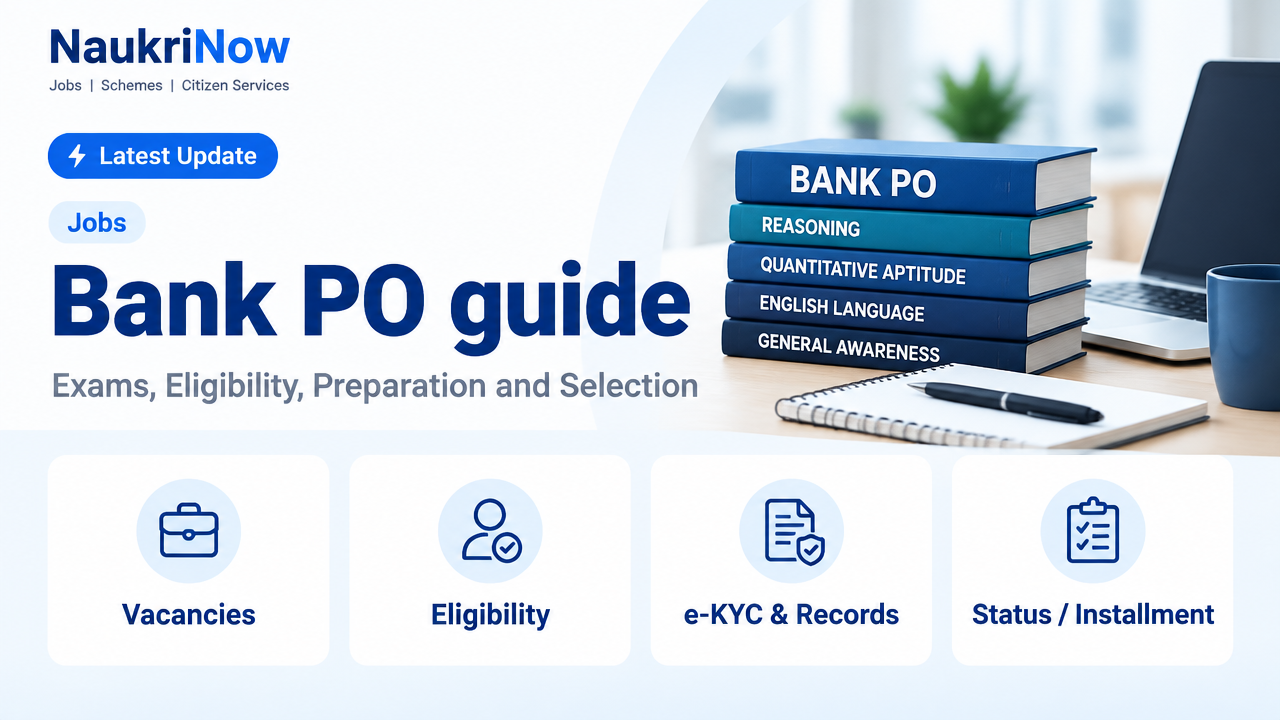
A bank probationary officer (PO) exam can be a route into a varied career in banking, but the process involves more than preparing for one written test. You need to identify the right recruitment exam, check its current eligibility rules, prepare for each selection stage and submit an accurate application.
This guide explains how bank PO recruitment generally works in India and how to approach it systematically. It is evergreen guidance, not a live recruitment notice. Participating banks, exam patterns, eligibility conditions and procedures can change, so use the latest official notification for every decision.
What does a bank PO do?
A probationary officer is generally an entry-level officer who receives training and may work across different banking functions. Depending on the bank and posting, responsibilities can include customer service, account and transaction processes, loan-related work, business development, compliance checks and supervising operational tasks.
The word probationary matters: a new officer may be trained, assessed and moved between roles or branches during the initial period of service. The exact probation period, salary structure, allowances, posting conditions and promotion framework are bank-specific. Check the relevant recruitment notice and the bank’s official materials rather than relying on a general description.
The role can suit candidates who are comfortable working with people, handling detailed processes and learning financial products. It may also involve targets, busy customer-facing periods and transfers. Consider the nature of the job—not just the exam—when deciding whether to apply.
Which bank PO exams should you consider?
There is no single exam that covers every bank PO vacancy. Two widely known recruitment routes are the Institute of Banking Personnel Selection (IBPS) Probationary Officer/Management Trainee recruitment and the State Bank of India (SBI) Probationary Officer recruitment. Other bank recruitments may use their own processes. Names, participating institutions and selection arrangements can change between cycles.
Start by reading the official notification for the specific exam. Confirm the recruiting body, participating bank or banks, post name and selection stages. Do not assume that registration for one exam automatically covers another, or that the same score is accepted by every bank.
Compare opportunities using factors that matter to you: the type of institution, location and transfer expectations, duties, eligibility, selection format and the official service conditions. Apply only through the application route stated in the relevant notice.
Eligibility: check the notification before you plan
Eligibility is not identical across all bank PO recruitments. Age limits, the date used to calculate age, educational requirements, category-related provisions, nationality conditions and acceptable proof can vary. Even when a rule seems familiar from a previous year, check the current notice before applying.
| Eligibility area | What to check | Practical action |
|---|---|---|
| Age | Minimum and maximum limits, calculation date and any permitted relaxations | Calculate your age using the date specified in the current notice |
| Education | Required qualification, recognition conditions and rules for candidates awaiting results | Check the wording carefully and keep evidence of your qualification status |
| Nationality | Who may apply under the recruitment’s stated conditions | Read the official eligibility clause rather than relying on informal summaries |
| Category or other provisions | Applicable relaxations, reservations and required certificates | Confirm the format, issuing authority and validity requirements in the notice |
| Other conditions | Any declaration, service, conduct or document requirements | Review the full notification, including notes and annexures |
Do not interpret a general degree requirement as proof that every degree, result status or document situation qualifies. If your case is unusual—for example, a result is pending, a certificate has a different name, or you are unsure how a category provision applies—look for a clarification on the official recruitment website. Where the notice does not resolve your question, use only an officially published contact or help facility, if one is provided.
How the selection process usually works
Many bank PO recruitments use more than one assessment stage. The exact sequence, names and qualifying rules vary. A typical process may include the following steps:
- Online application: Register on the official portal, enter the requested details, upload documents or images in the prescribed format, and complete any applicable payment or declaration steps.
- Preliminary examination: A screening test commonly assesses areas such as reasoning, quantitative aptitude and English. Whether its score is used only for shortlisting or in another way must be checked in the notice.
- Main examination: This is generally a more extensive assessment. It may include objective sections and, in some recruitments, a descriptive component. Do not assume the same pattern from one exam to another.
- Further assessment: A recruitment may include an interview, a group exercise or another assessment. The format and weight given to each stage are determined by the recruiting body.
- Final result and document checks: Candidates who progress may need to establish that their application details and eligibility are supported by original documents. Follow the instructions and deadlines in official communications.
Some stages may be qualifying, while others may contribute to the final merit calculation. The notification should explain the exam structure, marking approach, qualifying requirements and how the final result is determined. Read these details before deciding how to allocate preparation time.
Understand the syllabus and build a study plan
Bank PO preparation usually draws on a mix of reasoning, numerical problem-solving, English and awareness of banking or current affairs. The exact subjects, question types, time limits and weightings depend on the exam. Download or consult the current official pattern first, then use reputable study resources to practise the listed skills.
- Reasoning: Practise logical deductions, arrangements, relationships and other question types included in the exam pattern. Work on accuracy before trying to increase speed.
- Quantitative aptitude: Strengthen arithmetic and data interpretation skills, along with any other areas named in the syllabus. Keep a record of recurring errors and the methods that save time without sacrificing accuracy.
- English: Develop reading comprehension, grammar, vocabulary in context and clear writing where the assessment requires it. Regular reading is more useful than memorising isolated word lists alone.
- Banking and general awareness: Study concepts and developments relevant to the exam. For current topics, use recent, reliable material and revise it regularly; the period or scope considered may be specified by the exam or its preparation guidance.
- Descriptive or interview preparation: If included, practise organised writing and explain your reasoning clearly. Prepare to discuss your background and your interest in banking honestly, rather than memorising scripted answers.
A practical study cycle has four parts: learn a concept, solve timed questions, review mistakes and revisit the topic. Take a diagnostic mock early to identify gaps, then schedule full-length mocks after you have covered the core material. A mock score is useful only when you analyse it: note questions that took too long, concepts you misunderstood and errors caused by rushing.
Set weekly targets that fit your available time. For example, rotate subject practice, revision and a mock or sectional test rather than postponing all testing until the end. Keep one concise error log and revisit it each week. In the final stretch, focus on the official pattern, revision, test-taking decisions and rest; avoid making drastic strategy changes based on one practice result.
Application checklist: prepare before you register
Application portals can have technical and formatting requirements. Preparing information in advance reduces avoidable errors, but the notification and portal instructions always take precedence. Common items to check include:
- Your personal details, date of birth and contact information, entered exactly as required.
- Education details and supporting records, including the correct result or completion status.
- Category or other certificates, if applicable, in the form and format specified by the notice.
- A recent photograph, signature or other requested image files that meet the portal’s size and format rules.
- Any identity or eligibility information requested during registration.
- A reliable email address and mobile number that you can access during the recruitment process.
- A payment method, if a fee applies to your application. Check the current notice for the amount, exemptions and payment instructions rather than relying on old figures.
Before final submission, review every field and compare it with your supporting documents. Save or print the submitted application and any confirmation or payment record available through the portal. Keep the registration details secure; do not share passwords or one-time codes with anyone claiming to guarantee selection.
Common mistakes and how to troubleshoot them
- Preparing from an old pattern: A previous cycle’s syllabus or stage structure may not match the current one. Check the latest notice before choosing books, mock tests or a study timetable.
- Guessing eligibility: Similar exams can apply different cut-off dates or document rules. Match your circumstances against the exact wording of the relevant notice.
- Leaving the application to the last moment: High portal traffic, upload errors or payment delays can create avoidable stress. Apply well before the stated closing time, without assuming an extension will be offered.
- Using inconsistent details: Differences between the form and supporting records can lead to questions later. Enter information carefully and seek official clarification if a genuine discrepancy cannot be resolved.
- Ignoring instructions for uploads: A valid document may still fail an upload check if the file does not meet technical requirements. Recheck the portal’s dimensions, format and size instructions and use a clear file.
- Relying on unofficial messages: Treat claims about guaranteed jobs, special access or urgent payments with caution. Confirm recruitment updates on the official website and do not share sensitive credentials.
If an application page freezes, first check whether the form or payment was actually submitted before trying again. Save screenshots or transaction references where appropriate, and consult the official portal’s published instructions or support channel if available. For a login problem, use the portal’s stated recovery process. Avoid making multiple payments or submitting duplicate applications unless the official instructions tell you to do so.
What to verify from official sources
Use the recruiting body’s official website as the source of truth. Before applying, verify the post name, eligibility, age calculation date, exam stages, syllabus or pattern, application procedure, required documents and any fee or exemption details. Also check the official instructions for photograph and signature uploads, permitted corrections, admit-card access, exam-day requirements and result-related steps.
After applying, check the site and the contact details in your application periodically for notices about assessments, document verification and other next steps. Keep copies of relevant communications. Recruitment arrangements can change, and a previous year’s notice, a coaching page or a social media post cannot replace the current official notification.
Frequently Asked Questions
Is a bank PO exam the same as a clerk exam?
No. They are separate recruitment routes with different post responsibilities and selection rules. Compare the official notices for duties, eligibility, exam structure and service conditions before choosing.
Can a final-year student apply for a bank PO exam?
It depends on the specific recruitment’s education rules and the date by which the qualification must be completed or evidenced. Check the current notice; do not assume that appearing for final examinations is sufficient.
Are IBPS PO and SBI PO the same exam?
No. They are separate recruitment processes run by different organisations and may have different notifications, patterns and procedures. Check each official notice independently.
Is the preliminary exam score counted in the final result?
That depends on the recruitment rules. The notice explains which stages are qualifying and how scores from later assessments are considered. Read the current selection and merit provisions rather than relying on another exam’s method.
How many hours should I study each day?
There is no single daily target that suits everyone. Choose a sustainable schedule based on your starting level, other commitments and time before the exam. Consistent study, timed practice and careful review are more valuable than an unrealistic timetable.
Can I apply to more than one bank PO recruitment?
You may be able to apply to separate recruitments if you meet each one’s conditions, but each application has its own rules and process. Confirm eligibility, application requirements and any applicable fee separately for every exam.
What should I do if my name or details differ across documents?
Do not guess or alter information without guidance. Check the notification’s document requirements and seek clarification through an official channel if available. Keep any supporting records that explain the difference.
Where should I check for exam dates and application updates?
Check the official recruiting body’s website and the notices linked from it. Dates and procedures can change, so verify them directly before taking action and do not rely on a general guide for live recruitment details.

Comments