Table of ContentsClick to view all sections
- Educational Qualification Guide: What does educational qualification mean?
- How to read an eligibility requirement
- Qualification wording: what to watch for
- Percentage, CGPA and grade calculations
- Documents to prepare before applying
- Filling the educational details section accurately
- Practical examples
- Common mistakes to avoid
- Where to verify current requirements
- Conclusion
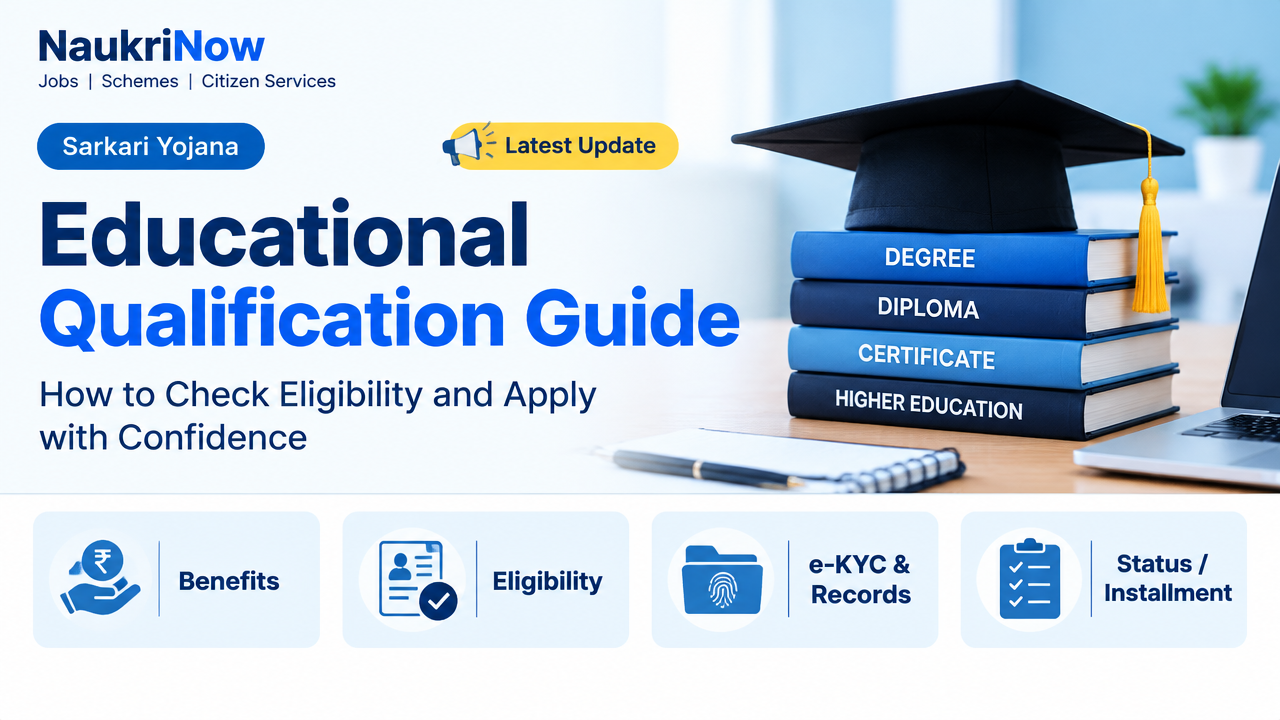
Educational Qualification Guide
Educational eligibility can look straightforward until an application asks for a specific degree, subject combination, percentage, passing date or proof of qualification. A small misunderstanding may lead to an incorrect application, even when you have studied a relevant course.
This guide explains how to read educational requirements for jobs, entrance tests and other selection processes in India. It also covers documents, marks, ongoing courses and common form-filling mistakes. Qualification rules differ between recruiters and institutions, so treat the relevant official notification or prospectus as the final authority. Do not rely on an old advertisement, an informal summary or another applicant’s interpretation.
Educational Qualification Guide: What does educational qualification mean?
An educational qualification is the formal level of study or credential that an applicant must have completed—or, in some cases, be pursuing—by a stated date. It may refer to a school-leaving certificate, diploma, undergraduate degree, postgraduate degree, professional qualification or a particular subject studied at one of these levels.
A notice may set out more than one condition. For example, it can require a degree in a named subject, a minimum level of marks, a qualification from a recognised institution, or completion by a specified cut-off date. Related conditions such as work experience, registration with a professional body, age and language ability are separate eligibility requirements. Meeting the education requirement alone does not automatically make an applicant eligible overall.
How to read an eligibility requirement
Read the full eligibility section before deciding whether to apply. Focus on the exact words used, rather than assuming that a similar-sounding course or a higher qualification will be accepted.
- Identify the essential qualification. Note the exact level, degree title, subject or combination of subjects. Check whether the notice asks for a specific credential or uses broader wording such as a degree in a relevant discipline.
- Check the completion date. Look for the date by which the course must be completed, results declared or certificate obtained. If your results are pending, do not assume that appearing for the final examination is enough. The notice must allow your situation, and its wording should be checked carefully.
- Read any marks requirement. Confirm whether the condition refers to a percentage, a grade, a class or another measure. Note whether it applies to the full course, a particular year, a particular subject or a qualifying examination.
- Check recognition and equivalence wording. The notice may specify the types of institutions or qualifications it accepts. If you studied through a different board, university, mode or qualification system, check the responsible authority’s official guidance or seek clarification from the recruiting body.
- Review additional conditions. Some roles or courses include a subject prerequisite, practical component, professional registration or a requirement to produce original documents at a later stage. Read these alongside the educational requirement.
- Confirm the applicable version. Use the current official advertisement, information bulletin or prospectus for that recruitment or admission cycle. If a correction or addendum is published, read it too.
Qualification wording: what to watch for
Small differences in wording can matter. “Degree in a specified subject” may not mean the same thing as “any degree with the specified subject studied as one paper.” Likewise, a diploma and a degree are not automatically interchangeable, even if their subject areas are similar. Check the exact wording and any definition or list of accepted qualifications included in the official notice.
Do not assume that a higher qualification will always replace a named lower one. A recruiter or institution may require a particular subject or credential because it is relevant to the role or course. If the notice does not clearly say that an equivalent or higher qualification is acceptable, use the official contact or clarification process, where available, before applying.
For a qualification obtained outside India, or through a mode or institution whose status is unclear, check the relevant official recognition or equivalence guidance. Recognition depends on the applicable rules and purpose; a statement made by a college, agent or discussion forum may not settle whether a qualification meets a particular recruitment requirement.
Percentage, CGPA and grade calculations
Enter marks in the format requested by the form. If the application asks for a percentage, use the method prescribed by the board, university or official notification. If it asks for CGPA or a grade, do not convert it unless instructions require conversion.
- Use the conversion formula officially issued by your board or university. Do not assume that multiplying a CGPA by a familiar number is valid for every institution.
- Check whether the form asks for aggregate marks across all semesters, marks in core subjects, final-year marks or another specific figure.
- Use the denominator and rounding method stated in the instructions. If no method is stated and your transcript does not give a percentage, seek clarification from the responsible authority rather than inventing a calculation.
- Keep a copy of the marksheets, transcript and any official conversion certificate or grading explanation available for verification.
If a form’s categories do not match the way your institution reports results, do not choose an option simply because it seems closest. Review the instructions and contact the recruiting body or institution through its official channel if the correct entry remains unclear.
Documents to prepare before applying
Requirements differ, but it is useful to organise your records before opening an application form. Check the notice for the exact documents and formats requested; not every process accepts the same evidence.
- School or board certificates and marksheets relevant to the stated eligibility.
- Semester-wise marksheets, a consolidated transcript or a provisional certificate for a completed degree, as applicable.
- The final degree or diploma certificate, if issued and requested.
- An official marks-conversion or grading document if the institution provides one and the application requires a conversion.
- Evidence of a name change or a clarification of a name difference, if your documents do not match.
- Official recognition, equivalence or registration evidence when the notice specifically asks for it.
Keep clear scans or photographs only in the size and format specified by the application portal. Retain the original records safely; uploading a document does not mean that originals will never be required. Do not assume that a digital copy or an online document service is accepted unless the current instructions say so.
Filling the educational details section accurately
- Enter details from the records. Use the qualification title, board or university, subject and completion year shown on your documents. Avoid shortening a course name in a way that changes its meaning.
- Match the requested level. If the form asks for the highest qualification, report the highest one you have completed by the relevant date. If it asks about all qualifications, include each one requested.
- Represent your status honestly. Distinguish between completed, awaiting results, currently enrolled and discontinued studies. Select an option only if it accurately describes your position and is allowed by the instructions.
- Check dates and marks twice. Compare the entries with your marksheets and certificates. A result declaration date, course completion date and certificate issue date can be different, so use the date the form asks for.
- Review before submission. Confirm that uploaded files are legible, the correct document is attached to each field and the final preview matches your records. Save the acknowledgement or submitted application for your files.
Practical examples
Example 1: Results are pending. An applicant has taken the final examination but has not received the result. The notice requires the qualification to be completed by a stated cut-off date. The applicant should check whether completion means the examination was taken, results were declared or the qualification was formally awarded. They should not mark the course as completed unless the instructions and their records support that entry.
Example 2: The transcript gives CGPA only. A form requests a percentage, but the university transcript reports CGPA. The applicant checks the university’s official conversion method and follows it if applicable. If no method is available or the form’s instructions are unclear, the applicant seeks guidance from the recruiting body instead of using an unofficial online calculator.
Example 3: The degree title is similar but not identical. A notice names a particular subject, while the applicant’s certificate uses a different course title. The applicant compares the course details with the notice and checks for an official accepted-equivalence list or clarification. Similar names alone are not proof that the qualification will be accepted.
Example 4: A higher qualification is held. An applicant has a postgraduate degree but the eligibility section specifies an undergraduate credential in a particular subject. They check whether the stated subject and underlying degree requirement are still met. They do not assume that the postgraduate degree automatically substitutes for the named qualification.
Common mistakes to avoid
- Relying on unofficial summaries. A coaching site, social post or older notice may leave out a condition or describe a previous cycle. Verify details in the current official source.
- Guessing about equivalence. Similar course content, duration or titles do not automatically establish formal equivalence.
- Using the wrong marks formula. A conversion rule from another university may not apply to your transcript.
- Confusing examination appearance with completion. Check what the notice means by having obtained or completed a qualification by the cut-off date.
- Entering an expected result as a final result. Report your status as it stands on the application date and follow the permitted options.
- Overlooking supporting evidence. An accurate entry may still need a marksheet, certificate or other document at verification.
- Waiting until the last moment to resolve a mismatch. Seek clarification through an official channel early, and keep a record of any response.
- Assuming a portal accepted an entry, so eligibility is confirmed. Online submission is not necessarily a final assessment of whether you meet every condition.
Where to verify current requirements
For a job, use the official recruitment advertisement, the recruiting department’s website and any official corrigendum or clarification. For an entrance test or admission, check the official information bulletin and the institution or examination authority responsible for that process. For details about a certificate, transcript, grading scale or course title, contact the issuing board, university or institution. For recognition or equivalence questions, consult the official authority responsible for that decision.
When asking for clarification, quote the exact requirement and describe your qualification precisely. Include the course title, awarding institution, completion status and the relevant document details, but avoid sending sensitive personal information unless the official process asks for it. If a reply is important to your application, save the response.
Frequently Asked Questions
Can I apply if I am in the final year of my course?
Only if the current notice permits applicants in that position and you can satisfy its completion and document conditions by the required date. Check the precise wording; appearing for a final examination may not be treated as completing the qualification.
Will a higher qualification automatically meet a lower qualification requirement?
Not necessarily. The requirement may specify a subject, course or credential that your higher qualification does not replace. Check the official notice for an equivalence provision or obtain clarification from the responsible body.
How should I enter CGPA when a form asks for percentage?
Follow the conversion method prescribed by your institution or the application instructions. Do not use a general formula unless it is officially applicable to your qualification. Ask the responsible authority if the correct method is not clear.
What if my name is spelt differently on a certificate and an identity document?
Check the application’s instructions for name mismatches and acceptable supporting evidence. Gather the relevant official documents before applying and contact the recruiting body or institution if the instructions do not explain your situation.
Does submitting an application prove that my qualification has been accepted?
No. A portal may allow submission without checking every eligibility detail. The recruiting body or institution can verify your documents later, so keep evidence that supports each entry.
Where can I check whether my qualification is recognised?
Start with the official notice and the authority responsible for the qualification or recognition decision. The issuing institution can explain its own certificate and grading system, but the recruiting body or admission authority decides whether that credential meets its stated requirement.
What should I do if the official notice is unclear?
Contact the responsible body through its official website or published communication channel, quoting the relevant clause and your specific qualification details. Avoid relying on assumptions or unofficial advice when the answer could affect eligibility.
Conclusion
Checking educational eligibility is more than matching a degree name to a line in an advertisement. Read the full requirement, verify dates and marks, use official conversion or equivalence guidance, and make sure your documents support every detail you enter. When the wording is uncertain, ask the recruiting body or institution responsible for the decision. A careful check before applying can help you avoid preventable errors and present your qualifications clearly.

Comments