Table of ContentsClick to view all sections
- What does the RRB exam pattern include?
- How the pattern can differ by recruitment category
- Subjects you may see in an RRB CBT
- How to read an official notification without missing a rule
- Turning the pattern into a preparation plan
- Scoring, negative marking and normalisation
- Mistakes to avoid
- Conclusion
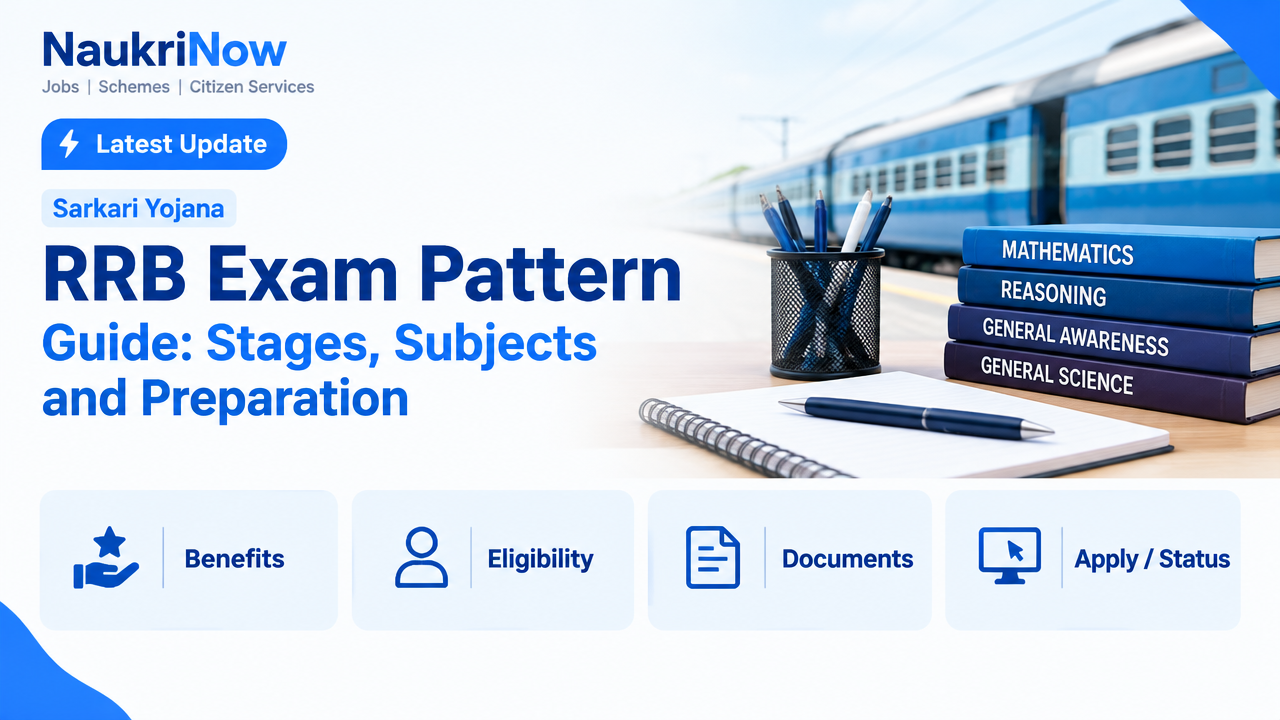
RRB Exam Pattern Guide: Stages, Subjects and Preparation
Railway Recruitment Board (RRB) exams do not follow one common pattern. The stages, subjects, test format and selection rules depend on the post and recruitment cycle. A test for a technical role, for example, may assess specialised knowledge, while another post may include a skill or physical test after the computer-based exam.
This guide explains how to read an RRB exam pattern, what stages you may encounter and how to turn the information into a practical study plan. Treat the examples as broad guides, not as a substitute for the notification. For the pattern that applies to you, check the detailed notification and any corrigenda on the official RRB website responsible for that recruitment.
What does the RRB exam pattern include?
An exam pattern is more than a list of subjects. It describes how candidates are assessed and how performance at each stage affects selection. When reviewing a notification, look for these details:
- Stages of selection: The number and order of computer-based tests (CBTs), skill or aptitude tests, physical tests, document verification and medical examination.
- Subjects or test sections: The areas tested at each stage, including any post-specific technical section.
- Question format: Whether questions are objective, practical, aptitude-based or assessed through a skill test.
- Time and marks: The duration, number of questions or marks, and any section-wise rules stated for that stage.
- Scoring rules: Whether incorrect answers attract a penalty, how qualifying standards work and how scores are considered across shifts.
- Eligibility checks: Any post-specific requirements that are assessed through documents, physical standards or medical fitness.
Do not assume that two RRB exams use the same rules just because they share subjects such as mathematics or general awareness. The notification for the particular post is the controlling document.
How the pattern can differ by recruitment category
The following overview shows the kinds of stages commonly associated with different railway recruitment categories. It is deliberately broad: the exact sequence and rules can change between notifications and posts within a category.
| Recruitment category | What the selection process may assess | What to check closely |
|---|---|---|
| NTPC posts | General CBT subjects, followed for some posts by a computer-based aptitude or typing skill test. | Whether the skill test applies to your post, whether it is qualifying or contributes to selection, and the applicable test rules. |
| Level 1 posts | A CBT followed by a physical efficiency test where prescribed, then document and medical checks. | Physical test requirements, exemptions if any, and the sequence used for the specific recruitment. |
| Assistant Loco Pilot (ALP) | More than one CBT may be used, with technical or trade-related assessment and an aptitude test for applicable candidates. | The content and role of each test stage, trade requirements and how marks from stages are treated. |
| Junior Engineer and other technical posts | General subjects may be combined with a substantial technical section related to the post or discipline. | The discipline-specific syllabus, technical question distribution and any later selection requirements. |
| Technician posts | Assessment may include general sections and questions connected to the relevant technical or trade qualification. | The post-specific syllabus and whether different posts under the same notice have different requirements. |
This comparison is a starting point, not an official promise about a particular recruitment. Even familiar post names can cover different levels, disciplines or selection arrangements. Match your post code and category to the detailed notice before choosing study material.
Subjects you may see in an RRB CBT
Many RRB computer-based tests draw on a mix of general and role-related subjects. The balance varies, so use the syllabus for your exact post rather than preparing every possible topic equally.
Mathematics
Questions may test calculation, number sense and the ability to solve problems accurately under time pressure. Depending on the syllabus, areas can include arithmetic, percentages, ratio and proportion, averages, time and work, speed and distance, basic algebra, geometry or data interpretation. Build accuracy first, then practise using timed sets. A calculator-free approach is useful for many objective tests, but follow the instructions given for the actual exam.
Reasoning and general intelligence
This section may assess patterns, relationships and logical steps through topics such as series, classification, analogy, coding, directions, arrangements, syllogisms or other reasoning formats. Learn the underlying method for each question type. Memorising isolated tricks is less dependable when a question is framed in a new way.
General awareness and current affairs
General awareness can cover a range of facts and concepts, while current-affairs coverage changes over time. Keep a steady revision routine rather than relying on a last-minute list. For railway-related facts or any topic named in the syllabus, use reliable reference material and verify information that may have changed. The notification’s syllabus, not a coaching checklist, sets the scope.
General science
Where included, questions are often based on foundational science concepts. Revise the level and subject areas specified in the official syllabus. Focus on understanding common principles and reading questions carefully; broad, unfocused study can take time away from higher-priority topics.
Technical or trade knowledge
Technical posts can require preparation in the relevant engineering discipline, trade or qualification area. The syllabus may be tied closely to the post, so a general railway exam book may not be enough. Organise revision around the official topic list, revisit core concepts and solve questions that match the required level. Do not assume that all technical posts share one paper.
How to read an official notification without missing a rule
- Confirm the recruitment and post. Check the notification identifier, post name, post code and discipline. Make sure you are not reading a notice for a different railway recruitment.
- Find the selection procedure. Note every stage in order. Mark which stages are tests and which are checks such as document verification or medical examination.
- Read the detailed exam scheme. Record the subjects, question or marks structure, duration and any section-specific condition exactly as stated.
- Check the marking and qualifying rules. Look for negative marking, minimum qualifying standards, qualifying-only tests and score-weighting rules. Never infer these from an older exam.
- Read the syllabus for your post. Technical and skill requirements can differ even within one recruitment notice. Use the relevant post or discipline entry.
- Check amendments and candidate instructions. Later corrigenda or official exam instructions may clarify or revise details. Recheck the relevant RRB website as the recruitment progresses.
- Keep a copy of the source. Save the official notice and note the section or page where the pattern appears. This makes it easier to verify details during revision.
For current recruitment-specific facts, use the official RRB website named for the recruitment and the detailed notification published there. If a summary on another site conflicts with the notification or a later corrigendum, rely on the official document.
Turning the pattern into a preparation plan
A useful plan follows the exam’s structure rather than a generic timetable. Start by making a one-page exam map with each stage, its subjects and its role in selection. Then use these steps:
- Separate stages. Make distinct study plans for the CBT, technical paper, aptitude or skill test, and physical test where applicable. A strong CBT score does not automatically prepare you for a practical or physical assessment.
- Prioritise by syllabus and confidence. List each topic as strong, developing or unfamiliar. Give regular practice to high-priority weak areas without abandoning topics you already know.
- Practise the question format. Use topic exercises first, then mixed timed sets. Practise reading options carefully and deciding when to move on from a difficult question.
- Use mocks as diagnosis. After a mock test, review incorrect answers, guesses and questions that took too long. Track the reason for each error: concept gap, calculation, misreading or time management.
- Revise on a schedule. Short, repeated revision sessions help retain formulas, facts and technical concepts. Keep a compact error log so the same mistake does not recur.
- Prepare for later stages early enough. If your post requires typing, aptitude, physical performance or another skill, check its rules and build practice into your routine instead of waiting until the CBT is over.
For example, a candidate preparing for a technical post might use a weekly plan that combines general reasoning practice with regular discipline-specific revision. Someone applying for a post with a typing test should also schedule short, consistent typing sessions and check the official test instructions. These are planning examples only; the applicable syllabus and assessment rules must come from the notification.
Scoring, negative marking and normalisation
Scoring rules can affect how you approach a paper, but they should never be guessed. Some notifications specify a penalty for incorrect answers; the amount and conditions must be checked for the particular test. If negative marking applies, random guessing can reduce a score. If it does not, leaving answerable questions blank may also be unhelpful. Practise using the rule stated for your exam.
When candidates take an exam in multiple shifts, the recruitment may describe a score normalisation process. Normalisation is intended to account for differences between test sessions under the method stated by the recruiting authority. Do not apply your own formula or compare raw scores across shifts as though they are automatically equivalent. Read the notification’s explanation of score calculation and how scores are used at each stage.
Also distinguish a qualifying test from a test whose marks contribute to merit. A stage may need to be passed without its marks being added to the final score, while another stage may influence ranking. The notification should explain this distinction for the recruitment.
Mistakes to avoid
- Using an old pattern as if it were current. Previous papers are useful for practice, but the latest notification decides the present structure.
- Preparing from a broad category label alone. A post code or discipline can change the syllabus and later tests. Check your own entry in the notice.
- Ignoring skill and physical stages. A written-test plan may leave too little time for a required typing, aptitude or physical assessment.
- Assuming every stage carries marks. Some tests may be qualifying, while other scores may determine merit. Verify the rule before deciding where to focus.
- Overlooking negative marking or section rules. Small details can affect test strategy. Confirm the rules and practise accordingly.
- Trusting unofficial updates without verification. Use coaching material for practice if helpful, but confirm changing details on the responsible official RRB website.
Frequently Asked Questions
1. Is there one common pattern for all RRB exams?
No. The pattern depends on the recruitment, post and sometimes the discipline. Different exams can have different CBT stages, syllabuses and skill or physical requirements.
2. Are all RRB exams computer-based?
Many recruitment processes use a computer-based test, but later stages may involve aptitude, typing, physical performance, document checks or medical examination. Confirm the full selection procedure in the relevant notification.
3. Do all posts have the same subjects?
No. Some subjects may appear across several exams, but the number of sections and the inclusion of technical or trade knowledge vary. Follow the syllabus for your specific post.
4. Is there negative marking in every RRB exam?
Do not assume that there is—or that there is not. The applicable notification states the marking rules for the exam. Check it before deciding how to handle uncertain questions.
5. What is the difference between a qualifying test and a merit test?
A qualifying test generally requires you to meet a stated standard, while a merit test can contribute to ranking or selection. A stage’s role is recruitment-specific, so check how the notification treats its score.
6. Where can I verify the latest RRB exam pattern?
Use the official RRB website responsible for the recruitment. Read the detailed notification and any subsequent corrigenda or official instructions, rather than relying only on an old paper or a third-party summary.
7. Are previous-year papers still useful if the pattern changes?
Yes, they can help you practise question styles and identify topic areas, but they may not reflect the current stages, syllabus or scoring rules. Use them alongside the latest official pattern.
Conclusion
The most reliable way to understand the RRB exam pattern is to start with your exact post and work through the official selection procedure, syllabus and marking rules. Use broad exam guides to understand the possibilities, then verify every recruitment-specific detail against the latest notification and corrigenda on the responsible RRB website. Once the stages are clear, build a focused plan that covers both the CBT and any later skill, aptitude or physical assessment. That approach keeps preparation practical and avoids surprises on exam day.




Comments