Table of ContentsClick to view all sections
- UPSC Geo-Scientist Final Result 2026: What the available result listing does—and does not—confirm
- Why an index entry is not the same as an official result notice
- How to verify the UPSC Geo-Scientist result status
- How to check a result document without misreading it
- What the supplied details do not establish
- What to do after checking your result
- Records to keep accessible
- Common mistakes to avoid
- Understanding corrections and later updates
- Final takeaway
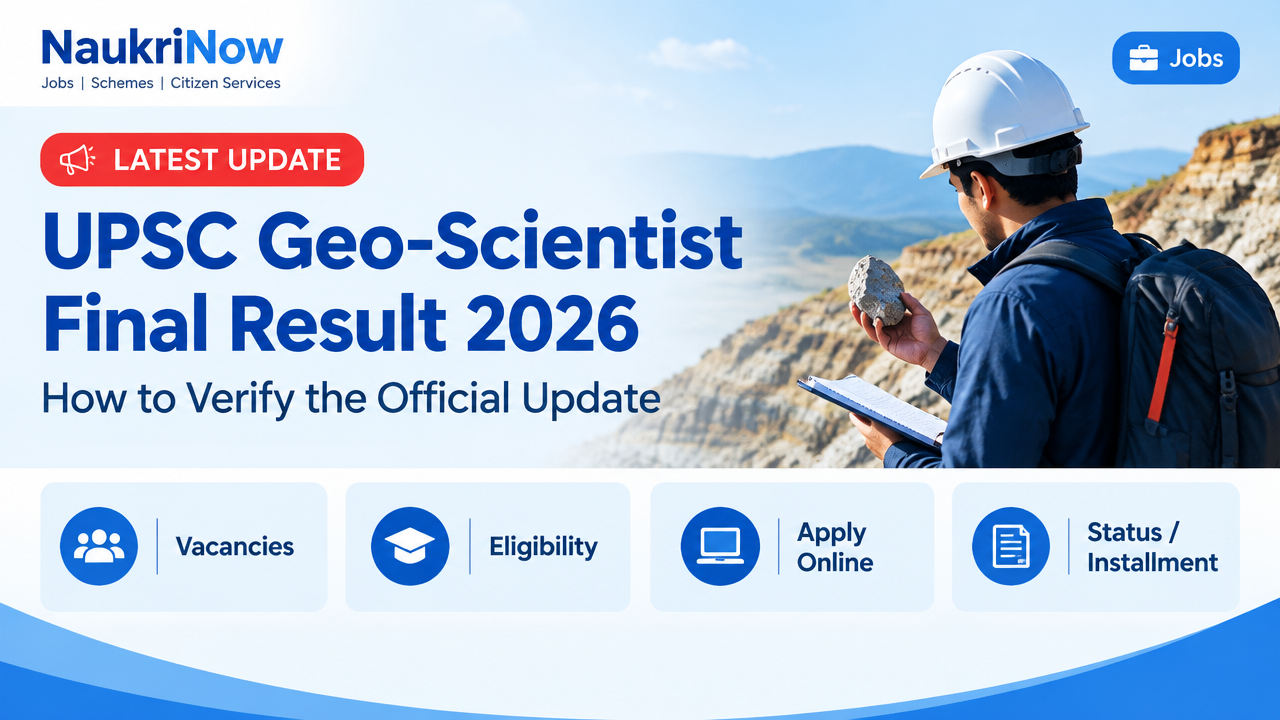
The UPSC Geo-Scientist Final Result 2026 appears by name in a result listing dated 16 October 2026. That date is shown as the webpage’s post date; the available information does not establish it as the result’s release date. The supplied listing details also do not include an official result notice, a result PDF, a candidate list or instructions for any next step. Candidates should confirm any result update through the Union Public Service Commission (UPSC) before treating it as declared or relying on a selection claim.
This guide separates the limited information visible in the listing from details that remain unconfirmed. It also explains how to look for an official notice, check a result document carefully if one is published, and avoid acting on incomplete or unofficial material. Nothing here establishes that UPSC has declared the result.
UPSC Geo-Scientist Final Result 2026: What the available result listing does—and does not—confirm
The reference page is a general results index. It includes an entry titled “UPSC Geo-Scientist Final Result 2026,” but the entry details provided here do not include the underlying UPSC notice or result file. A headline in an index can help a reader identify a topic to investigate; it is not, by itself, proof that the Commission has issued a result.
The distinction matters because a listing’s title and webpage date can be mistaken for an official announcement. The supplied date, 16 October 2026 at 10:11 PM, is the index page’s post date. No available information confirms that UPSC declared the result on that date. Likewise, the entry does not establish who qualified, whether a PDF exists, or what candidates should do next.
| Item | What the supplied information says |
|---|---|
| Result entry | The general listing includes the title “UPSC Geo-Scientist Final Result 2026”. |
| Webpage date | 16 October 2026, 10:11 PM, shown as the index page’s post date—not a verified result declaration date. |
| Official notice or result PDF | Not provided in the supplied listing details. |
| Candidate names or roll numbers | Not stated in the available information. |
| Marks, cutoff or discipline-wise information | Not specified in the available information. |
| Follow-up, appointment or joining instructions | Not included in the supplied listing details. |
Why an index entry is not the same as an official result notice
A results index may collect links or headlines for many examinations. Its purpose and reliability are not the same as an examination-specific notice issued by the relevant authority. Without an official document or a verifiable link to one, the index entry cannot answer basic questions such as whether the result has been published, which examination stage it concerns, or whether a candidate list has been released.
This is especially important when an entry uses a date or a confident-sounding title. A post date tells readers when a webpage entry is dated; it does not automatically tell them when an authority made an announcement. A title can also appear before a link or document is available, or remain visible after information has changed. The supplied details do not tell us whether any such update occurred here, so candidates should avoid guessing.
For the same reason, do not treat search snippets, reposted images or messages in a group as substitutes for the complete official notice. They may omit context, show an earlier version or refer to a different examination or result stage. Use them, at most, as prompts to check the source—not as confirmation of a result or a selection claim.
How to verify the UPSC Geo-Scientist result status
To verify the UPSC Geo-Scientist Final Result 2026, navigate to UPSC’s official website and look for its examination-results area. Menu names and page layouts can change, so follow the current site navigation rather than relying on an old set of menu instructions. Search for a notice that clearly matches the Combined Geo-Scientist examination, the relevant year and the final-result stage.
- Open the official source. Enter UPSC’s website address yourself or use a bookmark you trust. Be cautious with sponsored search results and look-alike websites.
- Find the results area. Use the site’s current navigation or search function to locate examination results.
- Match the notice details. Read the title and check that the examination name, year and result stage are the ones you are looking for.
- Open the complete item. Follow the official link to the notice or result document. Do not rely only on a headline or a search preview.
- Check the document itself. Read its heading, date and any explanatory text or instructions. Confirm that it relates to the examination and stage in question.
- Save the official version. If a relevant notice is available, keep a copy for reference and note any directions or dates stated in it.
If you cannot find a matching notice on UPSC’s site, do not treat the index entry alone as confirmation. It may simply be that you have not located the right page, or that no matching official document is available to you at that time. The supplied information does not resolve that question. Check the official site again when appropriate and rely on the latest relevant notice, if one is published.
How to check a result document without misreading it
If UPSC publishes a result document, first establish that it is the correct document before searching within it. A PDF’s filename or a result-related headline is not enough to confirm its contents. Read the document heading and surrounding text, and make sure the examination and stage match what you intend to check. If the notice points to annexures or separate lists, review the relevant parts rather than assuming that one page contains every detail.
For a list in PDF format, the search function can help locate a roll number or name. Treat that search as a convenience, not as the final check: compare the full entry with your own records and inspect the nearby text. Search tools may not find text in every document, and a partial match can produce a misleading result. If a number or name appears similar but not identical, do not infer that it is yours.
If the document is difficult to read, appears incomplete or does not open correctly, return to the official page and try the source link again. Avoid relying on a cropped screenshot or a copy shared without its original context. Keep the full document so you can refer to the notice, any explanatory language and the complete list together.
What the supplied details do not establish
The available index entry does not provide enough information to report candidate-level or recruitment details. In particular, it does not state a list of qualified candidates, marks, cutoff scores, discipline-wise outcomes, vacancies, pay, eligibility, application fees or appointment instructions. Those items should not be inferred from the word “final” in a listing title.
Some of these subjects may be covered in a separate recruitment notification or later official communication, but no such document is provided in the information available for this article. A result listing is not evidence of a particular vacancy count, salary, eligibility condition or document requirement. Check the relevant official notice for each question instead of using details from another year or a different recruitment.
Similarly, this article cannot confirm that a result PDF exists or provide a direct download link. If an official document is published, it should be located and checked through UPSC’s own website. If no matching official document can be found, there is no basis in the supplied listing details to report names, marks or a declaration date.
What to do after checking your result
First establish whether there is an official result document and whether it matches the examination and stage you intended to check. Then follow only the instructions in the relevant official notice. The supplied listing describes no post-result verification, appointment, joining process or deadline, so candidates should not assume that a particular action is required.
- If your roll number appears in an official document: check the full number and the document heading, then read the complete notice for any stated follow-up directions. Do not rely on the list entry alone to infer what happens next.
- If you are unsure whether an entry matches you: compare the complete roll number or name as shown with your own records. A partial match is not sufficient to establish identity.
- If you do not find your number: check that you opened the correct examination and result-stage document, and search the complete document carefully. Look for an official update or separate notice before drawing a conclusion.
- If no matching official notice is available: do not treat an aggregator headline as proof of selection or non-selection. Continue to use the official source for confirmation.
- If the notice gives a deadline or other direction: record it accurately and follow the notice as written. Do not substitute an unofficial summary for the official wording.
Records to keep accessible
The supplied listing does not include a document checklist or tell candidates to submit anything. As a practical record-keeping measure, keep relevant examination information accessible. This is not a claim that UPSC requires these materials after the result. Submit or send documents only if an official instruction asks you to do so, and follow the method and timing stated in that instruction.
| Record | How it can help |
|---|---|
| Application or registration details | Can help you identify the examination record you are checking or respond to an official query. |
| Admit card or roll-number information | Can help you compare the complete roll number with an official list. |
| Official result notice or downloaded document | Preserves the version you reviewed and any directions included with it. |
| Relevant supporting certificates | Keep records available in case a later official process specifically requests them; do not assume they must be submitted now. |
Store personal records carefully. Avoid posting application details, identity documents or a full admit card publicly to ask strangers to verify a result. If you need help understanding a notice, use its official contact or guidance channels where available, and share only information that is necessary.
Common mistakes to avoid
- Calling the post date a declaration date. The date shown, 16 October 2026 at 10:11 PM, belongs to the index webpage. The supplied information does not verify it as UPSC’s result date.
- Treating a headline as proof. The index names the result, but does not provide the official notice or result document.
- Checking the wrong year or stage. Confirm the examination name, year and result stage in the official document before searching for your details.
- Relying on a partial match. Compare the complete roll number or name; do not assume that a similar entry belongs to you.
- Using a cropped or reposted file as the authority. Find the full document from the official source so that you can see its context and any accompanying instructions.
- Assuming marks or cutoffs are included. The supplied listing states no marks or cutoff details. Look for an official communication that specifically addresses them.
- Assuming a next step or deadline. No post-result process or deadline is stated in the available listing details.
- Sharing sensitive information unnecessarily. A request from an unofficial account for personal documents does not establish that the request is genuine.
Understanding corrections and later updates
When checking any examination result, use the most recent relevant notice available from the official source and read it in full. If an official update, correction or additional notice appears, compare it with the earlier document and follow the newer instructions where they apply. This is general verification guidance; the supplied listing does not state that a correction or later update has been issued for this result.
Keep the date and source of the document you reviewed so you can distinguish it from an older copy if you check again later. If two versions appear inconsistent, do not choose between them based on a reposted summary. Return to UPSC’s site and look for an official clarification. The available details do not establish which, if any, later communication exists.
Frequently Asked Questions
Has UPSC officially declared the Geo-Scientist final result?
The available listing names the UPSC Geo-Scientist Final Result 2026, but the supplied information does not include an official UPSC notice or result PDF. Confirm the status on UPSC’s official website before treating the result as declared.
Is 16 October 2026 the result declaration date?
No declaration date is verified by the supplied information. 16 October 2026 at 10:11 PM is shown as the general index page’s post date, not as a confirmed UPSC announcement date.
Where should I look for an official result notice?
Use UPSC’s official website and look in its examination-results area for a notice matching the examination name, year and final-result stage. The supplied listing does not provide a direct official result link.
Is a result PDF or direct download link provided here?
No. The listing details supplied for this article do not include a result PDF or a direct UPSC download link. Use UPSC’s website to locate and verify any official document.
Are candidate names or roll numbers available in the listing?
No names or roll numbers are stated in the available information. If an official result document is published, check that document for candidate details.
Are marks or cutoff details available?
The supplied listing details do not include marks or cutoff information. Do not assume they are part of a result list; look for an official notice that specifically provides those details.
What should I do if I cannot find my roll number?
Confirm that you opened the right examination and stage document, then check the complete roll number carefully. If you still cannot find it, look for an official update or separate notice before drawing a conclusion. The index entry alone cannot explain an individual outcome.
What documents should I submit after the result?
No post-result document requirements are stated in the supplied listing. Keep your examination records accessible, but submit documents only when an official UPSC instruction requests them.
Final takeaway
The available index names the UPSC Geo-Scientist Final Result 2026, but it does not provide enough information to confirm an official declaration, result file, selected candidates, marks, cutoff or next-stage requirements. The listed date is a webpage post date, not a verified declaration date. Check UPSC’s official website, confirm that any document matches the examination and stage, and follow only instructions issued through an official notice.


Comments