Table of ContentsClick to view all sections
- Pradhan Mantri Viksit Bharat Rozgar: What Is PM-VBRY?
- PM-VBRY at a glance
- Objectives of PM Viksit Bharat Rozgar Yojana
- Structure of the Scheme: Part A and Part B
- How Part A Works for First-Time Employees
- How Part B Works for Employers
- Eligibility Criteria
- Documents Required
- Step-by-Step Application Process
- Important Points to Remember
- Advantages and Limitations
- Quick Access Links
- Conclusion
The Pradhan Mantri Viksit Bharat Rozgar Yojana (PM-VBRY) is an employment-linked incentive scheme intended to encourage formal hiring and bring first-time workers into the EPFO system. It has two parts: Part A provides an incentive for eligible new employees, while Part B supports EPFO-registered establishments that create additional jobs and meet the scheme’s conditions. This guide explains the stated benefits, eligibility requirements and application steps. Scheme rules, portal instructions and verification requirements can change, so check the official resources before submitting information or making decisions.
Pradhan Mantri Viksit Bharat Rozgar: What Is PM-VBRY?
PM-VBRY is designed to connect employment incentives with formal, EPFO-covered work. It addresses both sides of a new employment relationship: an eligible employee entering EPFO-covered employment for the first time may qualify for a one-time incentive, and a qualifying employer may receive an incentive for eligible additional hires. Payments are not automatic simply because a person starts a job or an establishment hires someone. The employee and employer must each meet the conditions relevant to their part of the scheme.
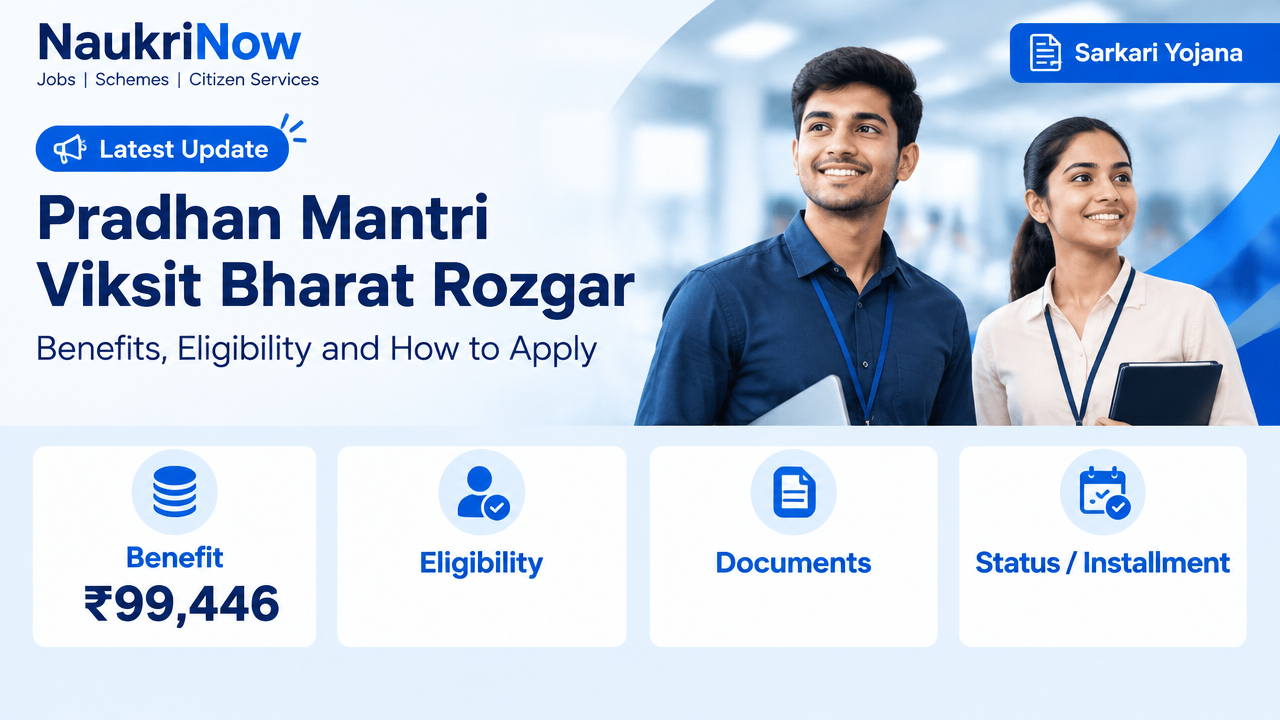
The Union Cabinet approved the scheme on 1 July 2025. It is implemented by the Ministry of Labour & Employment through EPFO, with a stated start date of 1 August 2025. The stated eligible job period runs from 1 August 2025 to 31 July 2027. The scheme’s stated total outlay is ₹99,446 crore, and its stated employment target is more than 3.5 crore jobs. These are scheme-level figures; an individual applicant should use the portal to confirm their own eligibility, claim status and any current deadlines.
PM-VBRY at a glance
| Particular | Details |
|---|---|
| Scheme name | Pradhan Mantri Viksit Bharat Rozgar Yojana (PM-VBRY) |
| Approved by | Union Cabinet, 1 July 2025 |
| Implementing department | Ministry of Labour & Employment, through EPFO |
| Scheme start date | 1 August 2025 |
| Stated period for eligible jobs | 1 August 2025 to 31 July 2027 |
| Scheme structure | Part A for eligible employees; Part B for eligible employers |
| Stated total outlay | ₹99,446 crore |
| Stated employment target | More than 3.5 crore jobs |
The scheme builds on the employment-linked incentive approach proposed in the Union Budget 2024–25. Its stated focus is to promote formal employment, expand social-security coverage and encourage employers to sustain new hiring. Manufacturing establishments may be eligible for an extended incentive period, subject to the scheme’s definition and other conditions. The figures and time periods above describe the stated scheme framework; they do not guarantee a payment to any particular worker or establishment.
Objectives of PM Viksit Bharat Rozgar Yojana
The objectives of Pradhan Mantri Viksit Bharat Rozgar help explain why its employee and employer provisions have different tests. Part A focuses on people entering EPFO-covered employment for the first time. Part B focuses on additional hiring by establishments and continued employment, alongside compliance with EPFO reporting requirements.
- Encourage employers to create additional formal jobs.
- Support eligible people entering EPFO-covered employment for the first time.
- Increase social-security coverage among workers through formal employment.
- Promote sustained hiring, particularly in manufacturing.
- Encourage financial awareness and saving among participating employees.
These objectives do not replace the detailed eligibility rules. For example, an employee still needs to meet the first-time membership test and the stated wage and service conditions. An employer still needs to meet its applicable hiring threshold, retain eligible employees and file ECRs as required.
Structure of the Scheme: Part A and Part B
Part A and Part B are related but separate. An employee should review the employee-specific rules, while an establishment should review the employer-specific rules. A person may need to coordinate with their employer to ensure that employment and payroll information is accurately recorded, but the employee’s incentive and the employer’s incentive remain distinct provisions with different conditions.
Part A vs Part B: Side-by-Side Comparison
| Feature | Part A: Employees | Part B: Employers |
|---|---|---|
| Who it is for | Eligible first-time EPFO employees | EPFO-registered establishments adding eligible employees |
| Stated incentive | One month’s EPF wage, up to ₹15,000 | Up to ₹3,000 per month for each eligible new employee |
| Payment pattern | Two instalments through direct benefit transfer | Monthly, subject to applicable conditions and ECR filing |
| Incentive period | One-time incentive, released in stages | Up to two years in all sectors; up to four years for manufacturing |
| Monthly wage ceiling stated in the scheme details | ₹1,00,000 | ₹1,00,000 for the eligible employee |
| Key condition | Service requirements and financial literacy course for the second instalment | Minimum additional hiring and retention requirements |
The comparison is a summary, not a substitute for the full rules. In particular, “up to” amounts and periods indicate limits rather than guaranteed payments. Verification, service history, hiring levels, retention and filing compliance can affect whether an incentive is payable and for how long.
How Part A Works for First-Time Employees
An eligible first-time employee may receive an incentive equal to one month’s EPF wage, capped at ₹15,000. The incentive is divided into two stages. A first instalment is associated with at least six months of continuous service. The second is associated with at least 12 months of service and completion of the financial literacy programme. The amount and release remain subject to the scheme rules and verification; the source material does not specify a separate fixed amount for each instalment.
| Milestone | Stated condition | Payment detail |
|---|---|---|
| First instalment | At least six months of continuous service | First part of the eligible incentive; no separate fixed amount is specified here |
| Second instalment | At least 12 months of service and completion of the financial literacy programme | Remaining eligible amount, subject to scheme verification |
Payments are described as being made by direct benefit transfer (DBT) to the employee’s Aadhaar-seeded bank account. Scheme information also states that a portion of the incentive is retained in a savings instrument or deposit for a fixed period. The details of that arrangement and the release conditions should be checked in the current official FAQs rather than assumed from a summary.
For an employee, the practical sequence is to confirm first-time EPFO status, check the wage limit and make sure employment information is recorded correctly. The service milestones matter: a person who leaves before the required duration may not meet the stated condition for an instalment. The financial literacy requirement is specifically relevant to the second instalment. Keep track of the portal’s instructions and any status or verification messages, and use official channels to resolve mismatched information.
How Part B Works for Employers
Part B is intended to reward establishments for creating and sustaining additional employment. The stated incentive is up to ₹3,000 per month for each eligible new employee, with a monthly wage ceiling of ₹1,00,000 for the eligible employee. A new hire generally must be retained for at least six months. The establishment must also meet the applicable workforce-addition threshold and continue filing Electronic Challan-cum-Returns (ECRs).
The stated minimum additional hiring requirement is two employees for establishments with fewer than 50 employees and five employees for establishments with 50 or more. Incentives are stated to run for up to two years across sectors and up to four years for manufacturing establishments. These periods are conditional, not automatic. Employers should verify how the thresholds apply to their establishment and confirm whether it meets the manufacturing definition used by the scheme.
The cited manufacturing definition refers to Section 2(72) of the CGST Act, 2017. An establishment should not rely only on its own informal description of its business to decide whether the longer period applies. Check the official scheme guidance for the relevant definition and supporting requirements. In all cases, accurate employee and payroll records, retention and regular ECR filing are important parts of the stated employer conditions.
Eligibility Criteria
Eligibility is different for employees and employers. The following summary sets out the main conditions stated for the scheme, but the official portal and FAQs determine how the conditions are applied in an individual case.
Eligibility for Employees (Part A)
- The employee must meet the scheme’s test for being a first-time EPFO member.
- The employee must join an EPFO-registered establishment during the stated eligible period.
- The monthly gross salary must not exceed the stated ₹1,00,000 ceiling.
- The employee must provide an Aadhaar-seeded bank account for DBT, as required.
- The stated service milestones apply to the instalments: at least six months for the first and at least 12 months, along with the financial literacy programme, for the second.
The precise test for first-time status should be checked against the official scheme FAQs. Do not assume that having no current EPF balance alone is enough. An earlier UAN or EPF contribution may be relevant to the scheme’s assessment, and any record mismatch should be addressed through the official EPFO process rather than by creating duplicate identities.
Eligibility for Employers (Part B)
- The establishment must be registered with EPFO.
- It must meet the stated minimum additional-hiring requirement applicable to its workforce size.
- It must retain eligible new hires for the required period.
- It must file ECRs regularly and meet other applicable compliance conditions.
- Its establishment and bank details must meet the portal’s requirements.
A manufacturing employer may qualify for the longer incentive period if it meets the scheme’s manufacturing definition and all other applicable conditions. The cited definition refers to Section 2(72) of the CGST Act, 2017. Confirm the classification and the applicable process in current official guidance before relying on the four-year period.
Who may not qualify
- An employee whose monthly gross salary is above the stated ₹1,00,000 ceiling.
- A worker who does not meet the scheme’s first-time EPFO membership test.
- An employer that does not meet its applicable additional-hiring or retention conditions.
- An establishment that is not EPFO-registered or does not maintain required compliance and ECR filings.
- An employee who has not completed the financial literacy course may be unable to receive the second Part A instalment.
Documents Required
Prepare the information relevant to your role, then follow the portal’s live instructions. This list reflects details identified in scheme information; it is not a guarantee that every item will be requested in every case. The portal may specify additional information or a different verification step.
For Employees
- Aadhaar details.
- Details of an Aadhaar-seeded bank account for DBT.
- PAN details.
- UAN and employment information.
- Employment or joining information from the EPFO-registered establishment.
First-time workers may be asked to generate a UAN using Face Authentication Technology through the UMANG app. Follow the current instructions from the official portal. Do not share an OTP or banking password with anyone claiming to process an incentive.
For Employers
- Establishment PAN and other tax identifiers requested by the portal.
- GST registration details, where applicable or requested.
- EPFO registration or establishment code.
- PAN-linked bank account details.
- ECR filing information and records for new employees.
Employers should check that establishment information, new-employee records and bank details are consistent with the information submitted through official channels. If a detail is incorrect or out of date, use the official process to correct it. Do not give account access or sensitive credentials to an unverified agent.
Step-by-Step Application Process
For Pradhan Mantri Viksit Bharat Rozgar applicants, the employee and employer processes are different. Use only the official PM-VBRY portals linked below, and follow the current instructions displayed there. Portal screens, document requests and verification requirements can change. A general outline can help applicants prepare, but it does not replace the process shown on the live portal.
Employee process
- Open an official PM-VBRY portal and review the employee eligibility and registration instructions.
- If you are a first-time user, follow the current steps to generate or validate your UAN. Scheme information describes UAN generation through UMANG Face Authentication Technology.
- Complete the required registration and provide the requested Aadhaar, PAN, bank and employment details.
- Check that your bank account is correctly seeded with Aadhaar and continue in eligible employment for the applicable service period.
- Track the six- and 12-month milestones that relate to the instalments.
- Complete the financial literacy programme by the required stage to be considered for the second instalment.
- Monitor portal information for verification or a request to correct details, and use official channels if your records do not match.
Employer process
- Confirm that the establishment is registered with EPFO. If it is not, use the relevant official EPFO registration route before seeking scheme benefits.
- Register on the PM-VBRY portal and submit establishment, tax, bank and other requested details.
- Determine the applicable minimum additional-hiring requirement for the establishment’s workforce size and meet the relevant scheme conditions.
- Retain eligible new hires for the required period and maintain accurate payroll and employment records.
- File ECRs on time and keep the establishment’s information current.
- Monitor the portal for verification, claim status or requests to correct information.
For either applicant type, a successful registration should not be treated as confirmation of a payable incentive. Eligibility and payment remain subject to the applicable conditions and verification. Keep a record of the information submitted and refer to the portal if the status is unclear.
Important Points to Remember
- Bank account details: Check that the employee’s bank account and Aadhaar details are correctly seeded for DBT. Employers should keep their registered establishment bank details current.
- UAN and prior EPF history: A previous UAN or EPF contribution may affect first-time status. Resolve a record mismatch through the official EPFO process rather than creating duplicate identities.
- Service and course milestones: Track the six- and 12-month requirements and complete the financial literacy course before the second-instalment stage indicated by the portal.
- Employer filings: Incomplete or late ECRs, inaccurate joining information or failure to meet the hiring threshold can affect employer incentives.
- Bank detail changes: Update details through the official portal and allow for verification. Do not rely on an unverified agent to change payment information.
- EPFO registration: An employer must complete applicable EPFO registration before claiming under Part B.
- Current instructions: Use official portals and FAQs for live registration steps and eligibility explanations. A general article cannot determine a specific claim outcome.
Advantages and Limitations
The scheme can be useful to eligible employees and employers, but its incentives are conditional. Considering both the potential advantages and the limitations helps applicants avoid treating the stated maximums as guaranteed payments.
| Pros | Cons |
|---|---|
| Part A provides a stated direct incentive for eligible first-time formal workers. | Part A is limited by the wage ceiling, first-time membership rules and service milestones. |
| Part B gives establishments a stated incentive to add eligible jobs and retain new employees. | Part B depends on workforce thresholds, retention and regular ECR compliance. |
| The scheme links incentives with EPFO coverage and formal payroll employment. | It does not apply to every job or every worker; eligibility must be established under scheme rules. |
| Qualifying manufacturing establishments may have a longer stated incentive period. | The longer period depends on meeting the scheme’s manufacturing definition and other conditions. |
| The employee incentive is divided into stages, with conditions stated for each instalment. | The second Part A instalment requires the financial literacy programme; scheme information also states that a portion may be held in a savings instrument or deposit. |
| Official online resources provide routes to review scheme information and registration instructions. | Applicants must follow current portal instructions and provide information that can be verified; registration alone does not establish payment eligibility. |
In practical terms, the scheme’s value depends on whether the worker and establishment can meet the relevant requirements. Employees should pay particular attention to first-time status, wage, service and bank details. Employers should focus on registration, additional hiring, retention and ECR filings. Where a requirement is unclear, checking the official FAQ before applying is preferable to assuming that a summary covers every case.
Frequently Asked Questions (FAQs)
What is the maximum incentive an employee can get under PM-VBRY?
The stated maximum is ₹15,000, equal to one month’s EPF wage. It is paid in two instalments subject to eligibility, verification and the stated service milestones. The first instalment is associated with at least six months of continuous service. The second is associated with at least 12 months of service and completion of the financial literacy programme.
What is the maximum incentive an employer can get under PM-VBRY?
The stated incentive is up to ₹3,000 per month for each eligible new employee. Payment depends on the scheme conditions, including the additional-hiring requirement, retention and ECR compliance. The amount is a stated maximum, not a guaranteed payment for every hire.
Who is considered a “first-time employee” under this scheme?
The scheme is intended for people entering EPFO-covered employment for the first time. The precise test relating to earlier UANs or EPF contributions should be checked in the official FAQs. Do not assume that having no current EPF balance alone is sufficient.
Is there a salary limit to be eligible for PM-VBRY?
The scheme details state a monthly wage ceiling of ₹1,00,000 for eligible employees. Confirm how the applicable wage is calculated in current official guidance, and check the portal for how the limit applies to the particular part of the scheme.
How long does the manufacturing sector get incentives under Part B?
The stated period is up to four years for qualifying manufacturing establishments, compared with up to two years for other sectors. The establishment must meet the scheme definition and all other conditions. The cited manufacturing definition refers to Section 2(72) of the CGST Act, 2017.
What happens if an employee does not complete the financial literacy course?
The course is stated to be a condition for the second instalment. If it is incomplete, the second payment may not be released. Check the official portal for the current course instructions and the stage by which it must be completed.
Can an establishment apply if it is not yet registered with EPFO?
The establishment must be registered with EPFO to claim under Part B. Complete the applicable EPFO registration first, then follow the current PM-VBRY portal process.
How will payments be made to employees?
Part A payments are described as DBT to the employee’s Aadhaar-seeded bank account. Keep bank and identity details accurate, and check the portal or official guidance if a payment is delayed or the details need correction.
When can eligible jobs be created under the scheme?
The stated eligible job period is 1 August 2025 to 31 July 2027. Check the official portal for current registration windows, verification steps and any updated instructions.
Quick Access Links
| Resource | Link |
|---|---|
| PM-VBRY registration portal (EPFO) | pmvbry.epfindia.gov.in |
| PM-VBRY portal (Ministry of Labour & Employment) | pmvbry.labour.gov.in |
| Official scheme FAQs | PM-VBRY FAQs |
| Scheme information on MyScheme | PM-VBRY on MyScheme |
| MyScheme portal | MyScheme |
| Government of India scheme overview | India.gov.in overview |
| EPFO official website | EPFO |
Conclusion
PM-VBRY is intended to support both sides of formal hiring: eligible first-time employees may receive a one-time incentive, while qualifying establishments may receive support for additional jobs. Before acting, verify EPFO history, wage and service conditions, the employer’s hiring threshold, bank details and current portal instructions. The Pradhan Mantri Viksit Bharat Rozgar scheme’s official portals and FAQs are the authority for live registration and claim requirements. Treat stated amounts and periods as conditional scheme limits, and confirm how the rules apply to your circumstances before relying on a potential payment.
Comments