Table of ContentsClick to view all sections
- E Shram Card 3000: What is the e-Shram card?
- Core purpose and unorganised-worker coverage
- What does “₹3,000” represent?
- Key features: what is and is not automatic
- Who can register for e-Shram?
- Pros and Cons of E Shram Card 3000
- What the card can and cannot do
- How to register: official route
- Keep these details ready
- After registration: check details and scheme information
- Avoid payment and registration mistakes
- How to assess a ₹3,000 payment claim
- Conclusion: check the benefit, not just the card
- Official links
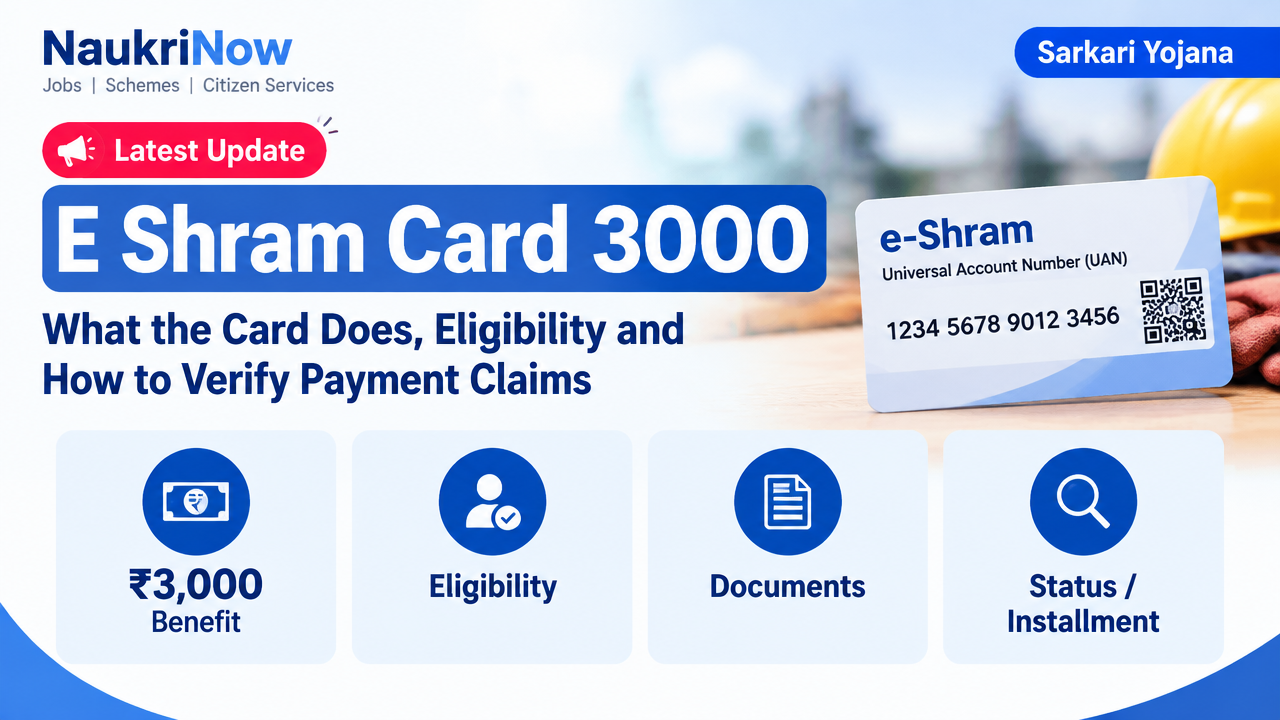
E Shram Card 3000 searches often suggest that registering for an e-Shram card guarantees a ₹3,000 payment or pension. That is not a safe assumption. e-Shram is a worker-registration platform, and registration alone does not establish entitlement to a fixed cash benefit. Check the relevant scheme’s current rules on an official government portal before acting on a payment claim.
This guide explains what the card is, what the figure of ₹3,000 may refer to in online claims, who may be eligible to register, and how to approach registration carefully. It also sets out the card’s practical advantages and limitations. The distinction matters: a worker-registration record and approval for a separate benefit are not the same thing.
E Shram Card 3000: What is the e-Shram card?
e-Shram is the Government of India’s national database for unorganised workers. An eligible worker who registers receives a 12-digit Universal Account Number (UAN) and an e-Shram card. The registration is intended to help create a record of workers and support access to applicable social-security and welfare schemes.
The card should be understood as a registration identifier, not as a pension order, payment sanction, insurance policy, loan approval or guarantee of work. It may help identify a registered worker and make it possible to check details through official services. Whether a person can receive a particular benefit depends on the rules of the programme offering that benefit, as well as the person’s circumstances and any required application or contribution.
| Point | What it means |
|---|---|
| Purpose | Registration of eligible unorganised workers in a national database |
| Card identifier | A 12-digit UAN |
| Payment guarantee | The card alone does not guarantee ₹3,000 or another fixed amount |
| Scheme benefits | Depend on the rules and eligibility of each separate scheme |
| Registration | Use the official e-Shram portal or seek registration assistance through a CSC |
Core purpose and unorganised-worker coverage
The central purpose of e-Shram registration is to create a formal record of eligible unorganised workers. A worker’s occupation and other information requested during registration contribute to that record. In practical terms, the platform provides a way for a registered worker to have a UAN and to view or manage card-related information through official services.
That registration purpose should not be confused with a promise that every worker will receive every welfare programme listed or discussed online. The database and a benefit scheme are different things. A registration record may be relevant when a worker checks available programmes, but the programme itself sets its own eligibility, application, contribution and benefit conditions. Those conditions can differ from one scheme to another and may change over time.
For that reason, it is better to treat the card as a starting point for checking official information rather than as proof of a particular entitlement. If a worker sees an announcement about support for a particular occupation, location or category, they should read the scheme’s own current terms and confirm whether a separate application is needed.
What does “₹3,000” represent?
The figure is commonly associated with pension claims, but it should not be described as an automatic annual payment for every e-Shram cardholder. A separate pension scheme such as Pradhan Mantri Shram Yogi Maandhan (PM-SYM) has its own enrolment conditions and contribution requirements; its pension benefit is conditional on meeting those rules. Holding an e-Shram card does not automatically enrol a worker in PM-SYM.
Some online messages may use the words “₹3,000 scheme” without clearly identifying a scheme, explaining who qualifies, or linking to an official announcement. The amount alone is not enough to establish that a benefit exists for every cardholder. Before relying on such a message, identify the named scheme, read its current official information, check who can apply, and confirm whether the amount is a pension, a one-time payment, recurring assistance or something else. Do not infer those details from a headline or social-media post.
| Claim or scheme | What workers should know |
|---|---|
| “₹3,000 for every e-Shram cardholder” | Do not treat this as a guaranteed e-Shram payment. Verify any current announcement on an official government site. |
| PM-SYM pension claim | This is a separate contributory pension scheme, subject to its own eligibility, enrolment and contribution rules. |
| Other cash assistance | May be available only under a particular central or state scheme and to workers who meet that scheme’s conditions. |
In other words, the phrase E Shram Card 3000 is best treated as a search query about a claim, not as the name of a confirmed universal payment. If an official page does announce an amount, read the full notice: the conditions, duration, application process and responsible department matter as much as the headline figure. For any E Shram Card 3000 claim, identify the named scheme and check its official terms before relying on the quoted amount.
Key features: what is and is not automatic
Some descriptions of a “₹3,000 scheme” imply direct benefit transfer, automatic eligibility, periodic distribution or an absence of charges. Those statements should not be attributed to e-Shram registration unless an official notice for a specific programme supports them. The card itself does not prove that a payment has been approved, identify a payment date or establish that money will be sent automatically to a bank account.
- Direct Benefit Transfer: Do not assume a DBT is due merely because a person has an e-Shram card. Check the named scheme’s official payment terms.
- Automatic eligibility: Registration does not automatically satisfy another scheme’s criteria or complete its application process.
- Periodic distribution: Do not assume that a quoted amount is monthly, annual or recurring without an official explanation.
- Charges: Do not pay a caller or intermediary to “release” a promised payment. For assisted registration, confirm any service charge directly with the CSC before proceeding.
These distinctions help prevent a real registration record from being used to make an unsupported payment promise. A card can confirm that a person registered; the decision on a separate benefit belongs to the scheme that offers it.
Who can register for e-Shram?
The portal’s eligibility rules are the authority. In general, e-Shram registration is intended for eligible unorganised workers, with age and other conditions applying. The commonly stated criteria include being aged 16–59, not being covered by EPFO or ESIC, and not being an income-tax payer. Check the current official FAQ before registering, as your work status and circumstances matter.
| Eligibility check | Practical guidance |
|---|---|
| Work status | You should be an eligible unorganised worker; check the portal’s definition and categories. |
| Age | The commonly stated registration range is 16–59 years; confirm current rules on the portal. |
| Existing coverage | EPFO or ESIC coverage may affect eligibility. Review the official criteria for your situation. |
| Income-tax status | Income-tax payers are generally excluded from e-Shram registration; confirm the current rule. |
| Identity and contact | Keep Aadhaar and a working mobile number available. The portal will show the information or verification required. |
Who may not qualify?
- People who do not meet the portal’s definition of an eligible unorganised worker.
- Applicants outside the permitted age range.
- Workers whose EPFO or ESIC coverage, income-tax status or other circumstances make them ineligible under current rules.
Do not rely on unofficial income limits or claims that every occupation qualifies. An occupation label in a message or video is not a substitute for the portal’s current criteria. If your work situation is unusual, check the official FAQ or ask an authorised registration centre before submitting information. The final eligibility decision should be based on the current rules, not on a general online checklist.
Pros and Cons of E Shram Card 3000
Registration can be useful, but it is important to weigh what it provides against what it does not. The advantages below describe the role of the registration record; they are not promises of additional benefits.
| Pros | Cons |
|---|---|
| Creates a formal registration record and a UAN for an eligible worker. | A record is not approval for a separate pension, cash benefit or insurance programme. |
| Can help a worker identify or check information about relevant welfare programmes. | Each programme has separate conditions and may require its own application or enrolment. |
| Provides official services for viewing or checking card-related details. | Workers may need to use the portal’s current process and resolve errors in their information. |
| May support identification as a registered unorganised worker. | The card does not guarantee a job, loan, health cover, insurance policy or payment. |
| Offers an official route for registration, with CSC assistance available for people who need help. | Applicants should protect personal details and verify any service charge with the centre. |
The main practical advantage is having a registration record that can be used when checking applicable programmes and managing card information. The main limitation is that registration is not itself a benefit decision. A worker who expects a guaranteed ₹3,000 solely because of the card may be disappointed or vulnerable to a scam. A worker who understands the distinction can use the card appropriately and verify each separate opportunity on its own terms.
What the card can and cannot do
| Potential value | Important limitation |
|---|---|
| Creates a formal record and UAN for a registered worker. | Registration is not the same as approval for a separate scheme. |
| Can help workers access information about relevant welfare programmes. | Each programme has its own application, eligibility and benefit rules. |
| Provides a way to check or update worker details through official services. | A card does not guarantee insurance, health cover, a loan or a job. |
| May support identification as an unorganised worker. | Do not assume a benefit amount, payment date or automatic DBT without an official notification. |
These points also explain why an e-Shram card should not be treated as proof that a claim has been approved. If a bank credit, pension or insurance benefit is important to you, look for a scheme-specific record or confirmation through the official service responsible for that benefit. Keep the card and any scheme approval information conceptually separate.
How to register: official route
Use the official portal’s current registration process. If you need help with online access or Aadhaar authentication, a Common Service Centre (CSC) may assist. Follow the portal’s instructions rather than relying on a third-party form or an old step-by-step guide. The live registration form is the best source for what information is required at the time you apply.
| Step | Action |
|---|---|
| 1 | Open the official e-Shram portal and select the registration option. |
| 2 | Review the eligibility information and the privacy or consent notices shown on the portal. |
| 3 | Enter the requested details accurately and complete the identity/mobile verification prompted by the system. |
| 4 | Provide any work, contact or other information requested in the live form. |
| 5 | Check all entries before submission. Correct errors through the official process if the portal allows it. |
| 6 | Save your UAN and download or view your e-Shram card using the official portal services. |
Online self-registration
If you can use the official portal, follow its registration prompts and provide only the information requested in the current form. Read the instructions on screen rather than assuming the fields or sequence are unchanged from a guide written earlier. Use the official domain, check that you have opened the right page, and review your entries before submitting. If the portal asks for identity or mobile verification, complete it within the process you initiated.
Assistance through a Common Service Centre
A CSC may assist workers who need help with online access or the registration process. Before sharing documents or personal information, confirm that you are dealing with an authorised centre. Ask about any service charge before the work begins and distinguish a registration service from a claim that someone can guarantee a separate payment. No intermediary should need your banking password, PIN or an OTP shared over a call to promise a benefit.
Keep these details ready
- Aadhaar details and access to the mobile number needed for the portal’s verification process.
- Accurate personal and contact details.
- Information about your occupation and work, as requested by the registration form.
- Any additional information or documents specifically requested by the official portal or assisted registration centre.
Requirements can change, so do not assume that an old photo specification, bank-account instruction or document list still applies. Use the current form as the checklist. If something is unclear, check the portal’s FAQ or ask the registration centre to explain why it is needed before providing it. Keep your own record of the details submitted and the UAN issued, and use official services if you later need to check the card.
After registration: check details and scheme information
Once registration is complete, retain the UAN and use the official card service to view or download the card as available. Review the displayed information for obvious errors. If you need to change or correct something, use the official process shown on the portal; do not assume an unofficial agent can alter a government record. Accurate contact and work information can make future communication and record checks easier.
When considering a separate benefit, start by identifying the exact scheme name and the government department or official portal responsible for it. Then check eligibility, whether enrolment is separate, whether contributions are required, what benefit is described, and how an application or payment is confirmed. A claim that refers only to “e-Shram ₹3,000” without naming the scheme or explaining its conditions is not enough to establish that you qualify.
Avoid payment and registration mistakes
- Do not pay someone for a promised ₹3,000 credit. A registration receipt or card is not proof of payment approval.
- Use the official domain. Avoid links sent by unknown callers, social-media posts or lookalike websites.
- Never share an OTP, PIN or password. Enter verification codes only in the official process you initiated.
- Check details before submitting. Mistyped identity or contact information can make verification and future updates harder.
- Confirm scheme-specific eligibility. A benefit may require a separate application, subscription or contribution.
- Verify payment messages independently. Check official scheme information and your bank account rather than clicking an unsolicited “release payment” link.
- Be cautious with urgency. A message insisting that you must act immediately, pay a fee or share a code to avoid losing a benefit should be independently verified.
- Keep the card separate from benefit proof. If someone says a card number proves approval, ask for the official scheme-specific confirmation instead.
These precautions apply whether a message arrives by phone, text, social media or in person. Do not use a link just because it displays a government-related name or logo. Navigate to the official portal yourself or use an official contact route to check the notice. If you believe you have encountered fraud or have a registration issue, use the grievance information provided through the official e-Shram portal.
How to assess a ₹3,000 payment claim
- Find the scheme name. A payment claim should identify the programme responsible, not just refer to an e-Shram card.
- Locate an official source. Check the relevant government portal or official announcement rather than relying on a forwarded message.
- Read the conditions. Confirm eligibility, enrolment steps, contributions if any, payment frequency and the meaning of the quoted amount.
- Look for individual confirmation. Do not treat a card or registration number as a payment sanction.
- Protect your information. Do not share OTPs, PINs, passwords or bank credentials to verify a claim.
If any of these details cannot be confirmed, pause before applying through a third-party link or paying an intermediary. The existence of a worker registration platform does not validate every benefit claim that uses its name.
Conclusion: check the benefit, not just the card
The key point behind E Shram Card 3000 searches is that e-Shram registration and a ₹3,000 benefit are not the same thing. The card provides a worker-registration record; any pension, insurance or cash assistance depends on a separate scheme’s current rules and your eligibility. Register or check your details through the official portal, and verify any payment announcement before sharing personal information or paying an agent.
Frequently Asked Questions
Does every e-Shram cardholder receive ₹3,000?
No. The card alone does not guarantee a ₹3,000 payment. Check whether a specific government scheme has announced a benefit and whether you meet its conditions.
Is the ₹3,000 an annual e-Shram payment?
Do not assume that it is. The e-Shram card is a worker-registration ID, not a universal annual cash-payment entitlement. Confirm the amount and payment terms on the official page for the relevant scheme.
Is e-Shram the same as PM-SYM?
No. e-Shram registers eligible unorganised workers in a database. PM-SYM is a separate contributory pension scheme with its own eligibility and enrolment rules.
Does getting an e-Shram card automatically enrol me in a pension scheme?
No. A worker must meet the separate scheme’s rules and complete any required enrolment or contribution steps.
Where should I register for an e-Shram card?
Use the official e-Shram portal. A Common Service Centre may provide assisted registration if needed; verify any service charge with the centre before proceeding.
What should I do if a caller promises a guaranteed payment?
Do not share OTPs, PINs or banking passwords, and do not pay to unlock a claimed benefit. Verify the announcement through official government channels and report concerns through the official grievance service.
Can I use an e-Shram card as proof that a benefit was approved?
No. The card confirms registration details; it does not by itself show that you have been approved for a separate payment, pension, insurance policy or loan.
Where can I check official registration guidance or raise an issue?
Use the e-Shram portal’s FAQ and grievance pages. For a scheme-specific benefit, consult that scheme’s official source as well.
Official links
Use these official e-Shram pages to check current registration guidance, card services and ways to raise an issue. Page content and processes can change, so read the live instructions before taking action.
| Resource | Link |
|---|---|
| e-Shram official portal | https://www.eshram.gov.in/ |
| Registration | https://www.eshram.gov.in/Register |
| Official FAQ | https://www.eshram.gov.in/faq |
| Grievance portal | https://www.eshram.gov.in/grievance |
| e-Shram card service | https://www.eshram.gov.in/mycard |
Comments