Table of ContentsClick to view all sections
- What Is Sukanya Samriddhi Yojana?
- Objectives of the Scheme
- Key Features and Benefits
- Interest Rate History
- SSY 2026: Maturity Calculator
- How Your Money Grows: Illustration
- Eligibility Criteria
- Documents Required
- How to Open an SSY Account
- Withdrawal and Premature Closure Rules
- Common Mistakes to Avoid
- Pros and Cons of Sukanya Samriddhi Yojana
- Conclusion: Is SSY Suitable for Your Family?
- Quick Links
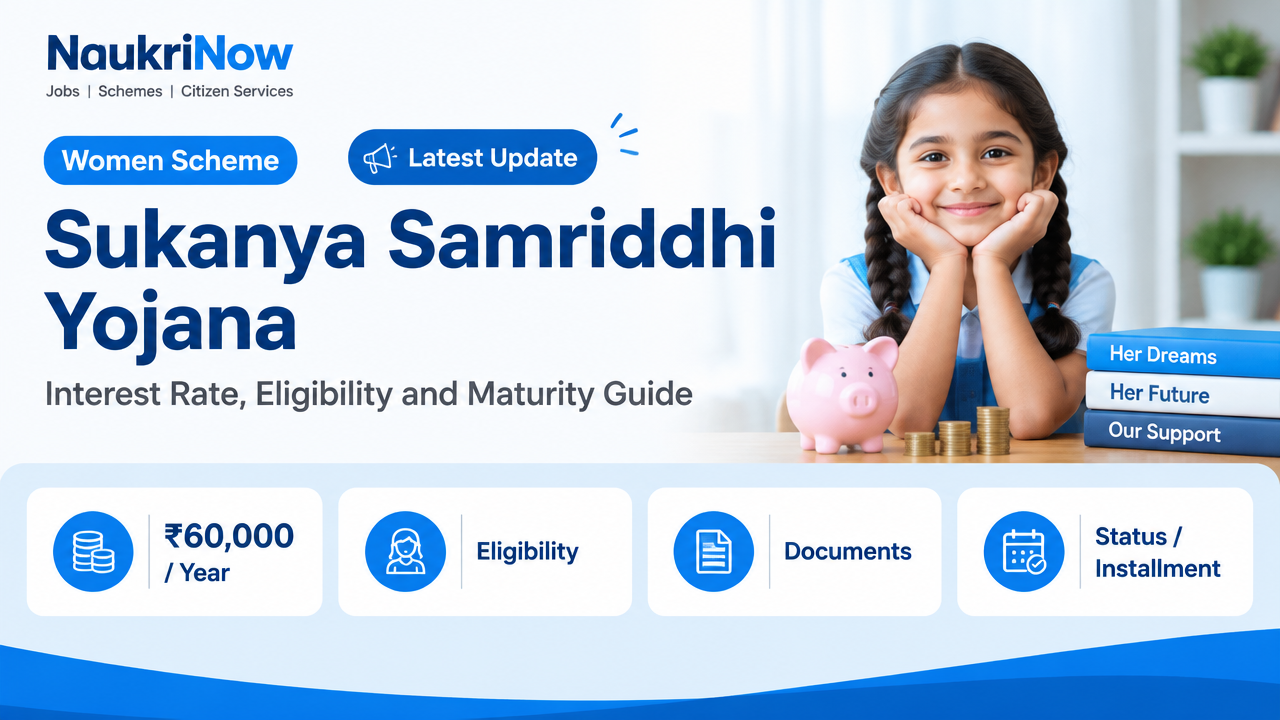
Sukanya Samriddhi Yojana (SSY) is a long-term savings scheme for an eligible girl child. A parent or legal guardian opens and manages the account on her behalf under the scheme rules. This guide covers the scheme’s purpose, eligibility, deposit limits, interest, taxes, account-opening process, maturity estimates and withdrawal conditions. The rate cited here is 8.2% per annum for Q1 and Q2 of FY 2026–27, as stated in the available scheme information. Small-savings rates can be reviewed periodically, so confirm the latest notification before making a decision.
What Is Sukanya Samriddhi Yojana?
Sukanya Samriddhi Account is the formal account name commonly referred to as Sukanya Samriddhi Yojana or SSY. It is a government-backed small-savings scheme introduced on 22 January 2015 under the Beti Bachao, Beti Padhao initiative. A parent or legal guardian opens an account in the name of an eligible girl child. The account is intended for long-term saving, rather than everyday banking or short-term access to money.
Deposits are permitted for the first 15 years from the account-opening date. The account normally matures after 21 years from opening, subject to the scheme rules. This means the contribution period and the full account term are different: the requirement to deposit does not continue for all 21 years, but the account remains in place beyond the 15-year deposit period until maturity. Withdrawals before maturity are limited to specified circumstances.
| Scheme detail | Information |
|---|---|
| Official account name | Sukanya Samriddhi Account, commonly called SSY |
| Introduced | 22 January 2015 |
| Who opens the account | A parent or legal guardian for an eligible girl child |
| Interest rate cited for this guide | 8.2% per annum for Q1 and Q2 of FY 2026–27; confirm the current quarter’s rate |
| Deposit limits | ₹250 minimum and ₹1,50,000 maximum per financial year |
| Deposit period | 15 years from the account-opening date |
| Normal maturity | 21 years from the account-opening date |
| Where to open | Post offices and authorised banks |
Objectives of the Scheme
Sukanya Samriddhi Yojana provides a dedicated way to save for an eligible girl child over a long period. Its structure encourages a family to set aside money regularly or in planned lump sums, while the account’s long term can help align saving with future needs. The scheme is associated with the Beti Bachao, Beti Padhao initiative and is designed specifically around a girl child’s account, rather than being a general-purpose account open to any saver.
For a household considering the scheme, its purpose is as important as its interest rate. The 15-year deposit window and 21-year maturity can make it relevant to long-range goals, but the restricted access also means it should not be treated as an emergency fund. Families should consider whether they can keep money committed for the relevant period and whether the account’s withdrawal conditions fit the goal they have in mind.
Key Features and Benefits
| Feature | What it means for the account holder |
|---|---|
| Interest | The government-notified rate can change over time; interest is compounded annually. |
| Flexible deposits | Deposits can be made in instalments or as a lump sum, subject to the yearly minimum and maximum. |
| Long-term saving | The 15-year contribution period and 21-year maturity encourage saving towards future expenses. |
| Tax treatment | Eligible contributions may qualify for Section 80C relief, subject to the applicable tax regime and overall limit. Interest and eligible maturity proceeds are tax-exempt under the scheme’s stated tax treatment. |
| Government-backed scheme | Returns are not linked to share-market performance, but the notified interest rate is not fixed for the full account term. |
The annual deposit minimum is ₹250 and the maximum is ₹1,50,000 per financial year during the deposit period. A saver may pay in instalments or as a lump sum; the scheme’s yearly limits still apply. The minimum matters because missing it may affect the account’s status, while the maximum matters when planning how much to contribute in a particular financial year.
Interest is compounded annually, but a rate quoted for one period should not be read as a promise for every year of the account. The government reviews small-savings rates periodically. For this reason, a long-term plan should be checked against more than one possible rate rather than relying on a single current-rate projection.
Tax rules depend on the account holder’s circumstances and the tax regime selected. In particular, Section 80C deductions generally apply under the old tax regime, subject to its rules and limits. Interest and eligible maturity proceeds receive tax-exempt treatment under the scheme’s stated tax treatment. Check current income-tax guidance or consult a tax professional before claiming a deduction or deciding how the account fits your tax planning.
Interest Rate History
The table below lists selected rate milestones, not a complete quarter-by-quarter history. It provides context on past rates; it is not a forecast of future rates or a basis for assuming the same return for the full account term. Always verify the rate applicable to the relevant quarter with an official source or the institution holding the account.
| Period or milestone | Annual interest rate |
|---|---|
| FY 2014–15, at launch | 9.1% |
| FY 2015–16 | 9.2% |
| FY 2019–20 | 8.4% |
| FY 2020–21 | 7.6% |
| FY 2021–22 | 7.6% |
| FY 2022–23 | 7.6% |
| From October 2023 | 8.2% |
| FY 2024–25 and FY 2025–26 | 8.2% |
| Q1 and Q2, FY 2026–27, as cited in the available scheme information | 8.2% |
SSY 2026: Maturity Calculator
A Sukanya Samriddhi Yojana (SSY) maturity calculator can help illustrate how a contribution plan might grow, but it cannot guarantee the amount eventually paid. A useful estimate needs to account for the amount deposited, the timing of each deposit, the 15-year contribution period, the six years between the end of that period and normal maturity, and the interest rate assumed. Since the rate can change during the account’s life, an estimate based only on today’s rate is a scenario, not an official maturity quotation.
The figures below are rounded illustrations assuming the same 8.2% rate throughout, annual deposits made at the beginning of each financial year for 15 years, and no further deposits during the remaining six years. The monthly amounts are saving equivalents used to help compare annual contributions; the table’s assumed deposits are annual. Actual returns may differ because the rate and deposit timing may differ.
| Monthly saving equivalent | Annual deposit | Total deposited over 15 years | Illustrative value at 21 years |
|---|---|---|---|
| ₹1,000 | ₹12,000 | ₹1,80,000 | About ₹5.5 lakh |
| ₹5,000 | ₹60,000 | ₹9,00,000 | About ₹27–28 lakh |
| ₹12,500 | ₹1,50,000 | ₹22,50,000 | About ₹69–70 lakh |
To use an estimate responsibly, first choose an annual contribution that fits the household budget and stays within the yearly limits. Then check that the calculator uses the account’s actual opening date or the intended opening date, applies contributions only during the 15-year deposit period, and uses a clearly stated rate assumption. If the tool assumes that the current rate remains unchanged for 21 years, treat its output as an illustration only.
It can also be useful to test more than one rate scenario. That does not predict what the government will notify; it simply shows how sensitive a long-term estimate may be to the assumed rate. Keep the contribution plan, deposit timing and rate assumption visible when saving or sharing a calculation. If any of those inputs change, the estimate changes too.
How Your Money Grows: Illustration
The account’s long period is a central part of how an SSY projection works. Deposits are made during the first 15 years, and the account normally continues until the 21-year maturity point. In the illustrations above, the account receives no additional deposits during the last six years, but the estimate still includes the account’s continued growth under the assumed rate. This is why the total illustrated value is different from the total amount deposited.
For example, the table’s ₹60,000 annual-deposit scenario totals ₹9,00,000 in contributions over 15 years. Its approximate ₹27–28 lakh maturity illustration is not a guaranteed payment or an official quote. It depends on the stated assumptions: a constant 8.2% rate, deposits at the beginning of each financial year, and no deposits in the subsequent six-year period. Changing the rate or contribution timing changes the result.
Use these numbers to understand the relationship between contribution size and a long-term projection, not to decide that a particular maturity amount is certain. Before making a financial commitment, check the rate and account rules in force, and choose a deposit level that can be maintained without relying on the illustrated maturity value.
Eligibility Criteria
| Eligibility point | Rule |
|---|---|
| Age of the girl child | The account must be opened before she turns 10. |
| Account opener | A parent or legal guardian opens it on her behalf. |
| Residence | The girl child must be a resident Indian when the account is opened. Ask the account office how a later change in residence affects the account. |
| Accounts for one girl | Only one SSY account is allowed for a girl child. |
| Accounts in a family | Normally, accounts may be opened for up to two girl children, with limited multiple-birth exceptions under the rules. |
Who cannot open an account under the usual rules?
- A child who has already turned 10 when the account is being opened.
- A person who is not the child’s parent or legally recognised guardian.
- A family seeking a second SSY account for the same girl child.
- A family exceeding the normal account limit without meeting a specified multiple-birth exception.
A grandparent or another relative can act only if legally recognised as the girl child’s guardian under the applicable rules. If your circumstances involve adoption, guardianship or a multiple birth, confirm the relevant conditions with a post office or authorised bank before applying. Do not rely on a general description to decide whether a particular family situation qualifies.
Documents Required
Prepare the documents the account provider asks for so the institution can check the child’s eligibility and the guardian’s identity. The commonly required items listed for opening an account are:
- The girl child’s birth certificate.
- The parent’s or guardian’s identity and address documents required for KYC.
- A completed Sukanya Samriddhi account-opening form, available from the account office.
- An initial deposit of at least ₹250.
- Any additional documents requested by the selected post office or bank for verification.
Document requirements and acceptable KYC proofs can vary by institution. Before visiting, contact the chosen office to confirm which documents it accepts and whether it needs originals for verification. Checking first can help avoid an incomplete application, but the provider remains the source for its current document checklist.
How to Open an SSY Account
| Step | Action |
|---|---|
| 1 | Choose a post office or bank authorised to offer SSY and confirm its current document requirements. |
| 2 | Request the SSY account-opening form and complete it with the girl child’s and guardian’s details. |
| 3 | Submit the form with the birth certificate and required guardian KYC documents. |
| 4 | Make the opening deposit, meeting the minimum amount of ₹250. |
| 5 | Check the account details and obtain the passbook or other account confirmation issued by the institution. |
| 6 | Keep depositing at least ₹250 in each financial year for the 15-year deposit period, without exceeding the annual maximum. |
Before submitting the application, check that the child’s name and date of birth and the guardian’s details are entered correctly. Confirm the account information on the passbook or other confirmation when it is issued. Keep the account record and deposit evidence in a place where the family can find them; these can help when checking contributions or asking the institution about account servicing.
Do not assume the account can be opened completely online. Opening involves document and KYC checks; online availability, if offered by a particular institution, may vary. After opening, some institutions may support online deposits or account servicing. Confirm the current options directly with your account provider.
Withdrawal and Premature Closure Rules
| Situation | What to know |
|---|---|
| Annual deposit | Deposit at least ₹250 and no more than ₹1,50,000 in each financial year during the contribution period. |
| Missed minimum deposit | The account may be treated as in default or discontinued. Ask the account office about the current revival process and applicable penalty before paying. |
| Interest credit | Interest is compounded annually. The applicable rate can change, so check the latest official notification. |
| Partial withdrawal | For qualifying higher-education expenses, up to 50% of the balance at the end of the preceding financial year may be withdrawn, subject to scheme conditions. Eligibility timing and evidence requirements should be confirmed with the account office. |
| Premature closure for marriage | Closure may be permitted when the account holder marries after turning 18, subject to the scheme’s timing and documentary requirements. |
| Other premature closure | Closure is restricted to specified circumstances, including the account holder’s death or certain serious medical or hardship cases. The account office must confirm whether the circumstances qualify. |
| Normal maturity | The account normally matures 21 years after opening. Deposits stop after 15 years, but the account continues as provided under the scheme rules until maturity. |
Higher-education withdrawals are conditional, not an unrestricted right to withdraw any amount at any time. The permitted amount, eligibility timing and evidence requirements are governed by scheme conditions. Similarly, premature closure is limited to specified situations. Contact the institution maintaining the account before making plans around a withdrawal or closure, and ask what documents and timing apply to the specific case.
Do not withdraw money or close an account based only on a general online summary. The permitted amount, qualifying purpose, supporting documents and timing are rule-dependent; get confirmation from the account office. The same applies if the account holder’s residence changes after opening: ask the provider how that change affects the account.
Common Mistakes to Avoid
- Missing the annual minimum: Keep track of the financial-year deposit requirement and set a reminder well before the year ends. Keep proof of each contribution and ask the account office about the revival process if a minimum is missed.
- Planning with a fixed rate: Do not treat the currently quoted interest rate as guaranteed for the full 21-year term. Use estimates as scenarios because the rate may change.
- Relying on a calculator without checking its inputs: Review the assumed interest rate, deposit dates, contribution period and maturity date. A calculator’s output is not an official maturity quotation.
- Confusing the saving equivalent with deposit frequency: A monthly saving amount in an illustration may simply be an equivalent of an annual contribution. Check whether the calculation actually assumes monthly or annual deposits.
- Opening a duplicate account: Check family records and the girl child’s existing accounts before applying, because only one SSY account is allowed for a girl.
- Assuming every relative can open the account: A grandparent or other relative needs to meet the legal-guardian requirement.
- Claiming a tax deduction without checking eligibility: Verify the current tax regime and Section 80C rules before filing. A tax benefit depends on the applicable rules and the taxpayer’s circumstances.
- Assuming access is unrestricted: The scheme is long-term, and partial withdrawals and premature closures have conditions. Consider whether the family can manage without unrestricted access to the funds.
- Using old rate information: Historical rates provide context but do not replace the latest notification. Check the rate that applies to the relevant period.
Pros and Cons of Sukanya Samriddhi Yojana
SSY may be useful for a particular long-term saving goal, but the same rules that encourage long-term saving can limit flexibility. Consider both sides before opening an account.
| Advantages | Limitations |
|---|---|
| Designed specifically for long-term saving for an eligible girl child. | The account must be opened before the girl turns 10, and eligibility rules restrict who can hold an account. |
| Government-backed and not directly exposed to share-market price movements. | The interest rate can be revised; today’s rate is not guaranteed for the full term. |
| The minimum annual deposit is ₹250, while contributions can be made in instalments or as a lump sum within the yearly limits. | The account has a 21-year normal maturity and restricted withdrawals, so it is not suited to short-term needs or unrestricted access. |
| Interest and eligible maturity proceeds receive favourable tax treatment under scheme rules. | The Section 80C deduction depends on current tax rules, the applicable regime and the overall limit. |
| The defined deposit period can help families plan contributions towards a long-range goal. | The family must keep track of the annual minimum during the 15-year deposit period to avoid account-status issues. |
| The account provides a dedicated structure for saving in the girl child’s name. | Only one account is allowed per girl, and family-level limits apply subject to specified exceptions. |
In practical terms, SSY is more likely to suit a family that can commit to a long-term goal and does not need the money to remain freely accessible. It may be less suitable for money that could be needed soon. Compare the account’s lock-in, withdrawal conditions, current rate and tax treatment with your purpose before deciding; no single feature makes the scheme the right choice for every family.
Conclusion: Is SSY Suitable for Your Family?
Sukanya Samriddhi Yojana may suit families seeking a government-backed, long-term savings option for an eligible girl child who will not need unrestricted access to the funds soon. Before opening an account, verify eligibility and the required documents with an authorised provider, check the latest notified interest rate, and decide whether the yearly contribution and long lock-in fit your finances. Treat maturity calculations as estimates, not guarantees, and review the relevant rules before relying on a withdrawal or tax benefit.
Frequently Asked Questions
Q1. What is the current SSY interest rate?
For Sukanya Samriddhi Yojana, the available scheme information cites 8.2% per annum for Q1 and Q2 of FY 2026–27. Rates can be reviewed periodically, so verify the applicable quarter on India Post or with an authorised account provider before acting.
Q2. Can I open an SSY account for a girl older than 10?
Under the usual eligibility rule, the account must be opened before the girl turns 10. Confirm the child’s date of birth and ask the account office if you are unsure how the age rule applies.
Q3. What happens if I do not deposit the minimum amount in a year?
The account may be treated as in default or discontinued. Revival may be possible under the applicable rules, but the required deposit and any penalty should be confirmed with the post office or bank holding the account.
Q4. Can I open an SSY account fully online?
Do not assume so. Opening involves KYC and supporting documents, and online account-opening facilities vary. Ask an authorised bank or post office about its current process; some providers may offer online servicing after the account is opened.
How long do I need to deposit money, and when does the account mature?
Deposits are permitted for 15 years from the account-opening date. Normal maturity is 21 years from opening, subject to the scheme rules and any permitted earlier closure.
Can the account be used for higher-education expenses?
Conditional partial withdrawal is permitted for qualifying higher-education expenses, subject to the scheme’s age, balance, amount and documentation rules. Check the precise conditions with the institution before arranging a withdrawal.
Q5. Is SSY better than PPF?
There is no universal answer. SSY is restricted to an eligible girl child and has its own deposit, maturity and withdrawal rules. Compare the current rates, access to funds, tax treatment and purpose of each scheme before choosing.
Q6. Can grandparents open an SSY account?
Only if the grandparent is legally recognised as the girl child’s guardian under the applicable rules. Otherwise, the account must be opened by a parent or eligible legal guardian.
Quick Links
| Resource | Official link |
|---|---|
| India Post Sukanya Samriddhi Account information | Visit the India Post SSY page |
| India Post official website | Visit India Post |
| National Portal of India | Visit India.gov.in |
Comments