Table of ContentsClick to view all sections
- What to Carry to Exam: Essential Checklist
- Read Your Admit Card and Official Notice First
- Prepare Your Admit Card and Supporting Documents
- Choose the Correct Photo Identification
- Pack Only the Stationery the Exam Permits
- Items to Carry Only If the Instructions Allow Them
- What Not to Pack Without Checking
- Check Special Requirements and Personal Needs
- Make a Practical Preparation Plan
- Plan Your Journey and Arrival
- Common Exam-Day Packing Mistakes to Avoid
- Advantages and Limitations of Using a Checklist
- Final Checklist Before You Leave
- Conclusion
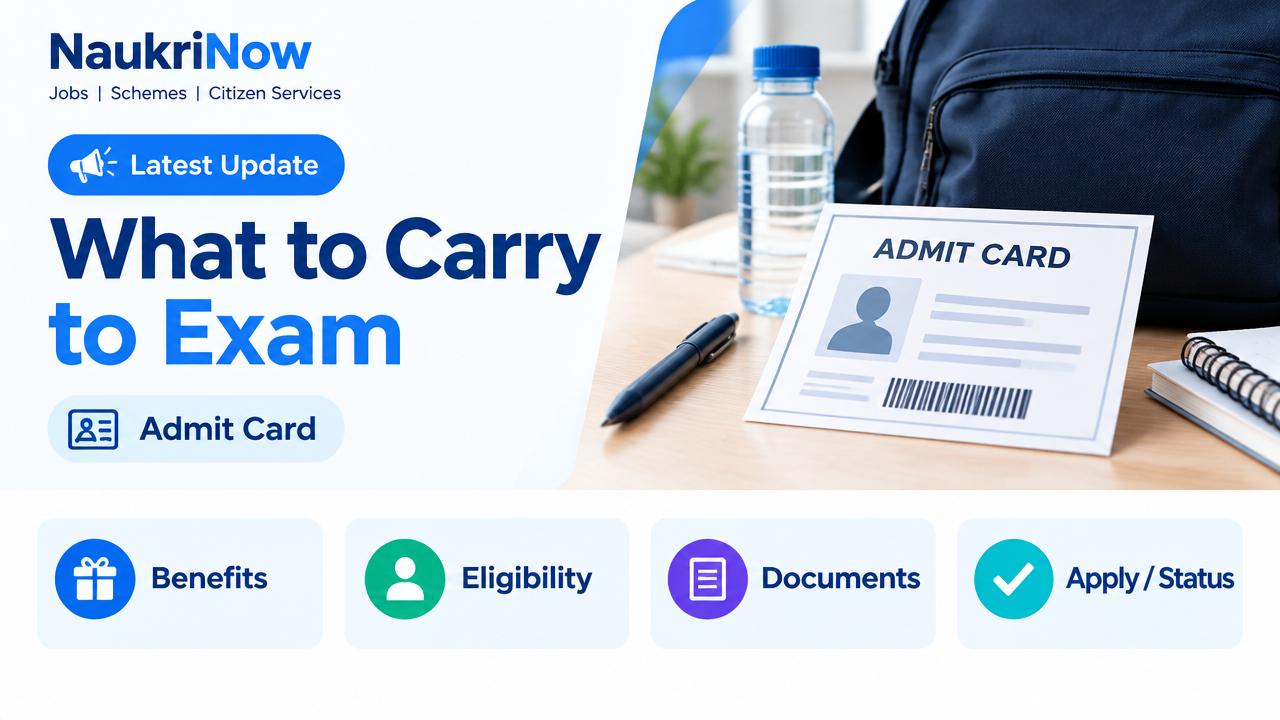
Knowing What to Carry to Exam day starts with one rule: follow the instructions for your specific test. Entry requirements, accepted identification, stationery rules and reporting times can differ by exam and centre. Use this checklist to organise your preparation, then compare every item with your admit card and the exam authority’s latest notice.
A useful checklist is not a substitute for official instructions. It helps you spot what to verify, prepare documents in advance and avoid packing items that may cause a problem at screening. If a rule is unclear, check the official source or use the contact route stated by the exam authority before exam day.
What to Carry to Exam: Essential Checklist
Start by separating items that are explicitly required from items that are optional or allowed only under certain conditions. Keep required documents together in a clear folder the night before. Do not assume that an item accepted at one exam will be permitted at another.
| Item | What to check | How to prepare |
|---|---|---|
| Admit card or hall ticket | Check whether the instructions require a printed copy, a particular page, or another specific format. | Download it from the official source in advance. If a printout is required, print it clearly and check that your photograph and details are readable. |
| Photo identification | Use only an ID type accepted in the exam instructions. Check whether the original document is required and whether your name and details match your application. | Keep the specified original ID accessible. Do not rely on a photocopy or digital version unless the instructions explicitly accept it. |
| Photographs | Bring recent photographs only if the admit card or official notice asks for them. Check any stated size, number or format. | Keep them in a small envelope so they do not get damaged. |
| Stationery | Check whether the exam is computer-based or pen-and-paper, and which writing tools are allowed. | Pack only permitted items. Do not assume you can bring your own pen, pencil, calculator or other tool. |
| Additional documents | Check whether a declaration, category-related document, disability-related document or other form is needed for entry or an accommodation. | Carry it only in the form and quantity specified by the authority. |
Use the checklist as a prompt for verification, not as a universal packing list. If an item is not mentioned in the official instructions, do not treat its presence in this table as proof that it is required or permitted.
Read Your Admit Card and Official Notice First
The admit card is usually the most direct place to find the candidate-specific information provided for an exam. Read all pages and any instructions printed on them. Then check the latest notice on the official exam or recruitment website for updates or clarifications. If the two sources appear to differ, use the authority’s stated support route to confirm which instruction applies instead of guessing.
Look for details about the entry documents, permitted stationery, prohibited belongings, reporting time, centre address and any required declaration. Instructions may also explain whether a document must be printed, whether an original ID is needed or whether photographs must meet a stated specification. Record the requirements somewhere easy to review, but keep the official documents available for reference.
Check that you have opened information for the correct exam and session. Advice from another candidate, an old message or a notice for a different test may not apply to your centre. A rule that sounds familiar still needs to be verified against your own instructions.
Prepare Your Admit Card and Supporting Documents
Download the admit card from the official source early enough to deal with a technical or printing issue. Confirm that the name, photograph and other visible details are readable. If the instructions require a printout, check the printed copy rather than assuming that the file will be enough. If they specify a page or format, follow that requirement.
Some exams may ask candidates to bring an additional declaration, category-related document, disability-related document or another form. Do not carry extra paperwork as a substitute for checking what is actually required. Confirm the exact document, format and quantity in the exam instructions, and make sure any form you need is complete according to the stated directions.
Keep required papers flat and together so you can find them easily when asked. A folder can help keep pages organised, but check whether the folder itself may be taken into the venue or exam room. If it is not permitted beyond a certain point, follow staff directions about where to keep it.
When working out What to Carry to Exam day, distinguish between documents required for entry and documents you are bringing only for your own reference. Do not hand over, leave behind or discard an official document unless an authorised staff member or the written instructions direct you to do so.
Choose the Correct Photo Identification
Identification rules are specific to each exam. Check the list of accepted ID types in your own instructions, and confirm whether the original document is required. Do not assume that an ID accepted for another exam, at another centre or for a different service will be accepted here.
Compare the name and other relevant details on your ID with the details used in your application and shown on your admit card. If there is a mismatch, an unusual spelling difference or another discrepancy, look for the authority’s guidance before exam day. Follow its stated procedure; do not alter an official document yourself or assume a photocopy will resolve the issue.
Keep the specified ID in a place where you can access it without unpacking everything. If the instructions also ask for a copy, prepare the copy in the requested way. A photocopy does not necessarily replace an original when the rules ask for the original, and a digital version should not be treated as an alternative unless the authority explicitly accepts it.
Pack Only the Stationery the Exam Permits
Stationery requirements depend on the test format and its rules. A computer-based exam may have different instructions from a pen-and-paper exam, but the format alone does not tell you which personal items are allowed. Check the permitted-items list rather than relying on assumptions about pens, pencils, erasers, geometry tools or calculators.
If writing tools are allowed, check whether the instructions specify a type or ask candidates to bring their own. Pack only what is permitted and avoid adding items simply because they are normally useful for study. Do not mark, write on or attach anything to an admit card or other document unless the instructions specifically require it.
For a calculator or another specialist tool, look for an explicit rule. If the instructions do not clearly allow it, ask the exam authority before exam day. Bringing an item in the hope that it will be accepted can create an avoidable question during screening, and leaving a required item at home can also cause difficulty.
Items to Carry Only If the Instructions Allow Them
Some belongings are allowed at certain exams but restricted at others. Treat these as check-before-packing items, not as standard parts of an exam kit.
| Item or arrangement | What to verify |
|---|---|
| Water bottle | Check whether bottles are permitted and whether there are conditions on their type or contents. |
| Prescription medicine or medical equipment | Read the exam rules and contact the authority in advance if approval or supporting documents may be required. |
| Watch, calculator or electronic device | Bring one only if it is expressly permitted. A device allowed in another exam may be barred here. |
| Religious or customary item | Check the exam authority’s instructions for any screening, reporting or advance-permission requirements. |
| Phone, bag or valuables | Check the centre’s rules and whether a storage facility is available. Do not assume the centre will accept or safeguard personal belongings. |
If an item is necessary for a medical or other personal reason, do not rely on a general checklist to settle the question. Check the authority’s process, any deadlines and any supporting information it asks you to provide. Where possible, seek clarification before arriving at the centre.
What Not to Pack Without Checking
The following items commonly need particular attention because rules may restrict them. This is a caution list, not a universal ban list:
- Phones, smartwatches, Bluetooth devices, headphones or other electronic items.
- Books, notes, loose papers or other written material.
- Calculators, geometry tools or stationery that the exam rules do not permit.
- Bags or valuables when the centre has no confirmed storage arrangement.
- Any personal item that the instructions do not clearly allow.
Use the official instructions to decide what is prohibited. If an item is not clearly allowed, ask the exam authority before bringing it. Avoid relying on another candidate’s experience, since a different exam or centre may have different rules. Do not assume that an item can be left at reception or stored safely at the venue unless the centre confirms that arrangement.
Also check whether restrictions apply to the venue, the exam room or both. Follow the instructions and staff directions about where a permitted personal belonging can go. If you are unsure whether an item is acceptable, the safest approach is to obtain an official answer in advance rather than argue for an exception at entry.
Check Special Requirements and Personal Needs
If you need an accommodation, accessible arrangements, medication or medical equipment, follow the exam authority’s process and deadlines. Carrying a supporting document alone does not necessarily secure an accommodation or permission to bring an item. Check what application, approval or confirmation is required and whether there are instructions for presenting relevant documents at the centre.
For religious or customary items, consult the specific exam instructions. There may be directions about advance permission, reporting or screening. Do not assume that a general rule for another exam applies to your situation. If the published guidance does not answer your question, use the contact route provided by the authority and keep a note of the response if appropriate.
If a name or other detail differs across documents, seek guidance before exam day. Follow the authority’s stated procedure and do not change, cover or rewrite official information yourself. Resolving a discrepancy early gives you more time to follow the correct process than waiting until you are at the centre.
Make a Practical Preparation Plan
A short preparation routine can help you catch missing documents and uncertainties before travel. The plan below is a general sequence; adapt it to the deadlines and instructions for your particular test.
| When | Action |
|---|---|
| The day before | Read the admit card and latest official notice. Confirm the centre address, reporting time, entry instructions and permitted items. |
| The day before | Prepare required documents and allowed stationery. Check that printed documents are legible and that your ID is the one specified. |
| The day before | Resolve questions about discrepancies, accommodations or conditional items through the official contact route where possible. |
| Before setting out | Check your route and allow a sensible travel buffer for delays. Keep the centre address and reporting details available. |
| On arrival | Follow staff directions and the centre’s screening procedure. Keep documents ready, but do not hand over or leave belongings unless instructed. |
Pack after checking the official list, not before. Lay out required documents and permitted items, compare them against the instructions, and then put them away together. This gives you a final chance to notice a missing printout, an unreadable page or an item that has not been confirmed as allowed.
Plan Your Journey and Arrival
Verify the centre address and reporting time from your own admit card or the latest official notice. Check your route in advance and allow a sensible buffer for travel delays. This is a planning suggestion, not a substitute for the reporting time set by the authority. Aim to follow the stated arrival instructions rather than relying on an estimate from someone sitting another exam.
Keep the address and relevant reporting details accessible while travelling. If you need directions, use the confirmed address rather than a general description or an unverified map listing. Do not assume that transport, food, storage or other facilities will be available at the venue unless the centre confirms them.
On arrival, follow signs and staff directions. Have required documents ready for the stated checks, and follow the centre’s screening procedure. Keep personal belongings under your control unless staff direct you otherwise. If a direction is unclear, ask an authorised staff member rather than leaving an item unattended or making assumptions about where it belongs.
Common Exam-Day Packing Mistakes to Avoid
- Relying on memory: An item permitted at a previous exam may not be allowed at this one. Check the current instructions again.
- Using an unofficial checklist as the final authority: A general article can help you prepare questions, but only the relevant exam instructions confirm requirements.
- Waiting until the morning to download documents: Use the official source early and check whether any required printout is readable.
- Bringing a digital document when a printout is required: Follow the stated format rather than assuming a phone display will be accepted.
- Assuming a photocopy replaces an original: Check whether the original ID or another original document is required.
- Packing extra items just in case: Unneeded items may be restricted, and storage may not be available.
- Ignoring an inconsistency in personal details: Ask the authority about the stated process before exam day instead of trying to correct documents yourself.
- Assuming a medical need automatically permits an item: Check the approval and documentation process in advance.
- Relying on old messages or social media posts: Verify the latest information through an official source.
When deciding What to Carry to Exam day, use each item’s status to guide your choice: required, allowed only under stated conditions, or not confirmed. Pack required items, verify conditional ones and leave uncertain belongings out unless the authority confirms they are permitted.
Advantages and Limitations of Using a Checklist
A checklist is a useful preparation aid, but it has limits. It works best when it is used alongside the admit card and official notices, not instead of them.
| Pros | Cons |
|---|---|
| Grouping documents, stationery and conditional items can help you review them systematically. | A general checklist cannot guarantee entry or establish what a particular centre permits because requirements vary. |
| Prompts to check the ID type, print format or device rule can help you identify questions that need official confirmation. | A saved or forwarded checklist may not reflect a later update, so the latest official notice still needs to be checked. |
| Checking documents before exam day leaves time to use the official download or support route if something is missing. | A checklist cannot resolve an individual discrepancy, accommodation or medical requirement that needs confirmation through the authority’s process. |
| Separating required items from optional belongings encourages you to check before carrying extra items. | A checklist cannot establish that storage or other arrangements are available at the centre. |
The practical balance is simple: use a checklist to organise, then use official instructions to decide. If the sources do not clearly answer a question, seek clarification instead of treating a general recommendation as permission.
Final Checklist Before You Leave
Before setting out, review your own instructions one last time. Confirm that you have the required admit card in the stated format, the accepted ID in the required form and any additional documents specifically requested. Check that photographs or stationery are included only when required or permitted, and that conditional items have been verified.
Confirm the reporting time and centre address, and make sure you know how to follow the stated entry procedure. Leave behind items that are prohibited or not clearly allowed. Do not count on the centre to store belongings unless that facility has been confirmed. If a special requirement remains unresolved, use the official contact route rather than assuming it will be handled at the venue.
The safest answer to What to Carry to Exam day is the list in your own admit card and the exam authority’s latest instructions. Prepare required documents early, pack only permitted items and plan your journey around the stated reporting time. When a rule is unclear, verify it through an official source before leaving.
Frequently Asked Questions
Is a printed admit card required for every exam?
No single rule applies to every exam. Check the admit card and official instructions to see whether a printout is required, which pages are needed and what format is accepted. If a printout is required, prepare it in advance and check that the details are readable.
Can I show my admit card on my phone?
Only if the exam authority explicitly accepts a digital copy. If the instructions require a printed admit card, bring the required printout. Do not assume that access to a file on your phone replaces a specified paper document.
Which photo ID should I bring?
Bring an ID type named in your exam instructions. Check whether the original is required and make sure the details can be matched to your application. If there is a discrepancy, follow the authority’s guidance before exam day.
Should I carry a photocopy of my ID?
A photocopy may not replace an original ID when the rules require the original. Carry a copy only if the authority asks for one or confirms it is useful. Check whether a copy must meet any particular instruction.
Can I take a pen, calculator or watch into the exam hall?
That depends on the exam. Check the permitted-items list, including any rules for computer-based tests. Do not assume an item is allowed because it was permitted at a different exam. If the instruction is unclear, seek confirmation from the authority before packing it.
Should I bring passport-size photographs?
Bring photographs if the admit card or official notice asks for them. Follow any stated requirements for number, size or format, and keep them protected so they do not get damaged.
What if I need medication or an accommodation?
Read the authority’s instructions and, if needed, contact it before exam day to confirm the approval process and documents. Requirements can vary by exam. Do not assume that carrying a supporting document alone guarantees permission or an arrangement.
What should I do if the centre rules are unclear?
Check the latest notice on the official exam or recruitment website and use its stated contact or support route. Do not rely on an unverified post or assume the centre will make an exception. If possible, resolve the question before travelling to the venue.
What should I do if I cannot download my admit card?
Use the official exam or recruitment website and its stated support route. Check that you are using the correct official page, and do not rely on unofficial download links. Avoid waiting until the morning of the exam to report a problem.
Conclusion
To prepare for What to Carry to Exam, use your admit card and the exam authority’s latest instructions as the final guide. Confirm required documents, permitted items, reporting details and any special arrangements before setting out. Pack only what is required or confirmed as allowed, and seek official clarification if any rule remains unclear.



Comments