Table of ContentsClick to view all sections
- Bank PO Guide: What does a Bank PO do?
- Understand the recruitment route before you prepare
- Check eligibility carefully
- Know the common areas tested
- A practical preparation plan
- Make mock tests work for you
- Prepare for the interview and the job
- Application and preparation checklist
- Mistakes to avoid
- Conclusion
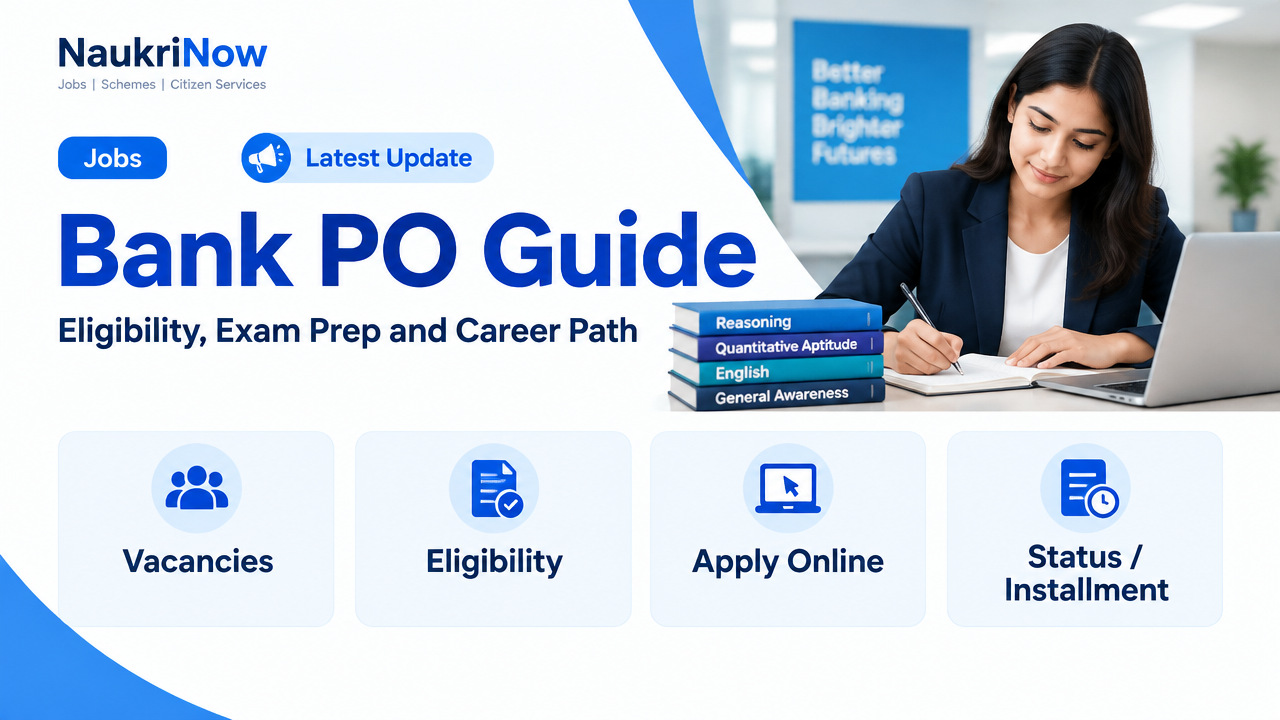
Bank PO Guide: Eligibility, Exam Prep and Career Path
A Probationary Officer (PO) role can be a rewarding starting point for a career in banking. It combines customer service, day-to-day operations, learning on the job and, over time, the chance to take on greater responsibility. But “Bank PO” is not one identical recruitment process: banks and recruiting bodies may set different eligibility conditions, exam stages and application procedures.
Use this Bank PO Guide to understand what the role involves, how to plan your preparation and what to check before applying. Treat the latest official recruitment notice as the final authority for any detail that can change, including eligibility, vacancies, dates, fees, exam pattern and selection rules.
Bank PO Guide: What does a Bank PO do?
A PO is generally recruited into an officer-track role and receives training or supervised work as they learn the bank’s systems and procedures. Depending on the bank, posting and stage of training, work may involve helping customers, supporting account and service requests, checking documents, assisting with loans, monitoring transactions, following compliance procedures and coordinating branch operations.
The job is broader than passing an exam or working at a counter. Officers need to communicate clearly, handle information responsibly, learn digital banking systems and make careful decisions within the bank’s rules. The balance between customer-facing work, administration and other responsibilities varies by institution and posting. A role can also involve transfers or working in different locations; check the recruitment notice and the bank’s official materials for the conditions that apply to a particular position.
Understand the recruitment route before you prepare
Bank PO recruitment may be conducted by an individual bank or through a recruiting body on behalf of participating banks. Processes commonly include more than one stage, such as an online examination and an interview, but the stages, order, assessment methods and weightage are not universal. Some notices may include additional assessments or different arrangements.
Identify the exact recruitment you are targeting before choosing study material. For example, a recruitment advertised by a particular bank may have requirements or instructions that differ from another PO recruitment. Do not assume that an old notification, a coaching website or a previous year’s pattern applies to the current cycle.
For current and binding information, use the recruitment section of the relevant bank’s official website or the official website of the recruiting body named in the notice. Read the full notification and any official updates, not just a summary. Be especially careful with unofficial social media posts and messages asking for payment or personal information.
Check eligibility carefully
Eligibility conditions can vary between recruitments and may be revised. Before preparing an application, confirm each condition in the notification rather than relying on a general guide.
- Education: Check the required qualification, the acceptable way to establish that you have completed it, and any rules about final results or documents. Do not assume that an expected result will count as a completed qualification.
- Age: Read the specified age limits and the date on which age is calculated. If you are claiming a relaxation, confirm the applicable category, conditions and supporting documents in the notice.
- Nationality and other conditions: Check all stated requirements, including any conditions that apply to your circumstances.
- Application details: Confirm the photograph, signature, identity proof, certificates and other information requested. Names and dates should match your documents.
- Exam arrangements: Check the official instructions on language options, test centres, permitted items and accommodations, if relevant.
If a condition is unclear, look for a clarification or update issued by the responsible recruiting body. Do not rely on a guess: an incorrect eligibility assumption can cost time and may affect an application.
Know the common areas tested
The exact subjects and format depend on the recruitment notice. Many Bank PO exams assess a combination of language ability, numerical problem-solving and reasoning. Depending on the exam, candidates may also encounter general or financial awareness, computer-related content, written communication or other components. The list below is a preparation starting point, not a promise that every exam will test every area.
- Reasoning: Practise interpreting conditions, identifying relationships and solving logical arrangements. Learn to recognise when a question is taking too long.
- Quantitative aptitude: Build accuracy in arithmetic and other commonly tested numerical topics, then work on pace. Understanding the method is more useful than memorising steps without context.
- English language: Develop comprehension, vocabulary in context, grammar awareness and clear written expression where the exam includes it.
- General and financial awareness: Read reliable news and explain key developments in your own words. Review basic banking and economic concepts, while checking the exam notice for the scope and format.
- Computer or digital topics: Prepare only to the depth indicated by the current syllabus or official exam information.
- Written assessment: If a descriptive component is specified, practise organising a response, supporting a main point and checking language within the stated time limit.
A practical preparation plan
- Start with the official notice. Download the current notification and note the subjects, stages, question formats, time limits, marking rules and any sectional requirements. Keep it as your reference document.
- Take a diagnostic test. Use a representative practice test to find your current strengths and gaps. Record not only your score but also accuracy, time spent and the questions you left unfinished.
- Build foundations before chasing speed. Choose a small set of reliable learning resources. For each topic, understand the underlying method, solve untimed examples and then practise under a time limit.
- Set a repeatable weekly routine. Divide study time between concept work, question practice, revision and current-affairs reading where relevant. Give extra attention to weak areas without allowing stronger subjects to go untouched.
- Use mocks as feedback. After every full-length or sectional mock, review incorrect answers, guesses and time-consuming questions. Add recurring errors to a short revision list.
- Adjust as the exam approaches. Increase timed practice when your foundations are sound. Keep revising formulas, vocabulary, concepts and important notes instead of starting many new resources at once.
A routine should fit your starting point and available time. For instance, a student with several months might reserve early weeks for fundamentals, the middle period for mixed practice and the final stretch for mocks and revision. Someone with less time can still use the same sequence, but should prioritise high-impact gaps and avoid trying to cover every book or course available. Neither schedule guarantees a result; consistency and honest review matter more than a dramatic timetable.
Make mock tests work for you
A mock score is useful only when you learn from it. After a test, label each missed or delayed question: concept gap, calculation error, misread instruction, poor question choice or time pressure. That diagnosis points to a different remedy. Relearn a concept when understanding is weak; practise carefully when the method is sound but accuracy is low; work on selection when you spend too long on difficult questions.
Keep a simple record of mock date, section-wise performance, accuracy and the main lesson from the review. Look for trends across several tests rather than reacting to one unusually good or bad attempt. Practise following the exam’s stated rules, including any sectional timing or other constraints, once you know what those rules are for your recruitment.
For example, if you repeatedly solve a reasoning set correctly but use too much time, more theory may not help. Practise deciding whether to attempt the set, set a time limit and move on when progress stalls. If you make frequent arithmetic slips, slow down during practice enough to identify the step where the error occurs, then rebuild speed without sacrificing accuracy.
Prepare for the interview and the job
If the recruitment includes an interview, prepare to speak clearly about your education, experience, interests and reasons for choosing banking. Be ready to explain your answers rather than reciting memorised scripts. Read about the recruiting bank through its own website, including its services and stated priorities, and follow dependable news for context. For questions about banking or the economy, focus on understanding the issue and expressing a balanced, factual view.
Practise answering aloud, but leave room for natural conversation. A useful answer is usually direct, relevant and supported by an example where appropriate. If you do not know something, avoid inventing a fact. Calmly explain what you do know and be honest about the limits of your knowledge.
Application and preparation checklist
- Find the official notice for the exact Bank PO recruitment you intend to apply for.
- Check eligibility, important instructions and application requirements against your documents.
- Use only the official application route specified in the notice and save the acknowledgement or other application record.
- Download the official syllabus or exam information available for that recruitment.
- Take a diagnostic test and make a realistic weekly study plan.
- Review mistakes after practice tests and schedule regular revision.
- Check official updates yourself instead of relying on forwarded messages or unverified claims.
Mistakes to avoid
- Preparing from an outdated pattern: A past paper can help with practice, but confirm the current structure and syllabus through the responsible official source.
- Ignoring eligibility details: Broad statements such as “graduates can apply” do not replace the conditions in a specific notification.
- Collecting too many resources: Constantly switching books, videos and test series can leave little time for practice. Choose a manageable set and use it consistently.
- Taking mocks without reviewing them: Repeating tests without correcting the same errors can create activity without progress.
- Chasing attempts over accuracy: Attempt strategy should reflect the exam’s instructions and your own performance, not someone else’s claimed number of attempts.
- Neglecting communication skills: Clear reading and writing support exam performance and can also matter in later selection stages or the job itself.
- Trusting unofficial promises: No coaching provider or individual can guarantee selection. Verify recruitment claims, updates and application links independently.
Frequently Asked Questions
1. Is Bank PO one common exam for every bank?
No. Recruitment arrangements differ. A bank may recruit directly or use a recruiting body, and the eligibility rules, stages and exam details can vary. Check the official notice for the specific post.
2. What qualification is required to apply?
The required education and the rules for proving it are set out in each recruitment notice. Confirm the qualification wording and any result or document conditions before applying.
3. What subjects should I study for a Bank PO exam?
Reasoning, numerical ability and English are common preparation areas. Other topics or written assessments may be included depending on the recruitment. Use the current official exam information to decide what to study.
4. How long does Bank PO preparation take?
There is no fixed preparation period that suits everyone. It depends on your starting level, available study time and the requirements of the exam. Take a diagnostic test, identify gaps and plan regular practice and revision.
5. Are Bank PO exams conducted online?
Exam delivery and arrangements are determined by the relevant recruiting body and can change. Confirm the format, instructions and permitted materials in the current official notification.
6. Where should I check dates, fees and vacancies?
Check the official recruitment page of the bank or the recruiting body named in the notice. Those details can change and should not be taken from an undated article or an unofficial post.
7. Does a PO role guarantee a particular posting or career path?
No general guide can guarantee a posting, duties or progression. These depend on the employer’s policies and the conditions of the role. Read the official recruitment materials and bank information for applicable terms.
Conclusion
A strong Bank PO application begins with knowing which recruitment you are targeting, checking its official eligibility rules and preparing from its stated requirements. Build fundamentals, practise under realistic conditions and use each mock to identify a specific next step. Just as importantly, verify changing information through the responsible bank or recruiting body. This practical approach can help you prepare with focus while keeping your application informed and organised.

Comments