Table of ContentsClick to view all sections
- Government Exam Planning: 1. Understand what effective exam planning involves
- 2. Shortlist exams that match your profile
- 3. Verify eligibility before committing to an exam
- 4. Read the notification and map the selection stages
- 5. Turn the official syllabus into a study plan
- 6. Make a weekly timetable you can maintain
- 7. Practise, review mistakes and adjust
- 8. Track applications, deadlines and official updates
- 9. Prepare documents and complete applications carefully
- 10. Manage more than one exam without losing track
- 11. Avoid common planning problems
- 12. Where to verify official information
- Conclusion: Keep your plan focused and flexible
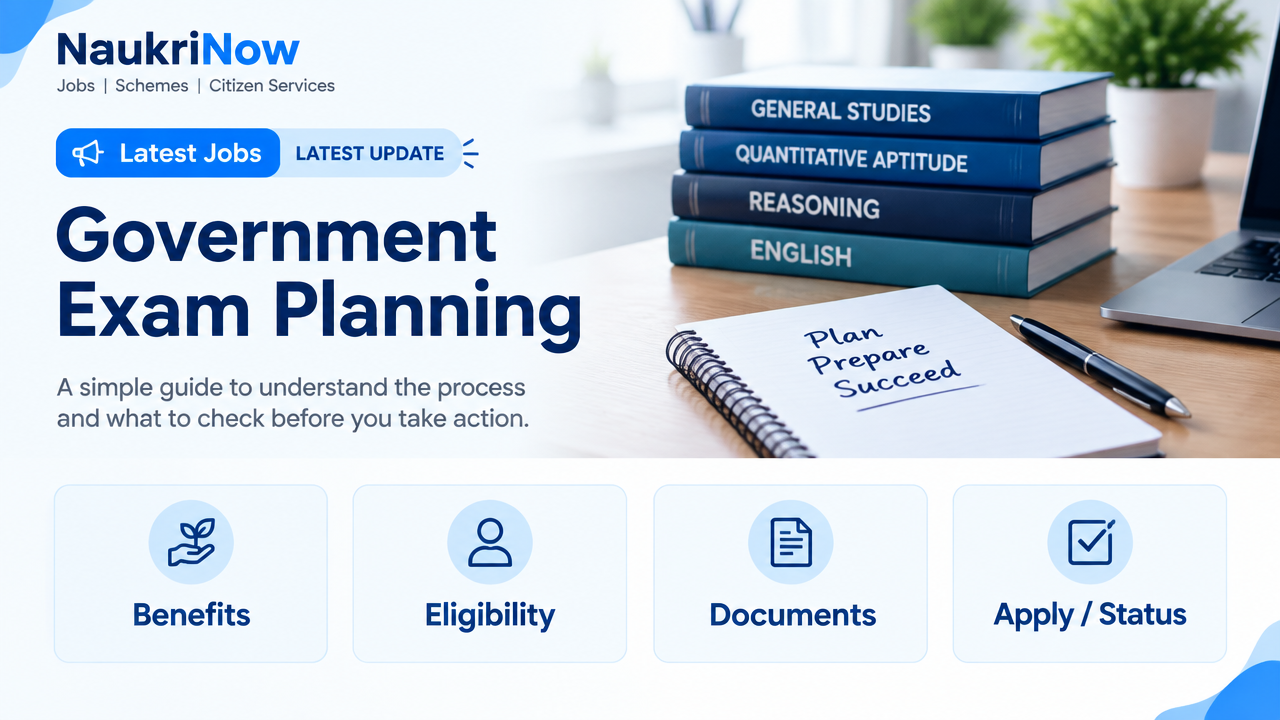
Good Government Exam Planning starts with choosing exams that fit your qualifications, goals and available study time—not applying for every vacancy you see. A clear system can help you track official notices, prepare the right subjects and avoid preventable application errors. Use this guide as a planning framework, then follow the latest notification for each exam.
Government Exam Planning: 1. Understand what effective exam planning involves
Government recruitment is not one shared process. Each exam can have its own eligibility conditions, syllabus, selection stages, application instructions and schedule. Even when two exams appear similar, their current notifications may set different rules. Planning therefore means managing several connected tasks: selecting suitable opportunities, checking the details, preparing for the stated exam pattern and responding to official updates.
Start with a simple principle: use general advice to organise your work, but use the current official notification to make decisions. A calendar or older notice can help you anticipate possible tasks, but it does not confirm the dates or requirements for a particular recruitment cycle. Check the relevant recruiting authority’s website before applying and check again for later notices or amendments.
This approach also helps you use your time deliberately. Instead of collecting a long list of possible exams, identify which opportunities are realistic for your education, circumstances and priorities. Then build a study and application routine around those choices. A written plan makes it easier to see what needs attention now, what can wait and which details must be verified.
2. Shortlist exams that match your profile
Begin with the kind of role and level of responsibility you want to pursue. Then compare the requirements of individual recruitments. UPSC, SSC, IBPS, RRB and state Public Service Commission recruitments do not all use the same rules or processes, so do not assume that a requirement for one exam applies to another.
Think about both eligibility and practical fit. An exam may look appealing, but it may involve subjects you have not studied recently, multiple selection stages, a location or language condition, or a document requirement that needs attention. Reviewing these points early lets you make a more informed shortlist before committing substantial preparation time. This shortlist is a practical starting point for Government Exam Planning.
| What to compare | Questions to ask |
|---|---|
| Role and level | Does the work and responsibility level suit your goals? |
| Eligibility | Do your education, age and other details meet the current notice? |
| Exam structure | Are there prelims, mains, skill tests, interviews or other stages? |
| Syllabus overlap | Can preparation for this exam support another exam you are considering? |
| Practical constraints | Can you meet any location, language, physical or document requirements stated in the notice? |
Keep the shortlist manageable. If you consider several exams, write down why each one belongs on your list and what preparation or application tasks it requires. Remove options that do not fit your qualifications or available time. This is not a claim that there is one ideal number of exams; the useful number is the one you can track and prepare for responsibly.
3. Verify eligibility before committing to an exam
Read the eligibility section in the latest notification rather than relying on a coaching summary, a discussion forum or a previous year’s rules. Check the exact educational qualification and its required completion date, age limits and any applicable relaxations, nationality or domicile conditions, attempt limits if stated, and physical or medical standards where relevant.
Pay attention to how the notice defines each condition. A qualification may need to be completed by a specified date, and a certificate or other evidence may need to meet particular instructions. Do not rely on a general description of a role or on assumptions drawn from another recruitment. Record the condition in your own checklist and note where the official notice explains it.
Do not assume that a category, reservation benefit or age relaxation applies automatically. Confirm the stated conditions and the supporting evidence required in the notice. If a rule is unclear, seek clarification from the recruiting authority through its official channel before submitting an application. Keeping a note of the question and the reply can help you refer back to the guidance when completing the form.
Eligibility checking is useful before you build a detailed study schedule because it can prevent you from preparing for an opportunity you cannot pursue under the current rules. Recheck the conditions when a new recruitment cycle opens; a past decision about eligibility does not confirm the requirements for a later notice.
4. Read the notification and map the selection stages
Once you have identified a suitable recruitment, read its current official notification from beginning to end. Do not stop after looking at the application dates or exam name. The notice is where you can verify the post, eligibility, syllabus or exam pattern, application instructions, fees if applicable, documents and any later stages that are described.
Make a one-page summary for each exam. Include the recruiting body, the notification date or cycle identifier if shown, the application deadline, the subjects or syllabus references, the selection stages, and any action you need to take. Add a reminder to check the official page again because later updates may alter instructions or clarify a process.
Map each stage in order. Some processes may include prelims, mains, skill tests, interviews or other stages; the relevant notice determines what applies. Knowing the sequence helps you see whether your preparation should include more than the first written test. It also helps you plan to check for instructions after each stage rather than treating application submission as the end of the process.
When comparing notices, keep information for separate recruitments separate. A useful habit is to label notes and files with the exam or recruitment name and cycle. This reduces the chance of applying a date, syllabus point or document instruction from one opportunity to another.
5. Turn the official syllabus into a study plan
After verifying the exam and its stages, use the current syllabus and exam pattern to create a topic checklist. Break larger subjects into manageable sections. Mark topics you already understand, topics that need learning and topics that require extra practice. This first review is a planning tool, not a final judgement of your ability; update it as you work.
Set study tasks that describe an outcome rather than simply a number of hours. For example, a task might be to study a defined topic, revise a set of notes, answer questions on a subject or review errors from a practice session. Concrete tasks make it easier to judge whether a plan is working and identify what needs to change.
| Preparation stage | What to do | Check your progress |
|---|---|---|
| Understand the exam | Read the notice, syllabus and exam pattern. List each subject and topic. | You can explain the stages and have a complete topic checklist. |
| Build subject knowledge | Study topics in manageable blocks and make concise revision notes. | Use topic questions to identify gaps rather than relying only on hours studied. |
| Practise the format | Work through suitable questions and timed practice based on the stated pattern. | Review incorrect answers and recurring time-management issues. |
| Revise and prepare for the next stage | Revisit weak topics, practise full-length tests where appropriate and check notices for later stages. | Adjust the plan using practice results and official instructions. |
Keep study materials aligned with the syllabus. If you use books, notes or online resources, compare their coverage with the current official topic list. A resource can be useful without covering every requirement, so record gaps instead of assuming that finishing one book means the syllabus is complete.
6. Make a weekly timetable you can maintain
A weekly timetable should reflect your available time and existing commitments. Give each study block a specific task, include space for revision and practice, and leave room for rest and unexpected changes to work, college or family responsibilities. An overloaded schedule can be difficult to follow; a realistic plan gives you a clearer basis for reviewing progress. A workable Government Exam Planning routine should fit those real commitments.
Decide when you will study each subject and how you will return to material you have already covered. A simple pattern can alternate between learning, practice and revision, but the balance should respond to your needs and the exam’s requirements. If a topic remains difficult, adjust the next week’s plan rather than continuing to tick off tasks without understanding them.
| Planning item | Example of what to record |
|---|---|
| Core study | Subject and topic to cover in each study block |
| Revision | Topics to revisit and the notes or questions to use |
| Practice | Question set or mock test, followed by an error review |
| Weekly review | Topics completed, topics still weak and priorities for the next week |
| Official updates | Recruiting body, notice checked and any action or deadline to follow |
At the end of the week, compare completed tasks with your plan. Note what went well, what took longer than expected and which topics need more attention. Use that review to make the next week more workable. If you miss a block, redistribute the task sensibly instead of trying to fit every missed activity into one crowded day.
7. Practise, review mistakes and adjust
Practice is most useful when it reflects the stated exam format and is followed by review. Choose questions or tests suited to the topics and stages in the notification. Timed practice can help you notice how you use the available time, while topic-based questions can show which concepts need further study. These exercises support preparation; they do not replace the official syllabus or instructions.
After a practice session, review incorrect answers and questions you found difficult. Record the topic, the kind of mistake and what you will do next. A mistake may point to a gap in subject knowledge, confusion about a question, an avoidable oversight or difficulty managing time. Identifying the reason gives you a more useful next step than simply recording a score.
Keep an error log or another brief record that you can revisit during revision. Group repeated issues by topic, and use the patterns to decide what to practise next. If your review shows that a subject is stronger than expected, you may be able to give more time to weaker areas. If results are inconsistent, continue reviewing the underlying topics instead of changing the whole plan after one practice test.
As the exam approaches, use your current plan and official information to decide which revision tasks deserve priority. Do not assume that a practice resource’s pattern overrides the recruitment notice. If the official exam pattern or instructions are updated, check the recruiting authority’s latest information and adapt your practice accordingly.
8. Track applications, deadlines and official updates
Application windows, correction facilities, admit-card releases and examination dates are specific to each recruitment. Keep a separate record for every exam and verify each update on the recruiting authority’s official website. Do not treat a social media post, forwarded message or old calendar as confirmation.
A deadline tracker can be a notebook, calendar or spreadsheet. For each recruitment, record the official page, the dates stated in the notice, the actions you need to complete and whether you have completed them. If a later notice changes or clarifies an instruction, update your record and retain a note of where the new information was published.
| Step | Action |
|---|---|
| 1. Find the notice | Open the relevant recruiting authority’s official website and locate the current recruitment notice. |
| 2. Verify the details | Check the post, eligibility, dates, fees if applicable, required documents and application instructions. |
| 3. Prepare the form | Gather the information and documents requested in the notice. Follow its rules for photographs, signatures and file formats. |
| 4. Submit carefully | Review personal details and selections before final submission. Follow the notice’s payment instructions, if a fee applies. |
| 5. Keep proof | Save the submitted application, confirmation or receipt where provided, and note any next steps. |
| 6. Check again | Monitor the official website for corrections, admit-card instructions, exam updates and later selection stages. |
Build checking official updates into your routine without letting it displace study time. You might use a regular reminder to revisit the authority’s page, especially when an application or examination is approaching. The correct frequency depends on the notices and dates for the recruitment; the important point is to check the official source rather than rely on an unverified message.
9. Prepare documents and complete applications carefully
Requirements vary, so use the notification’s document list as your checklist. Depending on the recruitment, you may be asked for:
- Proof of identity and personal details used in the application
- Educational certificates, marksheets or other qualification evidence
- Category, disability, domicile or other supporting certificates, where applicable
- A recent photograph and signature in the specified format
- Information needed for payment or application confirmation, if applicable
Check that names, dates and other details match the supporting records and the instructions in the notice. Follow the stated rules for photographs, signatures, file formats and document evidence. Do not upload a certificate or claim a benefit unless you meet the stated conditions and can provide the requested evidence.
Before you submit, review the form section by section. Check personal information, the recruitment or post selected, contact details and any declarations. Confirm that required fields have been completed and that the submitted information matches your supporting records. If the authority provides an application preview, use it to review the information before final submission.
Follow the notice’s payment instructions if a fee applies. After submitting, save the application and any confirmation or receipt provided. Keep those records somewhere you can find them later, and note any additional action or deadline. Do not assume that completing the form ends your responsibilities: continue checking for updates about corrections, admit cards and later stages.
10. Manage more than one exam without losing track
Preparing for more than one exam may be possible if the workload is manageable, but it requires clear priorities. Compare the syllabuses, selection stages and known dates before treating two exams as compatible. Subject overlap can make some preparation useful across exams, but it does not mean that their full syllabuses, formats or application rules are identical.
Use separate records for each recruitment. Keep the notice, eligibility notes, topic checklist, application status and deadlines together under that exam’s name. A combined calendar can show competing tasks, while the separate records help prevent details from being mixed up. Label shared study topics clearly and note which exam’s syllabus or pattern each resource is meant to support.
Review priorities when new notices appear or dates change. Consider what needs action first, what preparation overlaps and how much time you can realistically give to each exam. If the combined workload is no longer sustainable, reassess the shortlist. Choosing a narrower focus can be more practical than maintaining an unworkable plan for every opportunity.
Do not use an older calendar to promise yourself that two exams will fit together. Their schedules and instructions are recruitment-specific and may change. Check current official information as it becomes available, then update your study and application records.
11. Avoid common planning problems
- Preparing from an old syllabus: Compare your study material with the current exam notice and syllabus.
- Applying without checking eligibility: Verify every condition before spending time on a form or exam-specific preparation.
- Tracking too many exams: Prioritise a manageable shortlist with overlapping subjects and realistic deadlines.
- Ignoring the application after submission: Keep checking the official site for later instructions and changes.
- Using unverified dates or advice: Confirm important information with the recruiting authority, especially close to a deadline.
- Practising without reviewing mistakes: Record weak topics and use them to guide revision.
- Building an unrealistic timetable: Set tasks that fit your available time and revise the plan when commitments change.
- Mixing details between recruitments: Label notices, dates and documents so that each exam has its own record.
These problems are often connected. For example, an unclear shortlist can make it harder to maintain separate deadline records, while an old syllabus can send practice in the wrong direction. A periodic review of your shortlist, study plan and official information can reveal such issues before they grow into missed tasks.
12. Where to verify official information
Use the official website of the body conducting the recruitment. Depending on the exam, this may be UPSC, SSC, IBPS, the relevant Railway Recruitment Board or a state Public Service Commission. Find the specific recruitment notice on that authority’s site and check for later notices or amendments.
Since official links and recruitment pages can change, confirm the address independently rather than relying on an unverified link. When you find a notice, check that it relates to the correct exam and recruitment cycle. Use the latest relevant official communication for dates, eligibility, application steps and other instructions. If information remains unclear, contact the authority through its official channel.
Third-party summaries, coaching material and discussion groups can help you discover questions to investigate, but verify important claims against the authority’s own notice. Keep a record of the official page you used and revisit it when you are about to apply or take a required action. This habit is especially useful when a deadline or later stage depends on current instructions.
Conclusion: Keep your plan focused and flexible
Effective Government Exam Planning combines a carefully chosen shortlist, an eligibility check, syllabus-based study and a reliable deadline tracker. Start with the current official notification, translate its requirements into clear tasks and review your progress regularly. Keep your schedule flexible enough to fit real commitments, but do not let flexibility become a reason to ignore important dates or instructions.
A consistent process matters more than a complicated timetable. Compare suitable exams, study the topics they actually specify, practise and review your mistakes, and keep your application records organised. Most importantly, make official notices the basis for every decision about eligibility, dates and applications. This approach helps direct effort towards exams you can pursue and makes it easier to respond when recruitment instructions change.
Frequently Asked Questions
How should I start planning for government exams?
Choose exams that fit your qualifications and goals, read their latest official notifications, compare syllabuses and selection stages, then make a study and deadline plan. Keep the shortlist manageable and verify eligibility before investing heavily in exam-specific preparation.
Can I prepare for more than one government exam at a time?
Yes, if you can manage the workload. Compare syllabuses and dates, prioritise exams with useful subject overlap and keep separate records for each recruitment. Reassess your priorities if the combined schedule becomes difficult to maintain.
Which source should I trust for exam dates and eligibility?
Use the current notification and subsequent updates published by the recruiting authority. Treat third-party summaries and older notices as references to verify, not as the final authority.
Do eligibility rules stay the same every year?
Not necessarily. Check the notification for the specific recruitment cycle, including qualifications, age conditions, relaxations and any other requirements. Do not assume a previous cycle’s rules apply to a new recruitment.
How do I make a study timetable for a government exam?
Divide the official syllabus into topics, assign study and revision blocks, include exam-format practice and review progress regularly. Adjust the timetable to your available time and weak areas, and leave room for other commitments.
What documents should I prepare before applying?
There is no single document list for every exam. Follow the current notice, which may specify identity and education records, certificates, photographs, signatures or other evidence. Check its file and format instructions before submitting anything.
What should I do after submitting an application?
Save the application and confirmation details where available, then monitor the recruiting authority’s official website for corrections, admit-card instructions and other updates. Note any new action or deadline that applies to your recruitment.
What if an official calendar and a later notice show different dates?
Check the recruiting authority’s latest notice or amendment for that exam and follow its instructions. If the position remains unclear, contact the authority through its official channel.
How can I tell whether my preparation plan is working?
Review completed syllabus topics, practice results and recurring mistakes. Use that information to identify weak areas and adjust upcoming study tasks. Hours spent can be useful to record, but they do not show by themselves whether you understand the material.

Comments