Table of ContentsClick to view all sections
- PM Matru Vandana Yojana at a glance
- Why this scheme matters
- PMMVY 2.0: What changed?
- Objectives of the scheme
- Cash benefit structure: detailed breakdown
- Who is eligible?
- Documents required for an application
- How to apply online
- Common mistakes to avoid
- Application status: what to do at each stage
- Advantages and limitations
- Final takeaway
- Official links
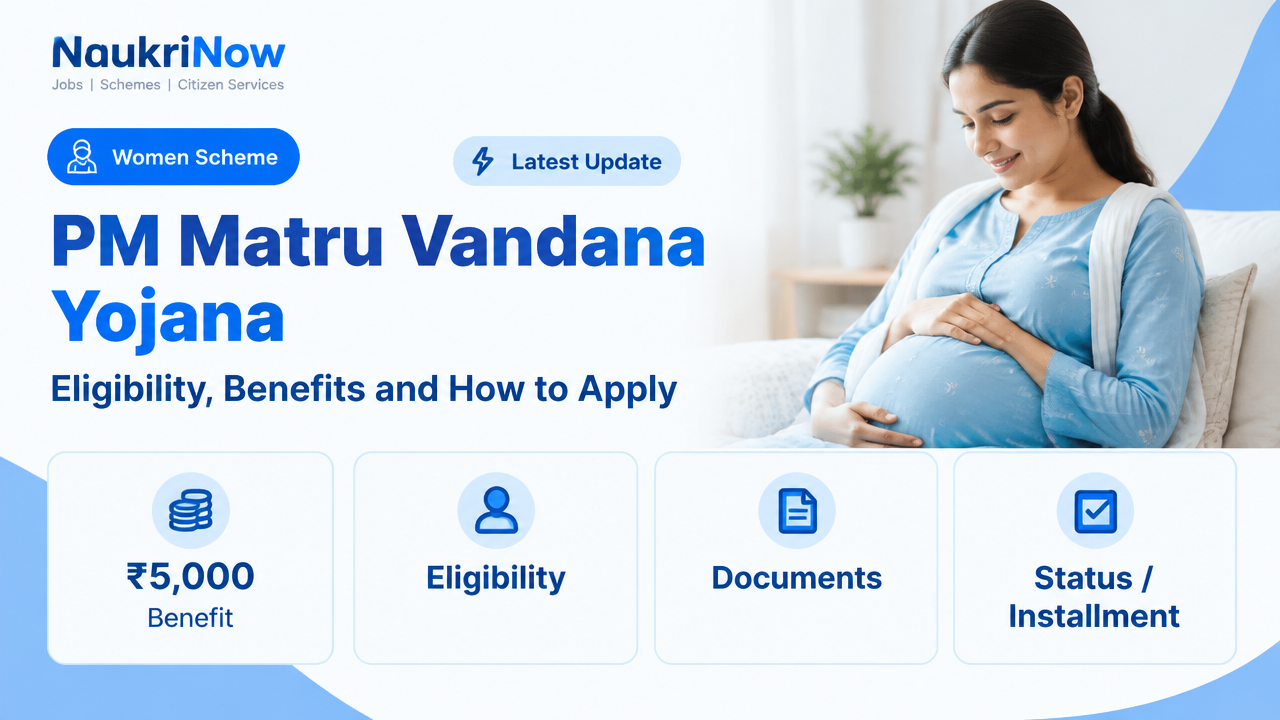
PM Matru Vandana Yojana (PMMVY) provides maternity cash support to eligible pregnant women and lactating mothers. The benefit is ₹5,000 for an eligible first child, or ₹6,000 for an eligible second child if the child is a girl. Payments depend on scheme conditions and verification; pregnancy alone does not guarantee a payment. Eligibility, documents and application steps can depend on current rules and local implementation, so confirm your case through the official portal or an Anganwadi worker before applying.
PM Matru Vandana Yojana at a glance
| Detail | Information |
|---|---|
| Scheme name | Pradhan Mantri Matru Vandana Yojana (PMMVY) |
| Responsible ministry | Ministry of Women and Child Development, Government of India |
| Launched | 1 January 2017 |
| Current framework | Revised as PMMVY 2.0 from 1 April 2022 under Mission Shakti |
| Benefit | ₹5,000 for an eligible first child; ₹6,000 for an eligible second child if the child is a girl |
| Payment method | Direct Benefit Transfer to the beneficiary’s bank or post office account, subject to verification |
| Application help | Official PMMVY portal, Anganwadi Centre or an approved health facility |
Why this scheme matters
Pregnancy, childbirth and early care for a newborn can affect a mother’s time, health and income. PMMVY is intended to provide partial wage compensation so a mother can rest around childbirth and to support the use of antenatal and postnatal health services. It also links some payments to early childhood immunisation milestones. These features make the scheme both a cash-support programme and a way of encouraging contact with health and child-care services.
The benefit is partial support, not a replacement for a full wage or a guarantee that all maternity-related costs will be covered. It is conditional: the applicant must meet the applicable eligibility rules and complete relevant milestones. The payment process also involves verification of the application details and supporting records. It is useful to understand those conditions early, keep a record of what has been submitted, and ask an authorised local worker about anything that is unclear.
PMMVY 2.0: What changed?
The original scheme focused on the first living child. From 1 April 2022, the revised framework added a benefit for the second child when that child is a girl. The first-child benefit remains ₹5,000. The PM Matru Vandana Yojana is now part of the Samarthya sub-scheme under Mission Shakti. The change means applicants should consider both the child’s order and, for a second-child claim, the child’s sex when checking which benefit may apply.
Quick comparison: PMMVY 1.0 vs PMMVY 2.0
| Feature | PMMVY 1.0 | PMMVY 2.0 |
|---|---|---|
| Applicable from | 1 January 2017 | 1 April 2022 |
| Coverage described in the scheme | First living child | First child, and second child if a girl |
| Umbrella framework | Standalone scheme | Mission Shakti |
| First-child benefit | ₹5,000 | ₹5,000 |
| Second girl-child benefit | Not covered | ₹6,000 |
Objectives of the scheme
The scheme’s stated purposes include providing partial wage compensation around childbirth, encouraging antenatal and postnatal care, and supporting completion of early childhood immunisation. Those objectives are reflected in the conditions attached to the instalments. For example, the first-child payment is divided across pregnancy-related and post-birth milestones, while the second-child benefit is linked to birth registration and immunisation conditions.
These conditions matter in practical terms. An applicant may need to make sure that a pregnancy registration, check-up, birth record or immunisation milestone is recorded in the relevant health documentation. If a service has been completed but the record is missing or inconsistent, the application may require follow-up. Ask the Anganwadi worker or health facility how the milestone should be documented in your area rather than assuming that a verbal confirmation will be enough.
Cash benefit structure: detailed breakdown
| Benefit category | Amount | Payment structure | Conditions in brief |
|---|---|---|---|
| First child | ₹5,000 | Two instalments | Applicable pregnancy, antenatal check-up, birth-registration and immunisation conditions must be met. |
| Second child, if a girl | ₹6,000 | One instalment | Applicable birth-registration and immunisation conditions must be met. |
First child benefit: ₹5,000 in two instalments
For an eligible first child, the benefit is described as two instalments. The first is ₹3,000, associated with pregnancy registration and at least one antenatal check-up (ANC). The second is ₹2,000, associated with registration of the child’s live birth and completion of the first cycle of immunisation, including the 14-week milestone.
| Instalment | Condition described for claiming | Amount |
|---|---|---|
| First | Register the pregnancy and complete at least one antenatal check-up. | ₹3,000 |
| Second | Register the child’s live birth and complete the first cycle of immunisation, including the 14-week milestone. | ₹2,000 |
The table summarises the milestones described for the benefit; it is not a substitute for checking the current application instructions. An applicant should confirm which documents or records are accepted to demonstrate each milestone and whether any further information is needed for the claim. Keep copies or details of relevant health records and the application acknowledgement so you can refer to them if asked to correct or complete the application.
Second child benefit: ₹6,000 only if the child is a girl
The second-child benefit is a single ₹6,000 instalment, and the second child must be a girl. The child’s live birth must be registered and the applicable first immunisation cycle completed. This benefit is not described as a general payment for every second child. Confirm the current claim requirements with an Anganwadi worker or on the official portal because application and verification processes may change.
Visual snapshot: cash benefit by category
- Eligible first child: ₹5,000 in two instalments—₹3,000 and ₹2,000, subject to the relevant milestones.
- Eligible second child who is a girl: ₹6,000 in one instalment, subject to the relevant milestones.
- Third child: No benefit is described under this benefit structure.
These amounts should be read alongside the eligibility rules. The amount alone does not establish that an applicant qualifies, and a payment is not automatic. Local officials can confirm which claim route and records apply to an individual case.
Who is eligible?
The PM Matru Vandana Yojana is intended for eligible pregnant women and lactating mothers, subject to the scheme’s conditions. Applicants should not assume that every pregnant woman qualifies automatically. Eligibility may depend on the current rules, the claim being made and proof of an accepted category or circumstance. An Anganwadi Centre or authorised scheme worker can help establish which category applies and what evidence is required.
General eligibility checks
| Check | What to consider |
|---|---|
| Pregnancy or motherhood | The applicant must be pregnant or a lactating mother and claim through the applicable scheme process. |
| Child order and sex | The benefit is for the first child; a second-child claim is available only if the second child is a girl. |
| Accepted eligibility category | Be prepared to provide proof of a category or circumstance accepted under current rules. Ask locally if you are unsure. |
| Identity and payment details | The beneficiary’s Aadhaar and account details are used for identity and payment verification. Check that the details are accurate and consistent. |
| Scheme milestones | Relevant pregnancy, check-up, birth-registration and immunisation milestones must be completed and recorded as required for the claim. |
Priority and disadvantaged categories
The scheme gives attention to women in disadvantaged or vulnerable circumstances. The information available here does not establish a complete list of accepted categories or the exact proof required for each one. For that reason, do not rely on an informal list or assume that a particular circumstance automatically qualifies. Ask an Anganwadi worker or check the current official application instructions to identify the accepted category and supporting document for your situation.
Who is not eligible?
Women who are regular employees of the Central Government, a State Government or a Public Sector Undertaking are generally excluded. Women already receiving similar maternity benefits under another applicable law are also excluded. If your employment or benefit situation is not straightforward, ask the scheme office to confirm how the rule applies before submitting a claim.
The reference information identifies Telangana and Odisha as states with separate maternity benefit arrangements. State coverage and the scheme applicable to an applicant should be checked with the PMMVY portal or the relevant state authority. Do not assume that the same process applies in every state or that a separate state arrangement has unchanged terms.
Special case: miscarriage or stillbirth
If a pregnancy ends in miscarriage or stillbirth, contact the Anganwadi worker or scheme official to ask how the event affects any unpaid instalment and a future pregnancy claim. The treatment of a later claim depends on applicable PMMVY rules and the beneficiary’s existing application record. Do not assume that an unpaid instalment will be paid automatically or that a new claim will be created without further steps. Keep any application reference and relevant records available when asking for guidance.
Documents required for an application
Document requirements can vary with the claim stage and the state’s process. The following items may be relevant, but this is a preparation guide rather than a definitive checklist for every applicant. Confirm the current requirements before uploading files or submitting copies. If you are applying in person, ask which documents to bring and whether the worker needs copies or information from the original records.
| Document or detail | Why it may be needed |
|---|---|
| Beneficiary’s Aadhaar | Identity verification under the scheme process. |
| Bank or post office account passbook or details | To verify the account for Direct Benefit Transfer. Check the account number and other details carefully. |
| Mother and Child Protection (MCP) card or health record | Evidence of pregnancy registration and health visits. |
| Proof of the applicable eligibility category | To establish eligibility where required by current rules. |
| Pregnancy or delivery record from a health facility | To verify pregnancy and claim milestones, where requested. |
| Child’s birth-registration details | Required for a claim linked to a live birth. |
| Immunisation record | To verify completion of the required immunisation milestone. |
Accuracy is as important as having the documents. Compare the beneficiary’s name and other requested details with the supporting records before submitting the form. If two records differ, ask the authorised worker how to handle the mismatch rather than guessing which version to enter. Do not assume that a husband’s identity document is mandatory in every case. Provide additional family or identity documents only if the official portal or an authorised worker requests them for your application.
How to apply online
You can seek registration through the official PM Matru Vandana Yojana portal or get help from an Anganwadi Centre or an approved health facility. Portal screens and available options may change, so follow the instructions currently displayed rather than relying on an old screenshot, an unofficial guide or a third-party link. If a particular option described below is not available on the portal, ask an authorised local worker about the current route.
Step-by-step online registration process
- Visit the official portal. Open pmmvy.wcd.gov.in. Check that you are using the official address before entering personal information.
- Check the current registration route. Look for the current citizen registration or application instructions, if provided. The available screens and options may change, so use what the portal currently displays.
- Register or verify your mobile number if prompted. Follow the portal’s current mobile verification instructions. Do not share an OTP, PIN or banking password with another person.
- Enter basic details. Provide the beneficiary’s details as requested and check them against the relevant identity and health records. Avoid guessing when a field is unclear; seek help from an authorised worker.
- Create or access an account if required. Follow the portal’s account instructions, if an account is part of the current process. Keep any login information private and secure.
- Complete the application form. Enter the requested personal, pregnancy, child and payment details. Check that names and numbers match the supporting documents.
- Upload requested documents. Attach the files requested by the portal, if applying online. Make sure you have selected the correct document for each field and that the information is readable.
- Review before submitting. Check the form and attachments for errors or omissions. Correct mistakes before submission where possible.
- Submit and save the acknowledgement. Keep the application reference number or acknowledgement provided by the portal. It can help with follow-up.
- Track the application and milestones. Use the portal’s status or beneficiary-tracking option if available, and complete the applicable pregnancy, birth-registration and immunisation steps.
This sequence is a practical guide, not a promise that every portal version will use the same labels or screens. If you cannot find an option, cannot complete mobile verification or are uncertain about a required field, ask the Anganwadi worker or authorised staff at an approved health facility. Avoid giving your login details to someone offering unofficial application services.
Offline application through an Anganwadi or health facility
- Visit your nearest Anganwadi Centre or an approved government health facility.
- Ask the Anganwadi worker, ASHA worker or authorised staff for the current application process and document checklist.
- Provide the requested details and copies through the authorised process. Ask for an acknowledgement or reference number if one is provided.
- Keep a record of what you submitted and follow up with the same centre if a document needs correction or a milestone has not been recorded.
In-person assistance can be useful if you do not have reliable access to the online process or need help understanding a form. The authorised worker can explain which route is in use locally and what information is needed for your claim. Still, review your details before they are submitted and keep any reference information you receive.
What about applying through a mobile app?
Use the official portal or seek help from an Anganwadi Centre or approved health facility to confirm the current application route. Do not assume that an app mentioned in an old guide or promoted by a third party is an official route. If the portal or an authorised local worker directs you to a mobile application, verify that instruction through an official channel before entering personal or banking information.
Common mistakes to avoid
- Waiting too long to ask about registration. Find out early how the pregnancy and later milestones should be recorded under the process in your area.
- Entering mismatched details. Check names, Aadhaar details, account numbers and other requested information against the supporting records.
- Providing incorrect payment details. Review the bank or post office account information carefully before submitting it.
- Assuming every applicant qualifies. Confirm the applicable eligibility category and any exclusions instead of treating pregnancy alone as sufficient.
- Assuming approval means immediate payment. Approval and payment credit are not necessarily the same event; check the payment update and account.
- Forgetting milestone evidence. Keep track of the records needed for pregnancy registration, antenatal care, birth registration and immunisation.
- Losing the application reference. Save the acknowledgement and keep copies or details of documents submitted.
- Using unofficial assistance. Do not pay an unauthorised agent or share an OTP, PIN or banking password with anyone.
Application status: what to do at each stage
Use the status or beneficiary-tracking option on the official PMMVY portal, if it is available for your application, or ask the Anganwadi worker who assisted with registration. Keep your application reference number and registered mobile number handy. Exact status labels and tracking fields may differ as the portal is updated.
| Status or issue | Practical next step |
|---|---|
| Pending or under verification | Check again later and ask the registering centre whether any document or verification is outstanding. |
| Approved | Approval does not necessarily mean the money is already in your account. Check the payment update and your bank or post office account. |
| Rejected or returned for correction | Read the reason shown, correct the information or provide the missing proof, then ask the portal or authorised worker how to resubmit. |
| Payment not received | Recheck the account details and application status. If the portal shows payment processing but no credit appears, contact the worker or scheme office handling your case. |
When asking for help, describe the issue clearly: whether the application is pending, returned for correction, approved without a visible payment, or missing a recorded milestone. Share the reference number only through the official portal or with an authorised worker assisting your case. Keep a note of any correction requested so you can check that it has been addressed.
Advantages and limitations
| Advantages | Limitations to keep in mind |
|---|---|
| Provides cash support through Direct Benefit Transfer to eligible beneficiaries. | The benefit is conditional and does not cover every pregnancy or every child. |
| Links support to antenatal care, birth registration and early immunisation milestones. | Payment can be delayed if details, documents or milestone records need verification. |
| Provides an additional benefit for an eligible second child who is a girl. | Eligibility rules and the relevant claim process must be checked; applicants should not assume they qualify automatically. |
| Registration help is available through local Anganwadi or health-service channels. | State arrangements and available application routes may differ, so local confirmation is important. |
| Sets out a defined cash benefit for eligible claims: ₹5,000 for the first child and ₹6,000 for an eligible second girl child. | The cash benefit is partial support, not a replacement for wages or all maternity-related costs. |
A balanced understanding helps applicants plan. The scheme can offer financial assistance and connect benefit claims with maternal and child health milestones, but eligibility restrictions and verification requirements affect who receives support and when. Keeping accurate records and using official or authorised help can make the process clearer, though it cannot remove the need to meet the scheme conditions.
Frequently Asked Questions
Is Aadhaar compulsory to apply?
The beneficiary’s Aadhaar is used for identity verification in the PM Matru Vandana Yojana process. Confirm any acceptable alternatives or additional requirements with the official portal or an authorised local worker. Check the current instructions rather than assuming that a particular document or alternative will be accepted in every case.
Can government employees apply?
Regular employees of the Central Government, a State Government or a Public Sector Undertaking are generally excluded. Women already receiving similar maternity benefits under another applicable law are also excluded. Ask the scheme office if your employment or benefit situation is unclear.
How many instalments are paid for the first child?
The ₹5,000 first-child benefit is described as two instalments: ₹3,000 after the applicable pregnancy registration and antenatal check-up milestone, and ₹2,000 after the birth-registration and immunisation conditions are met. Confirm the current documentation and claim steps locally.
How is the second-child benefit paid?
An eligible second child must be a girl. The benefit is ₹6,000 in one instalment after the relevant birth-registration and immunisation conditions are met.
What if I have a miscarriage or stillbirth after registering?
Contact the Anganwadi worker or scheme office to confirm how the event affects an unpaid instalment and any future pregnancy claim. The outcome depends on the applicable rules and your existing application record; do not assume a payment or a future claim will be automatic.
Is the scheme available in every Indian state?
State implementation and alternative maternity schemes can differ. Check the current official portal or ask your state’s Anganwadi or health-service office which scheme applies in your area. The reference information identifies Telangana and Odisha as states with separate maternity benefit arrangements, so confirm current coverage with the relevant authority.
How can I check my application status online?
Visit the official portal and use its status or beneficiary-tracking option if available for your application. You can also contact the Anganwadi worker or centre that helped register you. Keep your application reference number handy.
Can I get benefits for a third child?
The benefit structure described here covers the first child and, separately, a second child if the child is a girl. It does not provide a benefit for a third child under this structure.
What happens if my application is rejected?
Check the rejection reason, correct any mismatch or missing document, and ask the portal or authorised worker how to resubmit. Keep a copy of the corrected information and any new acknowledgement.
Final takeaway
PM Matru Vandana Yojana can provide ₹5,000 for an eligible first child and ₹6,000 for an eligible second girl child, subject to the scheme’s conditions and verification. Confirm your eligibility and current document checklist through the official portal or an Anganwadi worker. Submit accurate details, keep your application reference and supporting records, and follow up if a milestone, document or payment needs attention.
Official links
| Resource | Official link |
|---|---|
| PMMVY portal: application information and beneficiary services | https://pmmvy.wcd.gov.in/ |
| Ministry of Women and Child Development | https://wcd.gov.in/ |
| National Government Services and information portal | https://www.india.gov.in/ |
Comments