Table of ContentsClick to view all sections
- Railway Document Verification: What happens at document verification?
- Start with the instructions for your recruitment
- Document checklist: organise records by purpose
- How to prepare, step by step
- Common document problems and how to handle them
- On the day: a calm, practical routine
- Mistakes to avoid
- Useful examples
- Conclusion
Railway Document Verification — this guide explains the latest verified details, eligibility, benefits, application or status steps, and official resources relevant to this topic.
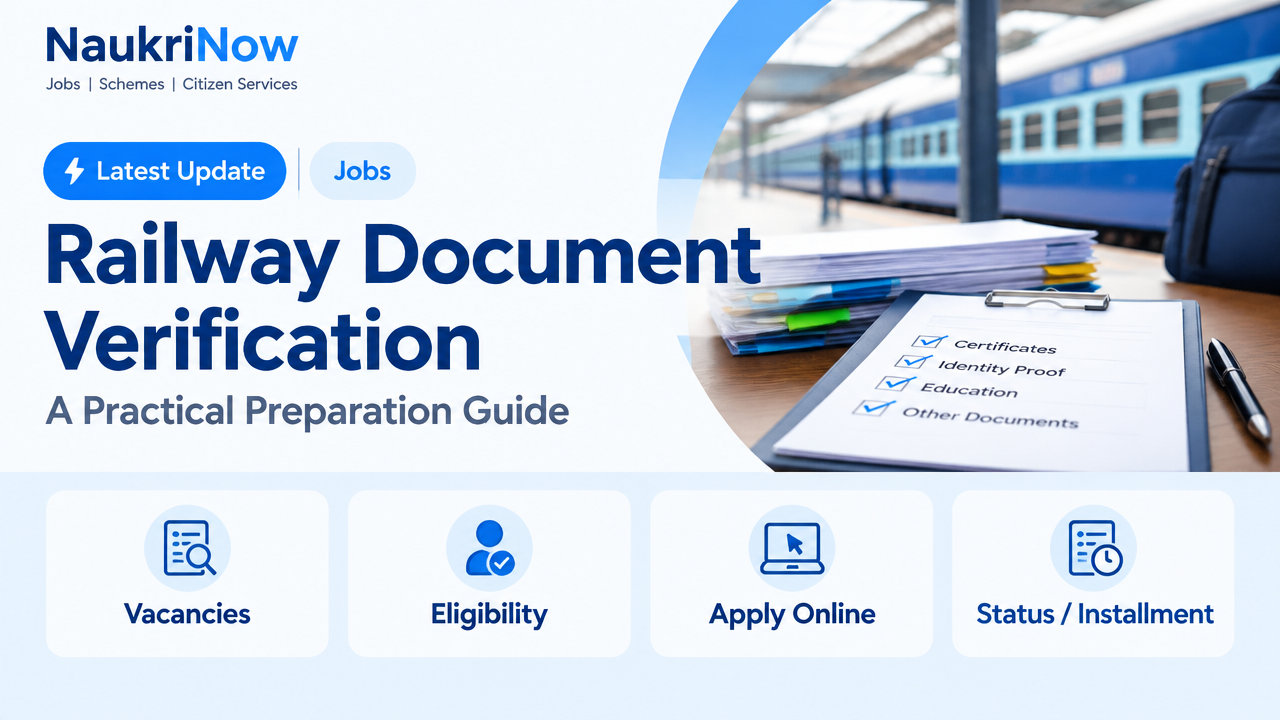
Railway recruitment document verification is the stage at which the recruiting authority checks whether your certificates and other records support the information in your application. Careful preparation can help you avoid preventable delays, but the documents required, verification process and next steps vary by recruitment and recruiting authority.
Use this guide to organise your records and spot common issues. For binding instructions, rely on the official notification, document-verification notice and call letter issued for your recruitment by the responsible Railway Recruitment Board (RRB), Railway Recruitment Cell (RRC) or other named authority. Do not assume that a rule or document accepted in one recruitment automatically applies to another.
Railway Document Verification: What happens at document verification?
At this stage, officials compare the details in your application with the supporting records you provide. They may check your identity, date of birth, educational qualifications and any category, disability, service or other claim relevant to the post. The exact checks depend on the recruitment notice and your circumstances.
Being called for verification is not, by itself, a guarantee of appointment. The recruiting authority may still need to complete other steps specified for that recruitment, such as checking eligibility, medical fitness or other required records. Read the official instructions to understand what the stage means and what follows it. If a certificate is missing or a detail does not match, ask the responsible authority how it will be handled; do not rely on informal assurances.
Start with the instructions for your recruitment
Before collecting documents, identify the exact recruitment name, post, notification or advertisement number, and the authority that issued the notice. Railway recruitment information can be published by different boards or cells, and instructions may differ even when the posts seem similar.
- Open the official website named in your recruitment notice. Check that the address is genuinely an official authority website rather than an advertisement or lookalike page.
- Read the original notification and any later official corrigenda, clarifications or verification notices. Later instructions may change or explain earlier ones.
- Check your individual call letter or login for the reporting venue, time, permitted items, required copies and any recruitment-specific forms.
- Note the prescribed certificate formats, relevant dates and rules for candidates whose documents were issued by another authority or are in a different language.
- If a point remains unclear, use the contact method published by the responsible authority. Keep a copy of your query and any official response.
Search-engine summaries, coaching websites, social-media posts and advice from candidates in other recruitment cycles can be useful leads, but they are not substitutes for your own official instructions.
Document checklist: organise records by purpose
The list below is a preparation aid, not a universal list of mandatory documents. Take only what your recruitment instructions require, and bring additional supporting records only when they are relevant or requested.
| Document group | What to check |
|---|---|
| Identity and application | Carry the identity documents and application-related records specified in the call letter. Check that names, photographs or other identifying details correspond to your records. |
| Date of birth | Use the record accepted for this recruitment. Confirm that the date matches the application and that any required supporting proof is available. |
| Education and qualifications | Gather the certificates, mark sheets, diplomas or other qualification evidence relevant to the post. Check that the course, result and issuing institution details are legible. |
| Category or reservation claim | If you claimed a category or other reservation, check the required certificate type, issuing authority, format and any date or eligibility conditions stated in the notice. |
| Other applicable claims | Depending on your application, this could include disability-related records, ex-serviceman documents, a no-objection certificate or proof supporting another declared claim. |
| Copies and forms | Prepare photocopies, photographs, declarations or prescribed forms only in the quantity and format instructed. Keep originals separate from copies. |
Do not assume that a familiar identity card can replace a certificate specifically required to prove a qualification or category. Likewise, do not assume that a digital copy will be accepted in place of an original. The call letter and recruitment notice determine what the authority expects.
How to prepare, step by step
- Make a requirement list. Read the notice and call letter line by line. Write down each document, its required format, whether an original is needed and how many copies are requested. Mark items that apply only if you made a particular claim.
- Compare every record with your application. Check spelling of your name, date of birth, qualification details and category or other declarations. Compare the application printout with the certificates rather than relying on memory.
- Check certificate details. Look at the full name, issuing authority, seal or signature where applicable, issue date and legibility. Confirm that any prescribed format has been followed. A certificate that appears genuine may still fail to meet a recruitment-specific requirement.
- Resolve differences early. If a name, date or other detail differs, find out whether the notice specifies acceptable supporting evidence or a correction process. Contact the responsible authority through its official channel if the instructions do not answer your question. Do not alter a certificate yourself.
- Arrange translations or supporting records if needed. If a document is not in a language accepted by the notice, follow its instructions about translation or certification. Do not assume an informal translation will be accepted.
- Prepare copies and a document order. Make clear copies if requested and arrange them in the order stated in the call letter. Keep each original with its matching copy where practical. Do not bind or mark originals unless instructed.
- Check logistics. Confirm the reporting location, time, route and entry instructions from your call letter. Allow time for travel and keep the letter and required identification accessible.
- Do one final check the day before. Use your written list, not a rushed visual check. Make sure documents are dry, readable and securely packed, and that you have any required forms and copies.
Common document problems and how to handle them
Name differences
A spelling variation, expanded initials, a name change or a difference in the order of names can prompt questions. Check whether the recruitment notice explains what evidence to provide. Depending on the circumstances and instructions, supporting records may be relevant, but no single solution should be assumed to apply to every case. Raise the issue with the authority before the appointment where possible and carry the specified evidence.
Qualification details do not line up
Applicants sometimes bring a provisional result when the notice asks for a particular certificate, or overlook a mark sheet needed to support a qualification. Check the exact qualification stated in your application against the eligibility wording and the documents requested. If a certificate is pending, do not assume that a receipt, online result or letter will be accepted unless the authority’s instructions say so.
Category certificate is the wrong type or format
Category-related requirements can depend on the recruitment and the claim made in the application. Check the prescribed wording, format, issuing authority and relevant dates in the official notice. A certificate accepted for another purpose or recruitment may not meet this one’s requirements.
Only a digital copy is available
Online access to a record is useful for checking details and keeping a backup, but it does not automatically replace an original or a specified certified copy. Follow the call letter on originals and electronic records. If an original is unavailable, seek official guidance promptly rather than waiting until you report.
On the day: a calm, practical routine
Arrive according to the reporting instructions and keep your call letter and required identity documents ready. Follow directions from authorised staff, submit documents in the requested order and answer questions clearly. If asked to provide a copy or complete a form, check that it relates to your recruitment before signing or handing it over.
If an official points out a discrepancy, stay courteous and ask what clarification or evidence is required and how to provide it. Do not argue from online rumours or pressure staff to accept a document that the instructions do not support. Keep any acknowledgement or written communication you are given. Never leave original certificates behind unless an authorised process explicitly requires it; if an original is retained, ask for an official receipt and follow the authority’s documented procedure.
Mistakes to avoid
- Using another recruitment’s checklist: Requirements can vary by post, notification and recruiting authority.
- Bringing copies but not required originals: Read the call letter carefully; do not guess which version is enough.
- Ignoring a mismatch: A small spelling or date difference is still worth investigating before verification.
- Relying on old or unofficial information: Confirm current instructions on the official recruitment website.
- Submitting altered or unclear records: Never edit a certificate or present a document you cannot verify. Ask the issuing authority about a genuine correction.
- Paying an unauthorised person: Do not pay an agent or share credentials because someone promises a favourable result. Use a payment channel only if an official notice specifically instructs you to do so.
- Sharing sensitive records publicly: Avoid posting call letters, identity numbers, certificates or application details on social media or in public groups.
Useful examples
Example 1: Initials differ from the application. An applicant’s education certificate uses initials, while the application spells out the name. The practical response is to check the recruitment instructions for acceptable proof, gather relevant supporting records and ask the recruiting authority what it requires. The applicant should not assume that a particular affidavit or declaration will automatically resolve the issue.
Example 2: A category certificate is available but the format is uncertain. The applicant should compare it with the format and conditions stated in the specific notice. If the issuing authority or wording does not appear to match, contact the recruiting authority and, where appropriate, the certificate-issuing office before verification. A certificate accepted elsewhere is not proof that it meets this recruitment’s conditions.
Example 3: An original qualification document has not been issued. The applicant should read the notice for instructions on pending or provisional documents and ask the responsible authority if the situation is not covered. An online result or application receipt may be helpful context, but acceptance depends on the official rules for that recruitment.
Frequently Asked Questions
1. Is document verification the same as final selection?
No. Verification checks records and eligibility claims. Whether further checks or stages apply, and when a candidate is considered for appointment, depends on the recruitment’s official process.
2. Which documents should I bring?
Use the list in your recruitment notification and individual call letter. Prepare the records relevant to your application, but do not treat a general online checklist as a substitute for those instructions.
3. Do I need both originals and photocopies?
Follow the call letter. It may specify which originals to present and how many copies to submit. Do not assume that photocopies or digital versions can replace originals.
4. What if my name is different across documents?
Check the notice for the procedure or supporting evidence it accepts, and contact the recruiting authority if the answer is unclear. Bring relevant records as instructed; do not alter certificates yourself.
5. Can I use a certificate issued in another state or language?
That depends on the certificate and the recruitment’s requirements. Check its prescribed format, issuing authority and language instructions in the official notice. Seek guidance before verification if anything is uncertain.
6. What should I do if a required document is missing?
Contact the responsible authority promptly through the official channel and explain the specific issue. Ask what, if anything, it will accept. Do not rely on an unofficial promise or assume that a substitute document will be allowed.
7. Where can I confirm the venue, schedule and latest instructions?
Check your call letter and the official website of the RRB, RRC or other authority named in your recruitment notice. Those sources are responsible for current, recruitment-specific information.
Conclusion
Good preparation for railway document verification means matching your records to your application, checking certificate requirements early and following the instructions issued for your exact recruitment. Keep originals and requested copies organised, resolve discrepancies through official channels and protect your personal information. Because formats, procedures and schedules can change, use the responsible recruiting authority’s official notice and call letter for the final word.


Comments