Table of ContentsClick to view all sections
- PM Vishwakarma Shram Samman Yojana: key objectives at a glance
- Who runs the scheme and where to apply
- Who can apply? Eligibility criteria
- Key benefits under the scheme
- Visual summary: how the support may flow
- Documents and details to prepare
- Step-by-step application process: how to register and apply
- How to check application or beneficiary status
- Advantages and limitations
- PM Vishwakarma Yojana vs PM SVANidhi: quick comparison
- Common application problems to avoid
- Conclusion
- Important links
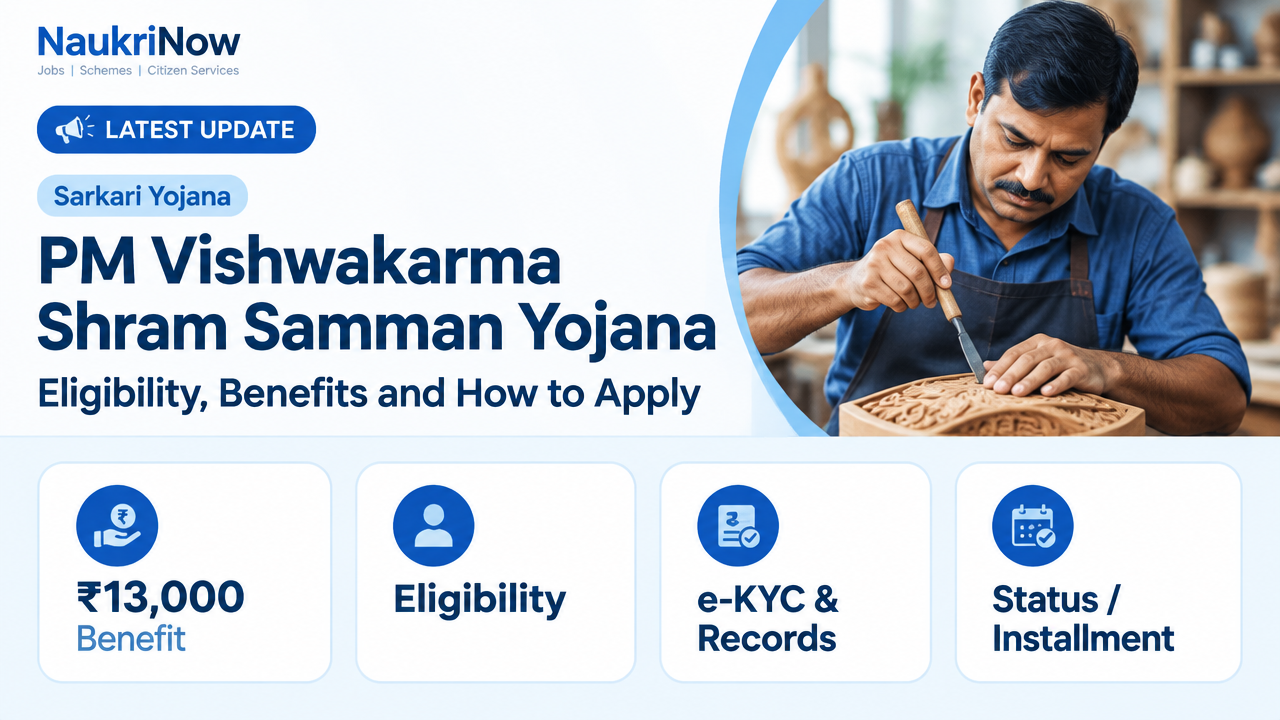
Looking up the PM Vishwakarma Shram Samman Yojana? This guide explains the Central Government’s PM Vishwakarma scheme, which people may search for using that name. It covers the scheme’s aims, the 18 eligible trades, application conditions, recognition, training, toolkit support, loans, digital and marketing assistance, and the CSC registration process. A state-level scheme with a similar name may have different rules, so confirm that you are using the official Central Government portal before applying.
PM Vishwakarma Shram Samman Yojana: key objectives at a glance
PM Vishwakarma is intended to support eligible traditional artisans and craftspeople who work with their hands and tools in specified trades. Its support combines recognition, skills development and assistance for business activity. The scheme is not a single unconditional cash payment: its benefits have separate conditions and are provided through the relevant registration, verification, training and lending processes.
| Detail | Information |
|---|---|
| Official scheme name | PM Vishwakarma |
| Launched | 17 September 2023 |
| Responsible ministry | Ministry of Micro, Small and Medium Enterprises (MSME) |
| Scheme period | FY 2023–24 to FY 2027–28 |
| Budget outlay | ₹13,000 crore |
| Who it supports | Eligible traditional artisans and craftspeople working in 18 specified trades |
| Where to register | Through a Common Service Centre (CSC) using the official PM Vishwakarma portal |
Who runs the scheme and where to apply
The Ministry of Micro, Small and Medium Enterprises is the responsible ministry. Registration is carried out through a Common Service Centre using the official PM Vishwakarma system. A CSC can help submit details and complete the prescribed verification steps; registration should not be confused with automatic approval for every benefit.
Start with the official portal at pmvishwakarma.gov.in or ask an authorised CSC about the current process. Avoid unofficial websites or messages that promise guaranteed approval, a guaranteed loan, or a faster benefit in exchange for payment or personal verification codes.
Who can apply? Eligibility criteria
The scheme is for eligible artisans and craftspeople working in covered traditional trades, generally in the unorganised sector on a self-employment basis. Applicants must meet the conditions in the scheme guidelines and have their details verified. The fact that someone performs skilled manual work does not by itself establish eligibility: the occupation must fit a listed trade, and other rules also apply.
Basic eligibility checks
| Check | What to know |
|---|---|
| Age | The applicant must be at least 18 years old on the date of registration. |
| Trade and work | The applicant must be engaged in an eligible traditional trade covered by the scheme. |
| Family limit | Only one member of a family may receive benefits under the scheme. The official guidelines define the family unit. |
| Government employment | Government employees and their family members are excluded under the scheme guidelines. |
| Previous credit-linked support | Prior loans under specified government credit-linked schemes can affect eligibility. The rules include conditions relating to loans taken in the previous five years and loans fully repaid. Ask a CSC to check your circumstances rather than assuming that an earlier loan does or does not disqualify you. |
| Verification | Identity, occupation and other application details are subject to scheme verification. |
Priority and focus groups
The eligibility described for this scheme is based on work in one of the specified trades and compliance with the scheme conditions. Do not assume that a separate community, income group or location automatically qualifies for priority unless the official rules say so. If you are unsure how your work should be classified, explain the tasks you actually perform to the CSC and ask it to confirm the appropriate trade category before submission.
The 18 trades covered under PM Vishwakarma
| No. | Trade | No. | Trade |
|---|---|---|---|
| 1 | Carpenter | 10 | Barber |
| 2 | Boat Maker | 11 | Garland Maker |
| 3 | Armourer | 12 | Washerman (Dhobi) |
| 4 | Blacksmith | 13 | Tailor |
| 5 | Hammer and Tool Kit Maker | 14 | Fishing Net Maker |
| 6 | Locksmith | 15 | Mason (Rajmistri) |
| 7 | Goldsmith | 16 | Basket, Mat or Broom Maker |
| 8 | Potter | 17 | Traditional Doll and Toy Maker |
| 9 | Sculptor or Stone Carver | 18 | Cobbler or Shoemaker |
Use the trade names shown on the official portal when applying. A familiar local name for a craft may differ from the portal category. If your work appears similar to a listed trade but is described differently, ask the CSC to confirm the correct category before the application is submitted. Selecting a near-match without checking can create questions during verification.
Key benefits under the scheme
Eligible applicants may receive several types of support, but these do not all arrive at the same time or in the same form. Recognition follows registration and verification. Training involves participation in the prescribed process. Toolkit assistance is an e-voucher, and enterprise credit is a repayable loan subject to lender assessment and scheme conditions.
| Benefit | What eligible applicants may receive | Important detail |
|---|---|---|
| Recognition and identity | PM Vishwakarma Certificate and ID Card | Issued after registration and verification through the scheme process. |
| Skills training | Basic training of 5–7 days; optional advanced training of 15 days or more | Training availability and progression depend on the scheme process. |
| Training stipend | ₹500 per training day | Payable for eligible training days under scheme rules; it is not a general application payment. |
| Toolkit support | Toolkit incentive of up to ₹15,000 | Provided as an e-voucher under the applicable process, not as an unrestricted cash award. |
| Enterprise credit | First loan up to ₹1 lakh; second loan up to ₹2 lakh | Collateral-free credit is conditional on lender assessment and scheme eligibility. |
| Digital and marketing support | Support for eligible digital transactions and marketing assistance | Availability and conditions should be checked on the official portal. |
1. Recognition and identity
Eligible beneficiaries may receive a PM Vishwakarma Certificate and ID Card after registration and verification. These provide formal recognition through the scheme. They are not, by themselves, a promise that every other benefit has been approved. Keep any acknowledgement or scheme record safely, and follow instructions for subsequent stages.
2. Skill training with a stipend
The scheme includes basic training lasting 5–7 days and optional advanced training lasting 15 days or more. The stated stipend is ₹500 for each eligible training day, subject to participation and the applicable process. It should not be treated as money paid simply for registering. Ask the CSC or the training authority what attendance, scheduling and follow-up requirements apply in your case.
Training may be relevant if you want to strengthen your existing skills or learn practices that support your work. However, training dates and progression depend on scheme arrangements. Do not assume that an advanced course is automatic or that a particular course date is available before it has been confirmed through the scheme process.
3. Toolkit incentive
The toolkit incentive is up to ₹15,000 and is provided as an e-voucher through the prescribed process. An e-voucher is not the same as an unrestricted cash payment. Check how the voucher is issued and what it can be used for before relying on it to purchase tools. The maximum amount should not be read as a guaranteed payment in cash to every applicant.
4. Collateral-free credit support
Eligible artisans may be able to access business credit in two stages through participating lending institutions. The scheme’s stated beneficiary interest rate is 5%, subject to applicable scheme and lender terms. These are loans, not grants, and approval is not automatic. A lender assesses the application, and the second tranche has additional conditions.
| Loan stage | Maximum amount | Repayment period | Key point |
|---|---|---|---|
| First tranche | Up to ₹1 lakh | 18 months | Subject to eligibility and lender approval. |
| Second tranche | Up to ₹2 lakh | 30 months | Not paid at the same time as the first tranche. Eligibility depends on meeting scheme conditions, including the status of the first loan and other prescribed requirements. |
The amounts in the table are maximums, not guaranteed entitlements. Before accepting a loan, ask the lending institution to explain the approved principal, interest, instalments, repayment schedule and any applicable charges. Consider whether expected business income can support repayment. If a second tranche matters to your plans, confirm the conditions for it rather than assuming it will be available automatically.
5. Digital and marketing support
The scheme also includes support for eligible digital transactions and marketing assistance. The exact conditions and availability should be checked on the official portal. Treat this as a possible part of the scheme’s support rather than a guaranteed payment or a promise of specific sales. Ask what steps are required to access any support relevant to your work.
Visual summary: how the support may flow
The following is a plain-language outline of the scheme process, not a promise that every applicant will receive every benefit. Eligibility checks and verification apply at each relevant stage.
- Check your trade and conditions: confirm that your work fits one of the 18 listed trades and review age, family, employment and previous-credit conditions.
- Register through a CSC: provide accurate personal, household, occupation and bank details and complete the prescribed verification.
- Wait for the scheme process: registration details are subject to verification. Keep the application reference and respond to any request for clarification.
- Follow recognition and training instructions: if eligible, proceed with the certificate, ID and training steps as instructed.
- Use relevant support: toolkit, digital and marketing support depend on their respective processes and conditions.
- Consider credit separately: apply for a loan only after reviewing lender terms and understanding that repayment is required.
Illustrative benefit distribution
| Support type | How to understand it | What to confirm |
|---|---|---|
| Certificate and ID | Recognition after registration and verification | Whether the application has passed the required checks |
| Training and stipend | Training participation with a stipend for eligible days | Schedule, attendance requirements and the applicable payment process |
| Toolkit | Up to ₹15,000 through an e-voucher | Issue and permitted use under the scheme process |
| Credit | Potential two-stage, collateral-free loan support | Lender decision, approved terms, repayment and second-tranche conditions |
| Digital and marketing support | Additional support for eligible users | Current availability and specific conditions |
Documents and details to prepare
Requirements can depend on the application and verification process, so ask the CSC which records are needed for your case. Commonly relevant details include:
- Aadhaar and access to the mobile number used for verification.
- Bank account details, including the account number and IFSC.
- Accurate personal, household and address information.
- Details of your trade and current work.
- Ration card or household details, if requested for verification.
Check spellings, account digits and other entries before the CSC submits the application. Keep your own record of the acknowledgement or application reference. Do not assume a caste certificate is a universal application requirement; follow the instructions given by the official portal or CSC for your case. Never share an OTP with an unofficial agent or a person claiming that payment will guarantee approval.
Step-by-step application process: how to register and apply
For the PM Vishwakarma Shram Samman Yojana search, remember that the official scheme covered here is called PM Vishwakarma. Registration is processed through a CSC using the official system, with identity verification. The steps below describe a practical preparation and follow-up sequence; the CSC should confirm the current requirements.
| Step | Action |
|---|---|
| 1 | Find an authorised CSC and ask whether it can process PM Vishwakarma registrations. |
| 2 | Bring Aadhaar, your mobile phone and bank details, along with any other records the CSC requests. |
| 3 | Complete the prescribed identity and e-KYC verification at the centre. |
| 4 | Give accurate household, occupation, trade and bank information. Check the selected trade before the application is submitted. |
| 5 | Ask for an acknowledgement or application reference and keep it safely. |
| 6 | Follow the application through the official portal or with the CSC. If verified and approved, proceed through recognition, training and benefit stages as instructed. |
Before leaving the centre, ask how to follow up and whether any further action is expected from you. If a detail is incorrect, ask about the appropriate correction process rather than submitting another application without guidance. Keep the registered mobile number accessible because the process may use it for verification or updates.
How to check application or beneficiary status
Use the official PM Vishwakarma portal and the applicant or status option available there. Keep your registered mobile number and application reference ready; the portal may require identity verification before displaying personal details. If the status is unclear, contact the CSC that submitted the form and ask what action is pending. Do not rely on unofficial lists, forwarded messages or social-media posts claiming that a benefit has been approved.
Scheme progress figures can change over time. Because a current verified progress figure is not included here, this guide does not state a total for registrations, training or loans. For current information, check the official portal and relevant government updates rather than relying on an undated figure.
Advantages and limitations
| Pros | Cons |
|---|---|
| Recognises eligible traditional workers through a scheme certificate and ID. | Only workers in the specified trades who meet the conditions can apply. |
| Combines skills training, toolkit assistance and possible business credit in one scheme. | These supports have separate processes; registration alone does not mean all benefits are approved. |
| Provides a stipend for eligible training days and toolkit support through an e-voucher. | Training participation is required for the stipend, and toolkit support is not an unrestricted cash award. |
| Offers collateral-free credit in two stages, subject to approval. | A loan must be repaid. The second tranche is conditional and cannot be assumed or claimed upfront. |
| Includes digital and marketing support intended to assist eligible artisans. | Availability and conditions should be checked; specific business results are not guaranteed. |
| CSC-assisted registration can help applicants complete the prescribed process. | Applicants need to provide accurate details and may need to complete verification or follow-up steps. |
The scheme may be useful if your occupation is covered and you can make use of the relevant training or business support. Its main limitations are the narrow trade-based eligibility, verification requirements and the fact that credit is repayable and lender-approved. Review each benefit on its own terms instead of treating the scheme as a guaranteed cash package.
PM Vishwakarma Yojana vs PM SVANidhi: quick comparison
These are separate Central Government schemes for different kinds of work. PM Vishwakarma is for eligible traditional artisans in specified trades; PM SVANidhi is designed for street vendors. The schemes have different application rules and loan structures. If you have received a loan under another government scheme, check the current PM Vishwakarma eligibility conditions before applying rather than assuming that both schemes can—or cannot—be used together.
| Point | PM Vishwakarma | PM SVANidhi |
|---|---|---|
| Intended group | Eligible traditional artisans and craftspeople in 18 specified trades | Street vendors |
| Support described here | Recognition, training, toolkit incentive, credit and other support subject to conditions | A separate scheme with its own application rules and loan structure |
| What to do before applying | Check trade eligibility, scheme conditions and the CSC process | Check the applicable PM SVANidhi rules and process |
Common application problems to avoid
- Choosing a near-match trade: confirm that your actual occupation fits one of the portal’s listed categories.
- Entering inconsistent details: check spelling, Aadhaar details, bank information and household data before submission.
- Assuming a loan is a grant: compare the lender’s repayment terms with your expected business income.
- Expecting the second tranche immediately: ask which conditions must be met after the first loan.
- Confusing a voucher with cash: confirm how the toolkit e-voucher works and what it can be used for.
- Relying on unofficial websites: start from the government portal and use an authorised CSC for registration.
- Ignoring follow-up: retain the application reference and check whether verification or another action is pending.
Conclusion
The PM Vishwakarma scheme can help eligible traditional artisans gain formal recognition, develop skills and access toolkit and credit support. Before visiting a CSC, confirm that your trade is listed and prepare accurate identity, household and bank details. Treat credit as repayable, lender-approved borrowing; check the conditions for every benefit on the official portal; and keep your application acknowledgement for follow-up. The name PM Vishwakarma Shram Samman Yojana is commonly used in searches, but check that you are applying to the Central Government’s PM Vishwakarma scheme rather than a different scheme with a similar name.
Frequently Asked Questions
Is PM Vishwakarma the same as PM Vishwakarma Shram Samman Yojana?
PM Vishwakarma is the name of the Central Government scheme covered here. People may search for it using “PM Vishwakarma Shram Samman Yojana.” A state scheme with a similar name may have different rules, so check the relevant government portal and confirm the scheme before applying.
Is there an age limit for this scheme?
An applicant must be at least 18 years old on the date of registration, subject to the other scheme conditions.
Can I apply directly from home without visiting a CSC?
Registration is processed through a CSC with the required identity verification. Contact an authorised centre for the current procedure; avoid websites promising guaranteed home registration or approval.
How much toolkit assistance is available?
The toolkit incentive is up to ₹15,000, provided through the scheme’s prescribed process as an e-voucher. It is not an unrestricted cash grant.
Is the stipend paid during training guaranteed?
The scheme provides a stipend of ₹500 per eligible training day. Payment depends on participation and the applicable scheme process; it is not a general registration payment.
Can I get both loan tranches together?
No. Credit is structured in two stages. The second tranche is subject to conditions, including requirements relating to the first loan. Confirm eligibility with the lender or CSC.
Is the PM Vishwakarma loan interest-free?
No. The beneficiary interest rate is stated as 5% under the scheme, subject to applicable terms. Confirm the final approved terms and repayment schedule with the lending institution.
How much progress has the scheme made so far?
Progress figures may change, and this guide does not provide an unverified current total. Check the official PM Vishwakarma portal or government updates for the latest available information.
What should I do if my application status is not changing?
Check the official portal using the details requested there, then contact the CSC that submitted your application. Keep your acknowledgement or reference number available and ask whether verification or another action is pending.
Important links
| Resource | Link |
|---|---|
| PM Vishwakarma official portal | pmvishwakarma.gov.in |
| Ministry of MSME | msme.gov.in |
| Government of India services and information | india.gov.in |
Comments