Table of ContentsClick to view all sections
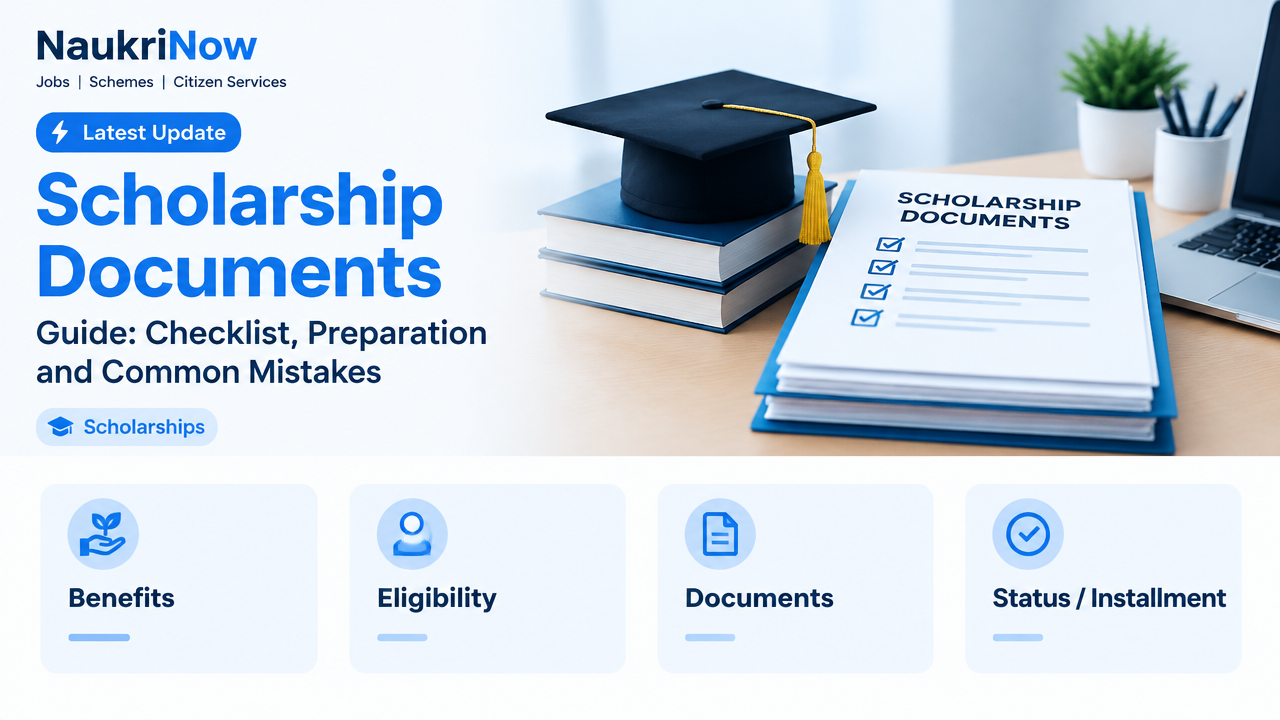
Scholarship Documents Guide: Checklist, Preparation and Common Mistakes
A scholarship application can depend on more than good marks or a well-written form. The documents you provide may be used to confirm your identity, education, eligibility, family circumstances and bank details. Missing pages, unclear scans or conflicting information can slow down verification or lead to a request for clarification.
There is no single document list that applies to every scholarship. Requirements differ by scheme, education level, institution and applicant circumstances. Use this guide to prepare a sensible document file, then check the latest instructions on the responsible official scholarship portal, government department, scholarship provider or institution before applying.
Scholarship Documents: Start with the official requirements
Before collecting papers, find the current application instructions for the specific scholarship. Check the official notice and application portal, and contact the relevant institution or administering office if the instructions are unclear. A search result, social media post or old application form may not reflect the current requirements.
Read the instructions for your applicant category and course, not only the general overview. Note which documents are compulsory, which are needed only in particular circumstances, what format and file size are accepted, and whether an original, copy, upload or later verification is requested. Also note whether documents must be issued by a specified authority or fall within a stated validity period. Do not assume these details are the same across schemes.
Make a two-column checklist: the document or detail requested, and the action you need to take. Mark each item as ready, needs updating, needs to be obtained, or not applicable. If a requirement is ambiguous, ask the official scheme contact or your institution rather than guessing.
Common scholarship document categories
The following categories are a preparation guide, not a universal mandatory list. Submit a document only when the scholarship instructions ask for it or it is relevant to proving your eligibility.
| Category | Examples that may be requested | What to check |
|---|---|---|
| Identity and personal details | Identity document, photograph, signature or proof of date of birth | Names and dates should be legible and consistent with the application instructions. |
| Academic record | Mark sheets, examination results, certificates, admission letter or proof of current enrolment | Include the academic year, course or term requested; do not substitute a different record without checking. |
| Family income | Income certificate or other evidence specified by the scheme | Check the accepted issuing authority, relevant period and any format or validity conditions. |
| Category or special circumstance | Certificate or supporting record for a category, disability, orphan status or other stated eligibility condition | Provide only what applies to you and confirm the required document and issuing authority. |
| Residence | Domicile, residence or address proof, if requested | Confirm which type of proof is accepted and whether it must relate to a particular state or period. |
| Bank details | Bank passbook page, account proof or another record specified by the scheme | Check that the account holder and account details meet the scheme’s instructions. |
| Institution information | Bonafide certificate, fee details, institution identification or verification form | Ask the school, college or university which parts it must complete or verify. |
Build a reliable document file
1. Confirm your details before scanning
Compare the spelling of your name, date of birth, parent or guardian details, address and other requested information across the application and supporting records. Pay attention to initials, surname order, spaces and differences caused by transliteration between languages. A small variation may need an explanation or supporting document, depending on the scheme.
Do not alter a certificate or edit a scan to make details appear consistent. If a genuine discrepancy exists, ask the administering authority what evidence or correction process it accepts. Where a correction is needed on an official record, allow time for the responsible issuing body to advise you.
2. Gather complete, readable copies
Scan or photograph each document in good light, with all edges visible and text in focus. Check that seals, signatures, dates and certificate numbers can be read. Avoid glare, shadows, fingers covering text, tilted pages and low-resolution images. If a document has information on both sides, check whether both sides are required and capture them as separate pages when appropriate.
For a multi-page record, make sure every requested page is included and in the right order. Do not crop off stamps or explanatory notes. Keep the original document safe; upload a copy unless the official instructions specifically require something else.
3. Use the required format and file rules
Follow the portal’s stated file type, size limit, dimensions and naming instructions. Requirements vary, so do not assume that a file accepted by one scholarship portal will work on another. If no naming convention is given, use a clear, simple filename such as Academic_Marksheet_Year or Income_Certificate. Avoid special characters that may cause upload problems.
Reduce a file’s size only with a method that preserves legibility. After compressing or converting a document, open the final file and inspect every page. A successful upload indicator does not always mean the image is readable or the correct document was attached.
4. Check dates, issuing authority and validity
Some documents are accepted only when issued by a specified authority or within a specified period. These rules are scheme-specific. Check the current instructions for the required issuer, date range, format and any renewal condition. If your document is old, unclear or appears to have expired, do not assume it will be accepted; confirm with the official source.
5. Keep a secure master folder
Store clean copies in a clearly organised folder, with subfolders such as Identity, Academic, Income and Institution. Keep a separate checklist showing which file was uploaded to which field. This helps when forms ask for similar documents in different places or when an application is returned for correction.
Scholarship records contain sensitive personal and financial information. Use a device and storage account you trust, avoid public computers where possible, sign out after using a portal and do not send identity or bank documents to unverified contacts. Never share passwords or one-time verification codes. Submit documents only through the official channel named by the scholarship provider or institution.
A practical checklist before you apply
- Read the current official notice and the instructions shown in the application portal.
- Check eligibility and make a list of every document required for your own circumstances.
- Confirm whether any certificate needs a particular issuer, date, format or supporting page.
- Compare personal and academic details across your form and records.
- Request missing documents from the relevant issuing authority or institution early.
- Scan complete pages clearly and prepare files in the accepted format and size.
- Open every final file to check that it is readable and matches the upload field.
- Review all entries and attachments before submitting, then save the acknowledgement or application reference if the portal provides one.
- Check the official portal or communication channel for any follow-up request and respond using the stated process.
Examples: how to handle common situations
Your name is written differently on two records
For example, an academic record may include a middle name while an identity record uses initials. Do not silently change either document or assume the difference will be ignored. Check the scholarship instructions and ask the official administrator what supporting evidence, if any, is accepted. Enter details in the form exactly as the instructions direct.
You are waiting for a document from your institution
Ask the school or college which office issues it, what information it needs from you and whether it must use a particular format. Keep a note of the request and follow up in good time. Do not upload an unrelated certificate merely to fill a required field unless the official instructions say it is an accepted alternative.
The portal rejects a file
Check the field label, permitted format and file-size limit shown by the portal. Confirm that the file opens and is not password-protected if the portal does not allow protected files. Create a fresh copy if needed, then inspect it before trying again. If the problem continues, use the official technical or scheme support route identified on the portal; do not rely on an unofficial intermediary.
A document does not apply to your circumstances
First check whether the field is optional or whether the scheme provides a different route for applicants in your situation. If the portal requires an upload and the instructions are not clear, ask the administering authority before submitting a substitute. Do not create or modify a certificate to satisfy a field.
Mistakes to avoid
- Using a generic online list as the final authority: document requirements are scheme-specific. Verify the list with the current official notice and portal.
- Uploading an old or unrelated certificate: confirm the accepted document, issuing authority and date conditions before using it.
- Submitting blurry or incomplete scans: check every page at normal viewing size, including small print, stamps and reverse sides where relevant.
- Mixing up similar files: use descriptive filenames and open each file immediately before attaching it.
- Assuming self-attestation or notarisation is always needed: follow the exact instructions. Do not add formalities unless requested or confirmed by the responsible authority.
- Changing information to force a match: never edit official records. Seek guidance on the correct way to explain or resolve a discrepancy.
- Waiting until the last moment: certificates and institutional records can take time to obtain. Start early, while checking the official application schedule yourself.
- Sharing sensitive documents with unverified agents: use official portals and verified institutional channels, and protect your login details.
- Forgetting to review the completed form: check that each attachment is in the correct field and that submitted information matches the supporting records.
Frequently Asked Questions
Are the same documents required for every scholarship?
No. Each provider sets its own eligibility and verification requirements. A document commonly requested by one scheme may not be needed by another. Use the current official instructions for the scholarship you are applying for.
Should I upload originals or photocopies?
Follow the portal or application instructions. Online applications commonly ask applicants to upload digital copies, while an institution may later ask to see an original for verification. Do not send or hand over an original unless the responsible authority specifically instructs you to do so.
What if I do not have a document listed as required?
Contact the official scholarship administrator or your institution to ask whether an accepted alternative or a process for your circumstances exists. Do not leave a compulsory field blank or substitute another document without checking the rules.
Can I use a photograph taken on my phone?
Use one only if the portal accepts that file and it meets the stated quality and format requirements. Keep the entire page in frame, avoid glare and verify that the saved file is clear before uploading.
Do documents need to be self-attested, notarised or translated?
There is no universal rule. Check the scholarship’s current instructions for attestation, translation and certification requirements. If they do not explain what to do, ask the responsible official source before arranging extra certification.
What should I do if information differs across my documents?
Do not alter a record. Ask the issuing authority or scholarship administrator how to handle the mismatch and what supporting evidence is acceptable. If a correction is required, use the official process for that record.
Where can I confirm the latest requirements?
Use the official scholarship portal, the department or provider responsible for the scheme, and your school, college or university where it handles verification. Treat unofficial websites and forwarded messages as leads only, not as final confirmation.
Conclusion
Good document preparation is careful, scheme-specific and secure. Start with the current official requirements, organise only the records that apply to you, check consistency and scan each page clearly. Keep copies of what you submit and follow up through verified channels. When a requirement or discrepancy is unclear, ask the responsible official source rather than relying on assumptions; that is the safest way to prepare a complete scholarship application.
Comments