Table of ContentsClick to view all sections
- Application Alerts
- Official Source Chain
- Who Should Apply?
- Important Dates
- Quick Overview – Supreme Court of India Junior Court Attendant 2026
- What Posts Are Available? – Supreme Court Vacancy & Eligibility 2026
- What Is the Salary? – Supreme Court Junior Court Attendant 2026
- What Is the Application Fee?
- How to Apply?
- सुप्रीम कोर्ट जूनियर कोर्ट अटेंडेंट भर्ती 2026 – 130 पदों के लिए ऑनलाइन आवेदन
- How Are Candidates Selected?
- The SahisarkariJobs.in Analyst’s Take
- What Documents Are Required?
- What Happens After Selection?
- Contact & Helpline
- Important Links – Supreme Court Junior Court Attendant 2026
- Before You Apply: Quick Self-Check
- Conclusion
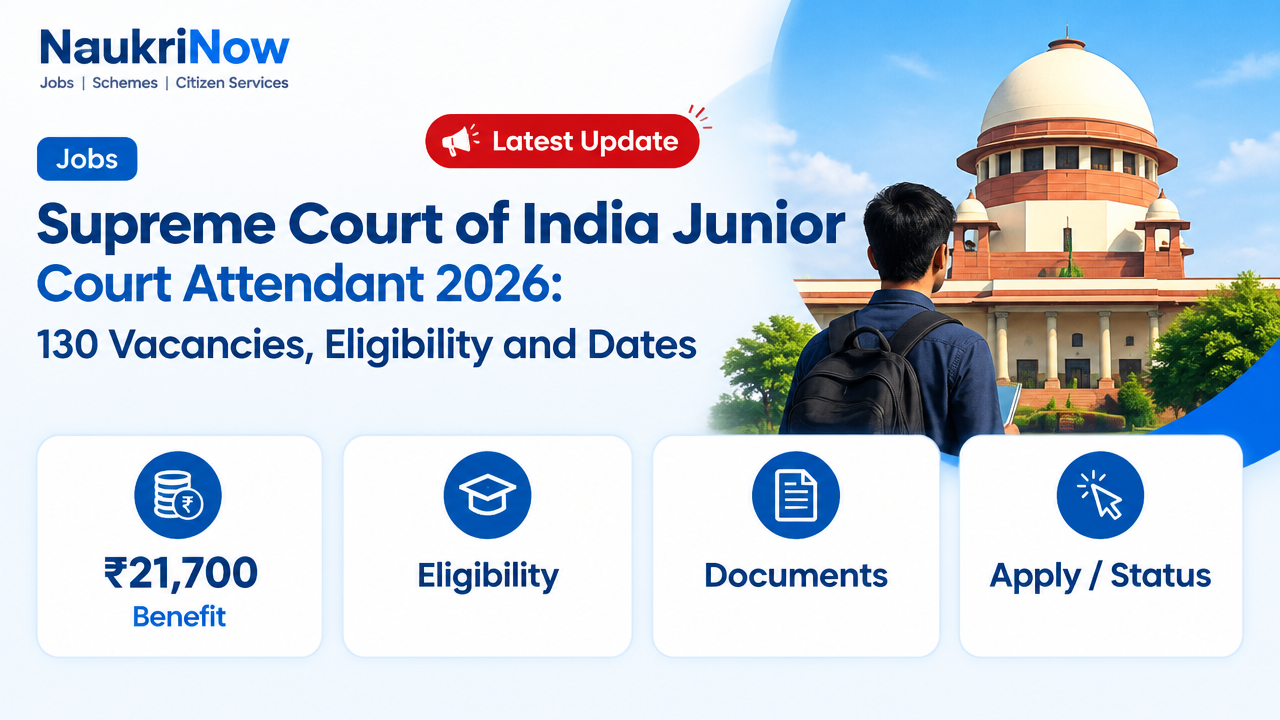
The Supreme Court of India Junior Court Attendant recruitment 2026 is for 130 tentative Group C non-clerical posts in the Supreme Court Registry at New Delhi. Online applications are scheduled to open on 4 November 2026 and close on 25 November 2026 at 11:55 PM. The education requirement is specific: applicants must have passed at least Class X and no higher than Class XII from a recognised Board or Institute.
Selection is through a 100-mark objective test followed by an interview. Before applying, read the official advertisement carefully. The application cannot be edited or withdrawn after submission, the fee is non-refundable, and the work includes practical support duties. This guide brings together the stated dates, eligibility rules, pay, examination details and application instructions so you can check the conditions before paying the fee.
Application Alerts
- Applications are not yet open: the stated opening date is 4 November 2026. Use the Supreme Court recruitment page to reach the application link when it becomes available.
- Closing time matters: the scheduled last date is 25 November 2026 at 11:55 PM. Do not wait until the final hours to register, complete the form or make payment.
- Check the education limit: the printed requirement is Class X through Class XII. The notice states a maximum qualification of Class XII, so applicants with a qualification above Class XII do not meet the stated education condition.
- Submitted forms cannot be changed: confirm your personal details, category, uploaded documents and preferred test cities before final submission.
- Use official sources: do not rely on unofficial forms, payment links or offers of job assistance.
Official Source Chain
The recruitment advertisement is identified as F.3/2026-SC (RC), dated 15 October 2026. The official Supreme Court recruitment page is the place to check for the application link and subsequent recruitment updates. Read the notification PDF as well as any instructions presented in the online form. If a later official update changes a date or process detail, follow the latest information published by the Registry rather than an older summary.
For application questions, use the contact instructions in the advertisement or on the official website. The notice identifies recruitment.cell@sci.nic.in for intimation of employment obtained after applying. It does not state a separate recruitment helpline number. The email address should not be treated as a substitute for reading the notification or as confirmation that a particular eligibility case will be accepted.
Who Should Apply?
For the Supreme Court of India Junior Court Attendant recruitment, this may be relevant to a person who meets the stated Class X-to-Class XII education band, falls within the applicable age limit or a listed relaxation, and is prepared to work in a non-clerical support role at the Supreme Court Registry in New Delhi. Applicants should also be comfortable with the two-stage selection process: an objective test covering four sections and a later interview.
Check the education condition particularly carefully. The notice does not describe the requirement as “Class X or above” without a ceiling; it sets both a minimum and a maximum. A person who has completed Class X or Class XII may fall within the printed band, subject to the other conditions. A candidate holding a qualification above Class XII does not meet the education condition as stated in the advertisement. The notice information available here does not separately settle cases where results are awaited, so those candidates should check the full notification or seek clarification through the official contact details before applying.
The position is based in New Delhi, and the stated duties are practical and service-oriented. Applicants should consider the location and nature of the work, not only the pay scale or the name of the institution. Meeting the eligibility conditions allows a person to apply; it does not guarantee an interview, placement on the merit panel or appointment.
Important Dates
| Event | Date or detail |
|---|---|
| Notification date | 15 October 2026 |
| Online applications open | 4 November 2026 |
| Last date to apply | 25 November 2026, 11:55 PM |
| Objective Type Test | 26 December 2026, tentative |
| Answer key upload | 28 December 2026, tentative |
| Answer-key objection window | 28–29 December 2026, until 11:55 PM, tentative |
| Interview | Date to be notified on the Supreme Court website |
The test and answer-key dates are expressly tentative. Check the official recruitment page for changes and for interview instructions. The interview date is not provided in the schedule above; it is to be announced on the Supreme Court website. Keep checking official updates after applying rather than assuming that the tentative dates are final. Applicants tracking the Supreme Court of India Junior Court Attendant schedule should rely on these official updates.
Quick Overview – Supreme Court of India Junior Court Attendant 2026
| Recruitment detail | Information |
|---|---|
| Recruiting organisation | Supreme Court of India, Registry |
| Advertisement number | F.3/2026-SC (RC), dated 15 October 2026 |
| Post | Junior Court Attendant, Group C non-clerical |
| Vacancies | 130, tentative and subject to change |
| Job location | Supreme Court Registry, New Delhi |
| Application mode | Online |
| Pay | Level 3: ₹21,700–₹69,100; initial basic pay ₹21,700 plus applicable allowances |
| Selection | Objective Type Test and interview |
This is one advertised designation, not a list of different posts. The number of vacancies is described as tentative and may change. The advertisement information covered here does not provide a category-wise vacancy breakup. Applicants should therefore avoid relying on unofficial vacancy splits and should consult the official notification for any applicable reservation provisions.
What Posts Are Available? – Supreme Court Vacancy & Eligibility 2026
| Post | Vacancies | Education requirement | Pay level |
|---|---|---|---|
| Junior Court Attendant (Group C non-clerical) | 130, tentative | Minimum Class X and maximum Class XII from a recognised Board or Institute | Level 3 |
The advertisement lists Junior Court Attendant as the post and sets the education range from Class X to Class XII. Applicants should confirm that their qualification is from a recognised Board or Institute and that it falls within the stated range. The notice does not say that a higher qualification can be disregarded; instead, it states Class XII as the maximum. Accordingly, candidates with qualifications above Class XII do not meet the printed education condition.
Age limit and relaxations
The general age range is 18 to 27 years, calculated as of 1 October 2026. The notice provides additional age provisions for specified groups. Check the full advertisement for the evidence and certificates required to claim a relaxation; do not assume that a category label alone is sufficient.
- Relaxation for SC, ST, OBC (Non-Creamy Layer), Persons with Disabilities and Ex-Servicemen is as per Government of India rules.
- Dependants of freedom fighters may receive up to five years beyond the prescribed limit.
- Widows, divorced women and women judicially separated who have not remarried may be eligible up to 35 years; the stated limits are 38 years for OBC-NCL and 40 years for SC/ST.
- Supreme Court Registry departmental candidates have no upper age limit.
- Employment in another government department, PSU, statutory body or nationalised bank does not itself provide age relaxation under the notice.
Reservation is stated to be governed by Rule 4A of the Supreme Court Officers and Servants (Conditions of Service and Conduct) Rules, 1961. The notice specifies Indian citizenship. The eligibility information covered here does not state a domicile requirement. Anyone seeking a category-based benefit should compare their circumstances with the exact notification wording and prepare the prescribed supporting documents.
What Is the Salary? – Supreme Court Junior Court Attendant 2026
The post carries Level 3 of the Pay Matrix, ₹21,700–₹69,100. The stated initial basic pay is ₹21,700, plus applicable allowances. The advertisement does not provide a take-home salary figure or specify current DA and HRA amounts. For that reason, an exact monthly in-hand amount cannot be confirmed from the information given here; actual pay will depend on applicable allowances and deductions.
The role is a regular Group C non-clerical support post at the Supreme Court Registry in New Delhi. Duties described in the notice include carrying files, paper books and records; dusting furniture and other items; and serving refreshments to Registry officers and officials. These duties indicate that the position is not described as a clerical desk job. Applicants should decide whether the practical duties and New Delhi posting are suitable for them before starting an application.
What Is the Application Fee?
| Applicant category | Fee |
|---|---|
| General / Unreserved | ₹1,500 plus bank charges |
| SC / ST / OBC-NCL / Ex-Servicemen / Persons with Disabilities | ₹750 plus bank charges |
Payment is online through the UCO Bank payment gateway provided with the application. The application fee is non-refundable, so confirm that you meet the stated conditions and have selected the correct category before paying. Bank charges are additional to the listed fee.
The notice also specifies a separate charge of ₹100 for each answer-key objection. That amount is refunded only if the objection is accepted as valid. Candidates should follow the objection instructions and deadline published with the answer key; the presence of an objection facility does not change the test’s stated marking scheme or guarantee that a challenge will be accepted.
How to Apply?
For the Supreme Court of India Junior Court Attendant application, the form is scheduled to become available online on 4 November 2026. Use the official Supreme Court recruitment page to find the application link. The following sequence is a practical way to check the main tasks; the online form and notification remain the authority for the exact fields and upload specifications.
- Open the official recruitment page. From 4 November 2026, visit the Supreme Court recruitment page and locate the Junior Court Attendant application link.
- Register and enter your details. Complete the form using accurate personal information. The notice instructs candidates to enter their name, date of birth and other details as shown on the Class X certificate.
- Upload the required materials. Add the photograph, signature and supporting certificates requested by the form. Include category or disability documents where applicable.
- Select preferred test cities. Choose from the options in the advertisement. The Registry may change centres depending on administrative requirements.
- Pay the applicable fee. Use the online UCO Bank gateway provided with the application and check that the payment is completed through the official process.
- Review before final submission. Check spelling, dates, category, qualifications and uploads. Submit the form and save or print a copy for your records.
Do not send a hard copy to the Registry. The notice says an application cannot be withdrawn or modified after submission. If more than one form is submitted, only the last submitted form is considered. The category selected in the form cannot later be changed. These restrictions make the review step important: correct errors before submission, not after it.
सुप्रीम कोर्ट जूनियर कोर्ट अटेंडेंट भर्ती 2026 – 130 पदों के लिए ऑनलाइन आवेदन
इस भर्ती में सुप्रीम कोर्ट रजिस्ट्री, नई दिल्ली में जूनियर कोर्ट अटेंडेंट के 130 अस्थायी पद बताए गए हैं। आवेदन 4 नवंबर 2026 से ऑनलाइन शुरू होने और 25 नवंबर 2026 को रात 11:55 बजे बंद होने के लिए निर्धारित हैं। योग्यता की सीमा कक्षा X से कक्षा XII तक है। आवेदन भरने से पहले आधिकारिक विज्ञापन में आयु, शुल्क, दस्तावेज और चयन प्रक्रिया की शर्तें ध्यान से देखें।
How Are Candidates Selected?
The Supreme Court of India Junior Court Attendant selection process has two stages: a 100-mark multiple-choice Objective Type Test followed by an interview. Candidates need at least 50 marks in the test and at least 13 marks in the interview to qualify. If many candidates reach the test qualifying mark, the Registry may restrict interview invitations to candidates in merit order at a 1:3 ratio against the tentative vacancies. Meeting a minimum qualifying mark is therefore not the same as being guaranteed an interview.
| Test section | Questions | Marks |
|---|---|---|
| General Intelligence and Reasoning | 25 | 25 |
| Numerical Aptitude | 25 | 25 |
| General English | 25 | 25 |
| General Awareness | 25 | 25 |
| Total | 100 | 100 |
- The test duration is 1 hour 30 minutes.
- Each correct answer carries one mark.
- Each incorrect answer attracts a deduction of 0.25 marks.
- The test date is tentative. Candidates choose preferred test cities from the options in the advertisement, but the Registry may change centres for administrative requirements.
- The interview may be conducted online or in person in Delhi, as stated in the notice.
For preparation planning, candidates can use the four published sections as a checklist of the test’s scope. The notice information presented here does not provide a more detailed topic-by-topic syllabus, so applicants should consult the official advertisement rather than assume additional subjects or question formats. The negative marking also makes it sensible to read the final examination instructions carefully and understand how unanswered questions are treated; no separate rule for unanswered questions is specified here.
Final placement on the merit panel does not by itself guarantee appointment. Appointment is subject to document verification and the Registry’s requirements. The advertisement does not specify a joining date, probation period or bond. No TA/DA is payable for attending the test or interview.
The SahisarkariJobs.in Analyst’s Take
The most important feature to check is the unusual education ceiling. Applicants should not rely on a general assumption that more education always meets a minimum qualification: this advertisement states a maximum of Class XII. The second important consideration is the nature of the work. Carrying files and records, dusting and serving refreshments are among the stated duties, so candidates should assess the actual role as well as the institution and pay scale.
There are several points to verify before submission: age as of 1 October 2026, the correct category and supporting certificates, the exact personal details matching the Class X certificate, and the preferred test cities. The fee is non-refundable, and the form cannot be edited after submission. Candidates should keep a copy of the submitted application and use the official website for updates about the test, answer key and interview. This is a summary of the stated conditions, not a replacement for the official advertisement.
What Documents Are Required?
The application instructions identify the following uploads, as relevant to the candidate. Check the online form and notification for file requirements and any additional evidence required for a particular claim.
- Recent photograph and signature.
- Class X certificate and Class XII certificate, if applicable.
- Caste or community certificate and non-creamy layer certificate, where applicable.
- Disability certificate, where applicable.
Keep original certificates ready for verification. Candidates employed in Central or State Government, PSUs, statutory bodies or nationalised banks must provide a No Objection Certificate as required by the notice. PwBD applicants seeking a scribe should check the prescribed appendices and supporting-document requirements in the official advertisement. Do not assume that an upload alone will be sufficient for a claim if the notice also requires a particular certificate or format.
What Happens After Selection?
- Answer key: the Registry is scheduled to upload the answer key according to the announced timetable. The notice provides a limited objection period and a ₹100 charge per objection, refundable only if the objection is accepted as valid.
- Interview: candidates who qualify may be called for interview. The date and further instructions will be published through the official website.
- Merit panel and verification: candidates who qualify both stages are placed on a merit panel. The Registry verifies eligibility and documents before appointment decisions.
The process does not end merely because a candidate has taken the test or attended an interview. Candidates should monitor official updates and be ready to provide the required original documents. A merit-panel place is not, on its own, a promise of appointment. The notice information covered here does not state when joining would take place or specify probation or bond conditions.
Contact & Helpline
The advertisement identifies recruitment.cell@sci.nic.in for intimation of employment obtained after applying. No separate recruitment helpline number is stated in the notice. Verify the contact instructions in the official PDF before sending information. Do not pay anyone offering job assistance or claiming to guarantee selection.
Important Links – Supreme Court Junior Court Attendant 2026
| Resource | Link |
|---|---|
| Official recruitment advertisement, F.3/2026-SC (RC) | Open notification PDF |
| Supreme Court of India recruitment page | Check official recruitment updates and application link |
| Supreme Court of India website | Visit the official website |
Before You Apply: Quick Self-Check
- Have you passed at least Class X and no higher than Class XII from a recognised Board or Institute?
- Have you calculated your age on 1 October 2026 and checked any relaxation you intend to claim?
- Are your name, date of birth and other details consistent with your Class X certificate?
- Have you selected the correct category and prepared the relevant supporting documents?
- Are you prepared for the objective test, its 0.25-mark penalty for incorrect answers and the subsequent interview?
- Are you willing to work in the New Delhi Registry and undertake the practical support duties described in the notice?
- Can you complete the online form and payment within the stated application window?
If any answer is uncertain, review the advertisement before submitting the form. In particular, confirm the education ceiling, the applicable age provisions and the precise documents needed for any reservation or relaxation claim. Since the application cannot be modified after submission and the fee is non-refundable, resolving these questions beforehand can help you avoid preventable mistakes.
Frequently Asked Questions
What is the last date to apply for Supreme Court Junior Court Attendant 2026?
The scheduled closing date is 25 November 2026 at 11:55 PM. Applications are scheduled to open on 4 November 2026. Check the official recruitment page for updates.
What is the age limit for Supreme Court Junior Court Attendant?
The general age range is 18 to 27 years as of 1 October 2026. Relaxations apply to specified categories and candidates under the conditions stated in the official advertisement.
Is there an exam for Supreme Court Junior Court Attendant, or is it interview-based?
There is an objective test followed by an interview. The test has 100 questions for 100 marks and lasts 1 hour 30 minutes. The stated qualifying marks are 50 in the test and 13 in the interview.
What is the salary of Supreme Court Junior Court Attendant?
The post is in Level 3 of the Pay Matrix, ₹21,700–₹69,100, with initial basic pay of ₹21,700 plus applicable allowances. The notice does not specify an in-hand salary.
Can final-year students or result-awaited candidates apply for Supreme Court 2026?
The advertisement information available here does not specifically explain result-awaited cases. It states the education requirement but does not settle this situation separately. Check the full notification or contact the recruitment authority through details published on the official site before applying.
Is Supreme Court Junior Court Attendant a permanent government job?
The post is described as a regular Group C non-clerical support role. The information covered here does not provide additional service conditions such as a probation period or bond.
Can candidates from other states apply for Supreme Court recruitment?
The notice information covered here specifies Indian citizenship and does not state a domicile requirement. Applicants should confirm all eligibility requirements in the official advertisement.
Where will I be posted if I get selected for Supreme Court Junior Court Attendant?
The stated location is the Supreme Court Registry at New Delhi.
What should I know before applying?
Confirm the Class X-to-Class XII education band, age on 1 October 2026, any relaxation documents, the non-refundable fee and the New Delhi support duties. Also remember that the submitted form cannot be modified or withdrawn and that the selected category cannot later be changed.
Conclusion
The Supreme Court of India Junior Court Attendant recruitment may suit candidates who meet the stated Class X-to-Class XII qualification band, fall within the applicable age limit and are willing to take up practical support duties at the Registry in New Delhi. Review the official notice before paying the fee, particularly if you are claiming an age relaxation or reservation benefit. Applications are scheduled for 4–25 November 2026; use the official recruitment page for the live form and any updates.

Comments (1)