Table of ContentsClick to view all sections
- ADIP Scheme 2026 at a glance
- What the ADIP Scheme 2026 does
- Who may qualify—and who should check first
- How much assistance may be available under the ADIP Scheme 2026?
- Examples of aids and appliances covered
- Documents to prepare
- How to apply for ADIP assistance
- Travel support, maintenance and delivery safeguards
- Which organisations implement ADIP?
- Advantages and limitations
- Common application problems to avoid
- Official resource
- Conclusion
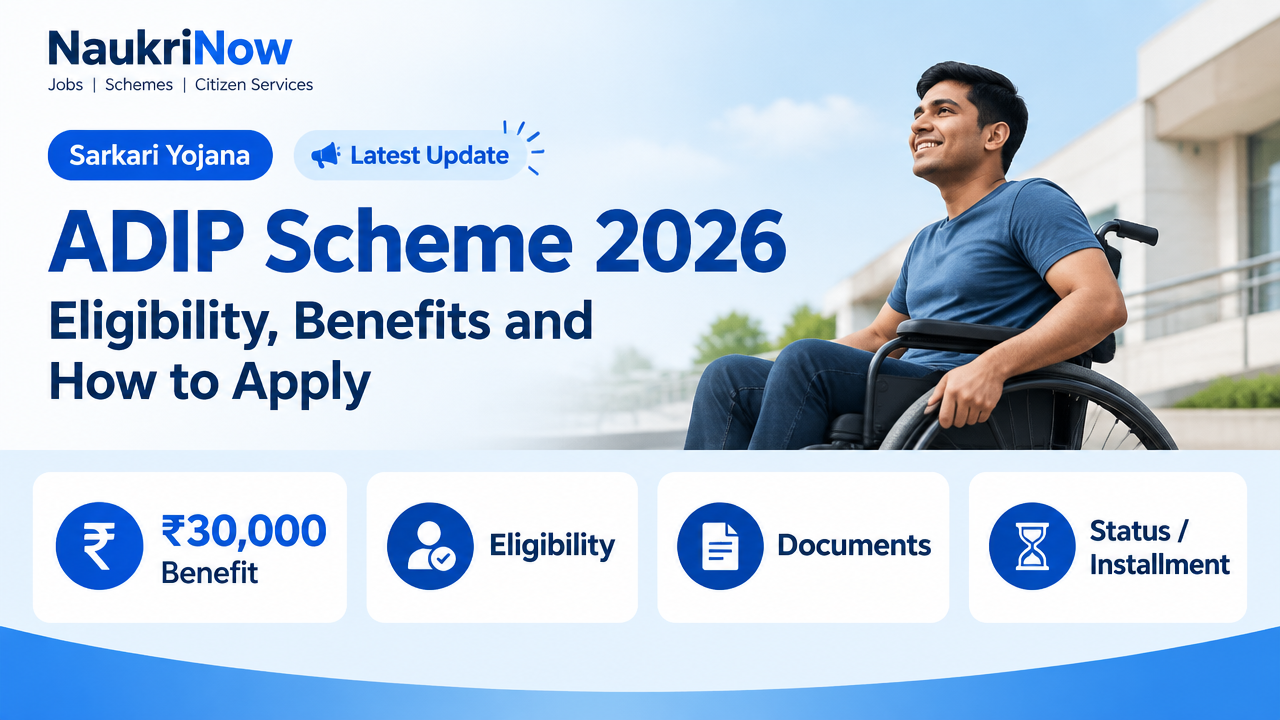
The ADIP Scheme 2026 helps eligible persons with disabilities access suitable aids and appliances at full or partial government expense. Before applying, check both the beneficiary’s income and the cost rules for the device: the admissible amount can depend on both. The guidelines described here took effect on 1 April 2024 and were stated to run through 31 March 2026, so confirm with the Department of Empowerment of Persons with Disabilities (DEPwD) whether updated or extended rules apply to applications after that date.
ADIP Scheme 2026 at a glance
| Particular | Details |
|---|---|
| Full name | Assistance to Disabled Persons for Purchase/Fitting of Aids and Appliances |
| Scheme type | Central Sector Scheme |
| Ministry and department | Ministry of Social Justice and Empowerment; Department of Empowerment of Persons with Disabilities (Divyangjan) |
| Introduced | 1981 |
| Disability threshold in the stated guidelines | At least 40%, supported by a UDID card or disability certificate |
| Monthly family-income ceiling in the stated guidelines | ₹30,000 |
| Guidelines period stated in the reference | 1 April 2024 to 31 March 2026; check DEPwD for any subsequent revision or extension |
What the ADIP Scheme 2026 does
ADIP is intended to help people who cannot readily afford assistive devices that address the effects of a disability. Depending on the person’s needs and assessment, support may cover devices such as mobility aids, prostheses, hearing aids, Braille and learning equipment, and other assistive products. The scheme operates through approved implementing agencies rather than as a general cash payment to every applicant.
A qualified professional assesses what device is suitable. Where medically required before fitting an aid, the stated guidelines also provide for assistance towards corrective surgery. Devices are intended for the beneficiary’s use, not for commercial resale or supply.
Who may qualify—and who should check first
| Eligibility check | What the stated guidelines require |
|---|---|
| Citizenship and age | Applicant must be an Indian citizen. The scheme covers people of any age, though particular devices have age conditions. |
| Disability certification | At least 40% disability, evidenced by a UDID card or disability certificate. The source also refers to a UDID enrolment number alongside the certificate; confirm the accepted proof with the agency. |
| Identity | Aadhaar number or Aadhaar enrolment ID. |
| Income | Monthly family income from all sources must not exceed ₹30,000. For a dependent child, the parent’s or guardian’s income is considered. |
| Previous assistance | The same type of aid for the same purpose should not have been received from any source during the previous three years. For children below 12, the stated interval is one year. |
| Assessment | The requested device must be appropriate to the person’s disability and needs, as determined through assessment by the implementing agency. |
Income proof accepted in the stated guidelines
- Income certificate issued by a Revenue Authority.
- Below Poverty Line (BPL) card or MGNREGA job card.
- Disability pension card.
- Certificate from an MP, MLA, councillor or Gram Pradhan.
- Notarised affidavit, where none of the listed documents is available.
Ask the agency which proof it currently accepts and whether it requires originals, copies or a particular format. Do not assume that a self-declaration alone replaces income evidence.
Who is not eligible, or may need a different assessment?
- A person who does not meet the stated disability or income conditions may not qualify under these guidelines.
- A repeat request for the same aid within the applicable waiting period is generally not permitted, subject to the child-specific interval noted above.
- Commercial supply or resale of devices is not covered as beneficiary assistance.
- A device request that has not been clinically or technically assessed as suitable may not be approved in that form.
How much assistance may be available under the ADIP Scheme 2026?
The stated rules contain both an income-based assistance rate and a device-cost rule. These are separate considerations; the figures below should not be treated as a guaranteed payout. The implementing agency must confirm the applicable ceiling, device price and any required contribution before the applicant proceeds.
Assistance by monthly family income
| Monthly family income | Stated assistance rate |
|---|---|
| Up to ₹22,500 | 100% of the admissible cost of the aid or appliance |
| ₹22,501 to ₹30,000 | 50% of the admissible cost of the aid or appliance |
Device-cost rules in the stated guidelines
| Cost of aid or appliance | Stated rule |
|---|---|
| Up to ₹15,000 | Full financial assistance, subject to the beneficiary’s applicable income-based rate and approval. |
| ₹15,001 to ₹30,000 | Assistance capped at ₹15,000 under the stated cost rule. |
| Above ₹30,000, other than cochlear implants and motorised tricycles | Government support is stated as 50% of the listed cost. The remaining share may come from a State Government, NGO or beneficiary, with prior Ministry approval. |
For a person with multiple disabilities, the stated cost ceiling applies separately to each required aid or appliance. Ask the implementing agency to explain in writing how the income rate and device-cost ceiling apply to the specific item being assessed.
Special assistance and corrective surgery
| Item or beneficiary group | Stated assistance | Important condition |
|---|---|---|
| High-end below-knee/above-knee or elbow prosthesis | Subsidy up to ₹30,000 | For a person with 40% or more disability; confirm the approved device and current ceiling. |
| Motorised tricycle or motorised wheelchair | Subsidy up to ₹50,000 | For people aged 16 or above with 80% or more disability; stated frequency is once in five years. |
| Cochlear implant for a child aged 1–5 | Up to ₹7,00,000 per unit | For pre-lingual hearing loss under the stated rules. |
| Cochlear implant for a child aged 5–18 | Up to ₹6,00,000 per unit | For acquired hearing loss under the stated rules. |
The research material describes cochlear implant support as including implant-related treatment and associated services, but applicants should obtain a current written breakdown from the authorised agency. Do not assume that every expense is separately reimbursed.
| Impairment category | Stated assistance for pre-fitment surgical correction |
|---|---|
| Speech and hearing impairment | ₹1,500 |
| Visual impairment | ₹3,000 |
| Orthopaedic impairment | ₹15,000 |
Examples of aids and appliances covered
| Disability or need | Examples listed under the scheme |
|---|---|
| Locomotor disability | Prosthetic and orthotic devices, mobility aids, surgical footwear, MCR chappals, daily-living devices, high-end prostheses and, in qualifying cases, motorised tricycles or wheelchairs. |
| Visual disability, including deaf-blindness | Communication and low-vision aids, learning equipment, arithmetic frames, abacuses and geometry kits. Accessible phones, laptops, Braille note takers or Braillers may be available for eligible students subject to stated age or study-level and repeat-use conditions. |
| Hearing disability | Hearing aids, including Behind-The-Ear models, educational kits and assistive or alerting devices such as visual doorbells and vibrating alarms. |
| Intellectual or developmental disability | Teaching and Learning Material kits and devices recommended by the relevant Expert Committee. |
| Multiple disabilities, leprosy-cured persons and other recognised disability categories | Suitable devices recommended following assessment; daily-living kits are also listed for leprosy-cured persons. |
This is not a promise that every listed product is available at every camp. Product choice, technical standards, assessment and current scheme rules determine what can be supplied.
Documents to prepare
| Document | Why it may be requested |
|---|---|
| UDID card or disability certificate | To establish disability status and percentage. |
| Aadhaar card or enrolment ID | Identity verification, as required by the stated guidelines. |
| Income proof | To establish the family-income category; use one of the accepted forms listed above. |
| Recent passport-size photographs | Application and beneficiary records. |
| Self-declaration or undertaking | To confirm that the same aid for the same purpose was not received during the applicable period. |
| Bank account details | May be needed for direct benefit or reimbursement where applicable; the scheme should not be assumed to pay every applicant in cash. |
An agency may request additional assessment or medical records for a particular device. Confirm the document checklist before travelling to a camp or centre.
How to apply for ADIP assistance
For an application under the ADIP Scheme 2026, the stated routes are through a distribution camp, an approved implementing agency, or the scheme’s online or mobile registration channel. The official DEPwD ADIP page is provided below; use it to reach current instructions rather than relying on an unverified third-party form.
| Step | Action |
|---|---|
| 1. Check current rules | Confirm with DEPwD or an approved agency that the applicable guidelines and device limits are current for your application date. |
| 2. Identify an agency or camp | Contact an authorised organisation, such as ALIMCO, a Composite Regional Centre (CRC), a District Disability Rehabilitation Centre (DDRC), a National Institute or another approved agency. |
| 3. Register and submit documents | Use the current official registration route, if available, or apply through the agency. Provide disability, identity, income and previous-assistance information. |
| 4. Attend assessment | Have the need and suitable device assessed by the relevant professional or specialist. Bring any requested medical or supporting records. |
| 5. Await verification and approval | The implementing agency verifies the application and determines the admissible aid, contribution, if any, and distribution arrangement. |
| 6. Receive and check the device | Collect the approved device through the agency or camp. Ask for fitting instructions, maintenance details and a record of distribution. |
| 7. Follow up if delayed | Contact the same implementing agency for the application or distribution status. The stated guidelines indicate supply within six months of registration, but confirm the current timeline and any case-specific delay. |
Travel support, maintenance and delivery safeguards
- Travel: The stated guidelines provide rail or bus fare support for the beneficiary and one escort, up to ₹250 per person. Confirm eligible journeys and claim procedure with the agency before travelling.
- Boarding and lodging: The stated provision is ₹100 per day for up to 15 days for eligible beneficiaries with monthly income up to ₹22,500, where a stay is required for surgery or specified fitting, including artificial limb, caliper or hearing-device fitting.
- Maintenance: Implementing agencies are required under the stated guidelines to provide one year of free maintenance for supplied devices. Ask where and how to request repairs.
- Distribution records: Agencies are required to upload beneficiary information to the scheme MIS within two days of distribution, according to the stated guidelines.
- Inclusive camps: The stated rules require at least 25% of beneficiaries at a camp to be women or girl children.
- Quality: Devices are expected to meet applicable certification or Expert Committee standards. Ask the agency for product and warranty details.
Which organisations implement ADIP?
Assistance is delivered through approved organisations. The stated categories include the Artificial Limbs Manufacturing Corporation of India (ALIMCO), National Institutes, Composite Regional Centres, District Disability Rehabilitation Centres, State handicapped-development corporations, approved NGOs and voluntary organisations, local bodies, registered hospitals and other eligible institutions. A prospective applicant should verify that the specific centre or organisation is authorised to handle ADIP cases.
Organisations seeking to implement the scheme may include registered societies, charitable trusts, Indian Red Cross branches and the listed public or specialist institutions. Grant-in-aid is not intended for commercial supply of devices.
Advantages and limitations
| Advantages | Limitations and points to check |
|---|---|
| Can reduce the cost of essential assistive devices for eligible lower-income households. | Eligibility depends on disability certification, income, assessment and the applicable rules. |
| Includes a broad range of mobility, hearing, visual, learning and daily-living aids. | Not every device is available at every location; the agency determines suitability and availability. |
| Can include specialist support for certain prostheses, motorised mobility devices and cochlear implants. | High-value items have specific age, disability, clinical and financial conditions; listed maximums are not automatic entitlements. |
| Delivery through camps and specialist agencies can include assessment, fitting and maintenance. | Applicants may need to travel, submit several proofs and wait for verification or distribution. |
Common application problems to avoid
- Applying with an expired, incomplete or inconsistent disability record; ask whether a UDID card, enrolment ID or certificate is required for your case.
- Using income proof that the local implementing agency does not accept. Confirm the accepted document before submitting.
- Leaving out prior-assistance details. The repeat-aid rule concerns the same type of aid for the same purpose.
- Assuming the maximum subsidy is the amount payable in every case. Request a written explanation of the income rate, cost ceiling and any beneficiary contribution.
- Travelling to a camp without first checking its date, services, required documents and whether it handles the device you need.
- Expecting a cash transfer or an online status facility without confirmation. Ask the implementing agency how approval, distribution and follow-up are handled.
Official resource
| Resource | Link |
|---|---|
| DEPwD information page for the ADIP Scheme | Visit the official DEPwD ADIP page |
The reference material names an ADIP portal and mobile application, but a separate current registration or status URL was not verified here. Use the DEPwD page or contact an approved implementing agency for the current application route.
Conclusion
ADIP can make important assistive devices more affordable, but approval depends on the person’s documented disability, family income, assessment and the device-specific limits. For the ADIP Scheme 2026, prepare the relevant proofs, check the repeat-assistance rule and ask the implementing agency to confirm the current guidelines, contribution and timeline in writing. Since the stated guideline period ends on 31 March 2026, verify whether any revised rules apply before submitting an application after that date.
Frequently Asked Questions
What is the full form of ADIP?
ADIP means Assistance to Disabled Persons for Purchase/Fitting of Aids and Appliances. It is a Central Sector Scheme administered through the Department of Empowerment of Persons with Disabilities under the Ministry of Social Justice and Empowerment.
What is the minimum disability percentage for ADIP assistance?
The guidelines covered here state a minimum of 40% disability, supported by a UDID card or disability certificate. Check the current requirement with the implementing agency before applying.
What is the ADIP income limit?
The stated monthly family-income ceiling is ₹30,000. The stated assistance rate is 100% of admissible cost for income up to ₹22,500 and 50% for income from ₹22,501 to ₹30,000, subject to device-cost rules and approval.
Can I apply again after receiving an aid?
The stated rule generally bars assistance for the same type of aid for the same purpose within three years. For children below 12, the stated interval is one year. Ask the agency how the period is calculated for your case.
Does ADIP support cochlear implants?
The stated guidelines list up to ₹7 lakh per unit for children aged 1–5 with pre-lingual hearing loss and up to ₹6 lakh per unit for children aged 5–18 with acquired hearing loss. These are conditional maximums; an authorised agency must confirm current eligibility and covered costs.
How can I apply online?
The reference information describes online registration and a mobile app, but a current application URL was not independently verified here. Start with the official DEPwD ADIP page or contact an approved implementing agency for the active registration route.
Is ADIP available across India?
The scheme is implemented through agencies and camps in different parts of India. Availability of a particular device or assessment service can vary by location, so check with a nearby authorised agency.
Can ADIP provide a motorised wheelchair?
The stated guidelines include a motorised wheelchair or tricycle subsidy up to ₹50,000 for eligible people aged 16 or above with 80% or more disability, once in five years. The device and current conditions must be confirmed through assessment and agency approval.
Comments