Table of ContentsClick to view all sections
- What Is Pradhan Mantri Fasal Bima Yojana? Overview for West Bengal
- What the scheme aims to do
- Premium rates and the West Bengal arrangement
- Key features and potential benefits
- Eligibility criteria for Pradhan Mantri Fasal Bima Yojana
- Documents to keep ready
- What risks can be covered?
- How to apply for Pradhan Mantri Fasal Bima Yojana online
- How to check application or claim status
- What to do if your crop is damaged
- PMFBY and Bangla Shasya Bima: what changes?
- Common problems and practical fixes
- Pros & Cons of the scheme
- Conclusion
- Official quick links
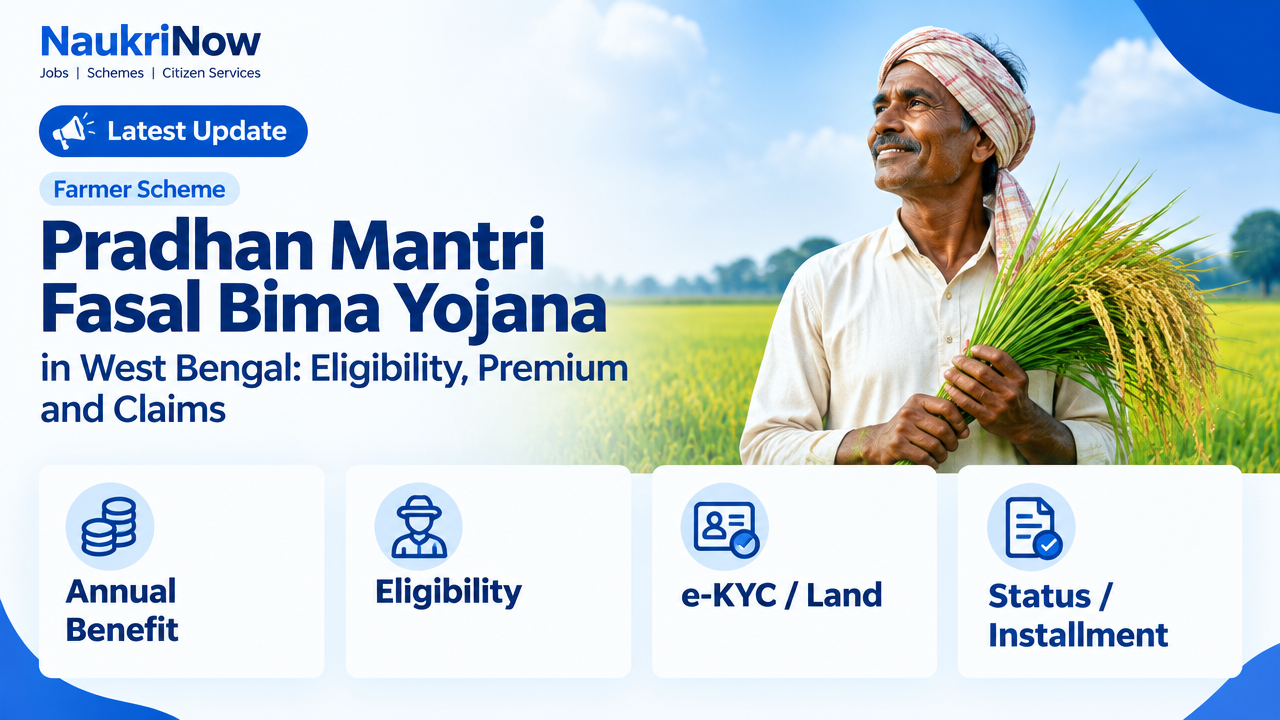
Pradhan Mantri Fasal Bima Yojana (PMFBY) is a crop insurance scheme intended to protect farmers against specified crop losses. West Bengal’s transition from Bangla Shasya Bima to PMFBY is stated to take effect from the Kharif 2026 season. The exact crops, notified areas, enrolment window and operating instructions can vary by season, so check the latest official notification before applying.
What Is Pradhan Mantri Fasal Bima Yojana? Overview for West Bengal
| Detail | What farmers should know |
|---|---|
| Scheme | Pradhan Mantri Fasal Bima Yojana (PMFBY) |
| West Bengal transition | Stated to begin from Kharif 2026, replacing the state’s earlier Bangla Shasya Bima arrangement |
| Who may enrol | Farmers with an insurable interest in a notified crop in a notified area, subject to that season’s rules |
| Farmer premium support in West Bengal | The state has stated it will bear the farmer’s share. Confirm the applicable arrangement and any payment shown during enrolment for your season. |
| Enrolment channels | PMFBY portal, Common Service Centres (CSCs), participating banks and Primary Agricultural Credit Societies (PACS), subject to availability |
| Official sources | PMFBY portal and West Bengal Agriculture Department’s PMFBY page |
What the scheme aims to do
- Reduce the financial shock of specified crop losses.
- Help stabilise farm income after a poor season.
- Provide insurance protection across notified stages of cultivation, subject to scheme rules.
- Support continued investment in farming and the flow of agricultural credit.
Premium rates and the West Bengal arrangement
Under the standard PMFBY framework, the farmer’s maximum premium share is linked to crop season and crop type. The balance is subsidised by the government according to the applicable rules. West Bengal has stated that it will also cover the farmer’s share, which could mean no premium payment by eligible enrolled farmers. Check the state’s current season notification and the final premium details shown by the authorised enrolment channel.
| Crop category | Standard farmer premium share | West Bengal arrangement stated for the transition |
|---|---|---|
| Kharif food and oilseed crops | Up to 2% of the sum insured | State has stated it will bear the farmer’s share; verify for the notified crop and season |
| Rabi food and oilseed crops | Up to 1.5% of the sum insured | State has stated it will bear the farmer’s share; verify for the notified crop and season |
| Commercial and horticultural crops | Up to 5% of the sum insured | State has stated it will bear the farmer’s share; verify for the notified crop and season |
These are standard farmer-share rates, not a guaranteed sum insured or a promise that every crop is covered. Crop and area notifications determine whether cover is available.
Key features and potential benefits
| Feature | Why it matters |
|---|---|
| Protection against specified crop risks | May help offset eligible losses caused by listed natural events, pests or diseases. |
| Coverage at different crop stages | Depending on the notified cover, protection may include prevented sowing, crop damage or certain post-harvest losses. |
| Technology-supported assessment | Tools such as satellite data, weather networks and drones can support yield or loss assessment; the method used depends on the claim and applicable rules. |
| Direct claim payment | Approved claim amounts are generally transferred to the beneficiary’s bank account, so correct account details matter. |
| State support for the farmer share | If implemented for the relevant season and crop, state payment of the farmer share can reduce the farmer’s enrolment cost. |
Eligibility criteria for Pradhan Mantri Fasal Bima Yojana
Eligibility depends on the season’s notification and the applicant’s insurable interest and supporting information. Use this table as a checklist, then confirm the current rules for your crop and area.
| Eligibility requirement or applicant type | What to check |
|---|---|
| Notified crop and area | Your crop and location must be included in the season’s official notification. |
| Insurable interest | You must have an insurable interest in the crop being insured and provide the required cultivation details. |
| Loanee farmers | Farmers with crop loans should ask their bank how enrolment applies to them for that season and verify the policy details. |
| Non-loanee farmers | May apply voluntarily, subject to the notified crop, area, documentation and deadline. |
| Tenant farmers and sharecroppers | May be able to enrol if the season’s rules permit and they can provide the prescribed proof of cultivation or tenancy. |
Who may not be covered?
A farmer cannot assume cover applies if the crop or area is not notified, the application is late or incomplete, or the applicant cannot establish an insurable interest as required. A crop or loss that falls outside the policy terms may also be ineligible. Check the current state notification and insurer conditions rather than relying on a previous season’s list.
Documents to keep ready
Requirements can differ by applicant type, district and season. Farmers are commonly asked for:
- Aadhaar or other accepted identity details.
- Bank account information, such as a passbook or cancelled cheque, for claim payment.
- Land records, such as a Khatian or Parcha, where applicable.
- Crop, area and sowing details or a sowing declaration.
- For tenants or sharecroppers, the prescribed tenancy, cultivation or other supporting proof.
- A mobile number for registration and application updates.
Ask the bank, CSC or local agriculture office for the current document list. Do not submit false land, crop or cultivation information.
What risks can be covered?
PMFBY cover depends on the notified crop, area, policy terms and type of loss. The scheme’s risk basket can include drought, flood or inundation, cyclone, hailstorm, unseasonal rain, pest attack and plant disease. Specific provisions may also cover prevented sowing, localised calamities and certain post-harvest losses. The notification for your crop and season is the deciding reference.
West Bengal’s transition information refers to a paddy inundation cover from Kharif 2026. Paddy growers should confirm whether it applies to their area and crop in the official season notification before treating a loss as insured.
Losses that may not qualify
Insurance does not cover every farm loss. Exclusions can include risks such as war or nuclear events, malicious damage or theft, and losses outside the notified policy conditions. Post-harvest cover is limited by its rules and time period. Report an event promptly and ask the insurer or agriculture office whether the particular loss is covered.
How to apply for Pradhan Mantri Fasal Bima Yojana online
| Step | Action |
|---|---|
| 1. Check the season | On the official PMFBY portal or through the West Bengal Agriculture Department, confirm the current season, notified crop, area and last date. |
| 2. Open the farmer service | Visit the PMFBY portal and use the farmer enrolment or login service. Follow the options currently available for your applicant type. |
| 3. Enter applicant details | Provide the requested identity, contact and bank information. Check spelling and account details carefully. |
| 4. Add crop and land details | Enter the notified crop, cultivated area and required land or tenancy information accurately. |
| 5. Upload documents and review | Upload the documents requested by the portal. Review the application, including the displayed premium or state support, before submission. |
| 6. Submit and save proof | Submit before the notified deadline and save the application or acknowledgement number for future status checks. |
Farmers who need assistance can ask a CSC operator, participating bank or PACS, or the local agriculture office about enrolment. Availability of each channel can vary. Do not assume that a previous year’s deadline or crop list still applies.
How to check application or claim status
| Step | Action |
|---|---|
| 1. Visit the official portal | Open PMFBY’s farmer service and select the available application or status option. |
| 2. Enter your reference | Use the application or receipt number and any other requested details, such as your registered mobile number. |
| 3. Review the result | Check whether the application is submitted, under review, accepted or requires action. For a claim, note any decision or payment update shown. |
| 4. Follow up if needed | If information is missing or a claim is disputed, contact the insurer, bank or local agriculture office. Keep your acknowledgement and supporting records. |
What to do if your crop is damaged
- Notify the insurer, bank or local agriculture office promptly after the loss. For localised calamity claims, report within the applicable reporting window; the scheme guidance cited for such losses specifies 72 hours.
- Give your application or policy details, crop and location, date of loss, and the type of damage.
- Keep photographs and any acknowledgement or complaint reference, where available.
- Follow instructions for field inspection or other loss assessment. Do not delay while waiting for a portal status change.
- Track the claim and raise a grievance if it is rejected or delayed, attaching relevant records.
Claim assessment may use field-level procedures as well as technology such as YES-TECH, weather data under WINDS, satellite information or drones. The method depends on the notified process and claim type; technology does not remove the need to follow reporting instructions.
Scheme guidance describes a 21-day claim-settlement requirement and a 12% interest penalty for certain delays. The applicable conditions and responsibility for a delay matter, so ask the insurer or use the official grievance channel if your claim exceeds the stated timeline.
PMFBY and Bangla Shasya Bima: what changes?
| Point | Bangla Shasya Bima | PMFBY transition in West Bengal |
|---|---|---|
| Scheme framework | State-run crop insurance programme | Central scheme implemented with state participation |
| Farmer premium support | State-funded under the previous arrangement | West Bengal has stated it will bear the farmer share; check the applicable season terms |
| Risk and crop rules | Set under the state programme | Set through PMFBY rules and seasonal notifications, including notified crops and areas |
| Assessment and administration | State programme processes | PMFBY framework can use national technology and claim processes, alongside state implementation |
Do not assume that every crop, deadline or claim rule carried over unchanged. Use the latest PMFBY notification for your district and season.
Common problems and practical fixes
- Crop or area is missing: Check the official season notification before applying; not every crop is necessarily notified everywhere.
- Application details do not match records: Correct name, bank and land or cultivation details with the enrolment channel as soon as possible.
- Tenant or sharecropper proof is unclear: Ask the local agriculture office which documents are accepted for that season before submitting.
- Status is not visible: Keep the acknowledgement number and ask the portal support channel, bank or CSC to check whether the application was successfully submitted.
- Crop damage has occurred: Report it promptly through the prescribed channel and keep a record of the report; late intimation may affect eligibility.
- Claim is delayed or disputed: Contact the insurer and use the Krishi Rakshak grievance portal if the issue remains unresolved.
Pros & Cons of the scheme
| Pros | Cons |
|---|---|
| Can protect against specified losses that would otherwise fall entirely on the farmer. | Only notified crops, areas and eligible loss types are covered. |
| West Bengal’s stated payment of the farmer share may reduce out-of-pocket premium costs. | The state support and crop list must be confirmed for the current season; do not assume every enrolment is automatically free. |
| Digital services and technology-assisted assessment can support application tracking and loss evaluation. | Applications still depend on accurate details, timely reporting and the prescribed assessment process. |
| Tenant farmers and sharecroppers may be eligible where they meet the documentation rules. | Proof requirements can be difficult to meet and may vary by season or applicant type. |
Conclusion
For West Bengal farmers, the key change to watch is the stated transition from Bangla Shasya Bima to Pradhan Mantri Fasal Bima Yojana beginning with Kharif 2026, together with the state’s commitment to cover the farmer premium share. Before relying on that support, confirm that your crop and area are notified, check the deadline and document rules, and keep your application acknowledgement. If damage occurs, report it promptly and retain the claim reference so you can follow up through the insurer or official grievance channel.
Frequently Asked Questions
When does PMFBY start in West Bengal?
The transition is stated to begin from the Kharif 2026 season. Confirm the operational notification, crops and dates on the official PMFBY or West Bengal Agriculture Department website.
Do West Bengal farmers have to pay a premium?
The state has stated that it will bear the farmer’s share. Check the current season’s official terms and the amount shown during enrolment, as implementation details can vary.
Is enrolment compulsory for every farmer?
No single answer applies to every borrower and season. Non-loanee farmers can generally apply voluntarily if eligible. Farmers with crop loans should confirm enrolment requirements and options with their bank under current rules.
Can tenant farmers and sharecroppers apply?
They may be eligible where the notified rules allow it and they provide the required proof of cultivation or tenancy. Ask the local agriculture office or enrolment channel for the season-specific document list.
What should I do after crop damage?
Report the loss promptly to the insurer, bank or local agriculture office using the prescribed process. For localised calamity claims, follow the applicable reporting window; scheme guidance specifies reporting within 72 hours for such losses.
How can I check my PMFBY application?
Use the farmer service on the official PMFBY portal and enter your application or receipt details as requested. Keep the acknowledgement number issued when you applied.
What if my claim is delayed or rejected?
Ask the insurer for the reason and keep your policy, application and loss-report records. If unresolved, raise a grievance through the Krishi Rakshak portal or seek assistance from the relevant agriculture office.
Does PMFBY cover every type of crop damage?
No. Cover is limited to notified crops, areas, risks and policy conditions. Check the season notification and report the loss through the prescribed channel.
Official quick links
| Resource | Link |
|---|---|
| PMFBY official website | https://pmfby.gov.in/ |
| PMFBY farmer login | https://pmfby.gov.in/farmerLogin |
| West Bengal Agriculture Department: PMFBY | https://agriculture.wb.gov.in/pm-fasal-bima-yojana-central-state- |
| Krishi Rakshak grievance portal | https://pmfby.gov.in/krph/login |
Comments