Table of ContentsClick to view all sections
- Education Certificate Guide: What counts as an education certificate?
- Start with the receiving organisation’s checklist
- A practical checklist before you submit
- How to check and verify a certificate
- If a name, date or result is incorrect
- Replacing a lost or damaged certificate
- Share documents safely
- Examples: choosing the right document
- Mistakes to avoid
- Conclusion
Education Certificate Guide: Documents, Verification and Safe Submission
Education certificates are used to show what you studied, where you studied and which qualifications you completed. You may need them for a job, further study, a professional registration or another formal application. The exact documents and submission method depend on the organisation requesting them, so do not assume that one certificate will meet every requirement.
This guide explains common school and college records, how to check them, what to do if details are wrong and how to share copies responsibly. For current requirements, contact the institution, examination board, university, employer or other organisation that will receive the documents. Use its official website or office rather than relying on forwarded messages or unofficial agents.
Education Certificate Guide: What counts as an education certificate?
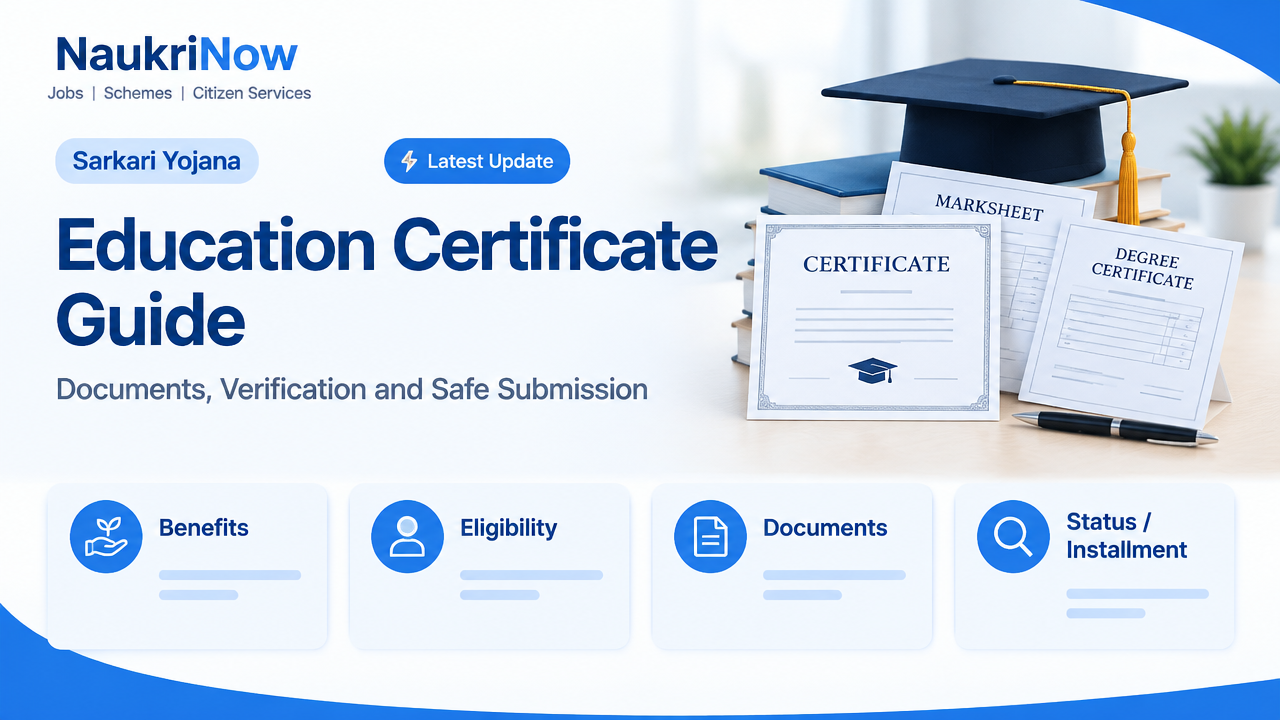
The phrase is often used broadly. Some documents confirm a qualification or examination result; others show attendance, enrolment or a student’s standing. A marksheet records subjects and marks or grades, while a pass certificate or degree certificate confirms that a course or examination was completed. A provisional certificate may serve as interim evidence, but whether a recipient accepts it is for that recipient to decide.
Common records include:
- Marksheet or statement of marks: Shows the subjects and marks, grades or credits recorded for an examination or academic term.
- Pass certificate: Confirms that a named examination was passed, where the relevant board or institution issues one separately from a marksheet.
- Degree or diploma certificate: Records the award of a qualification by a university or other authorised institution.
- Provisional certificate: A temporary or interim record issued in some circumstances before a final certificate is available. Check its stated purpose and validity with the issuer and the receiving organisation.
- Transfer or school-leaving certificate: Records a student’s departure from an institution. It is not the same as a marksheet or proof of a completed qualification.
- Migration certificate: May be requested when moving between education boards or institutions. The receiving institution can confirm whether it is needed.
- Bonafide or study certificate: Confirms a person’s connection with an institution for a stated period or purpose; it does not, by itself, prove that a qualification was completed.
Names and document formats vary between boards, universities and institutions. Check the wording printed on your own record instead of treating similar-sounding documents as interchangeable.
Start with the receiving organisation’s checklist
Before applying for a certificate or sending a copy, find out exactly what the recipient needs. Its instructions should clarify the qualification or study period to be proved, acceptable document types, whether all pages are required, and whether it expects an original, a self-attested copy, a scan or a digital record shared through an official service.
Ask for clarification if the instruction simply says “education certificate.” A useful question is: “Do you need the final degree certificate, the marksheets, or both?” Also check whether the record must cover every year or semester, and whether a translation, attestation or verification is required. Do not pay for extra services or arrange certification unless the receiving organisation or issuing authority says it is necessary.
A practical checklist before you submit
- Match the requirement to the document. Use the certificate that proves the specific fact being requested. A study certificate may show attendance, for example, but it may not establish that a final examination was passed.
- Gather the complete record. Include the relevant pages, both sides if information appears on the reverse, and all requested marksheets or academic years. Keep unrelated personal documents out of the submission.
- Compare your details carefully. Check your full name, parent or guardian details where shown, date of birth if printed, course or examination, institution, year, roll or registration number, subjects and result. Compare them with your application and other identity records, but remember that different records may follow different naming conventions.
- Check readability and completeness. Make sure seals, signatures, serial numbers, QR codes and printed text are visible. A cropped edge or glare can make a genuine record difficult to assess.
- Confirm the format and route. Follow the recipient’s stated upload, email, portal, postal or in-person process. If it asks for an original, establish how it will be handled and returned before handing it over.
- Keep a record of what you send. Save a clean copy, note the date and destination, and retain any acknowledgement or tracking reference supplied through the official process.
How to check and verify a certificate
Begin with the issuing authority. Confirm the name of the board, university or institution and use contact details published on its official website or in its formal communications. Ask whether the document can be checked online, through an official student or verification portal, by an authorised email process or through the institution’s records office. The available method differs, so do not assume that every issuer offers the same service.
Some records carry a QR code, serial number, digital signature or other verification feature. Use the issuer’s instructions to check it. A QR code that opens an unfamiliar page is not enough to establish authenticity; inspect the web address and avoid entering sensitive information on an unverified site. A photograph of a seal or signature is also not a substitute for verification through the issuer if a recipient requests formal confirmation.
Digital document services, including DigiLocker, may provide access to records issued or made available by participating institutions. Check that the record is shown as issuer-provided, that its details are correct and that the receiving organisation accepts that form. A phone screenshot or a scan uploaded by a user may be treated differently from a record retrieved directly from an issuer. Follow the recipient’s current instructions and the service’s official guidance.
For an unfamiliar institution, qualification or course, verify the details with the relevant official education authority or professional regulator, where applicable. Do not rely on a search result, social media post or a third-party website as the final word on recognition. The appropriate authority depends on the qualification and purpose.
If a name, date or result is incorrect
Do not edit the certificate yourself, even if the error seems minor. Altering a scan or changing printed information can make a genuine record appear unreliable. Contact the office responsible for the record—such as the school, examination board, university examination section or registrar—and ask for its formal correction procedure.
Describe the discrepancy precisely. For example, say that the surname on the marksheet has one spelling while the institution’s enrolment record has another. Ask which supporting records it requires, how documents should be submitted and how the corrected record will be issued or collected. Requirements can depend on the type of error and the issuer’s rules, so obtain the current checklist directly from that office.
Keep copies of your request and the material you provide. If an application or job deadline is approaching, tell the receiving organisation about the discrepancy and ask whether it will consider an interim official acknowledgement or another issuer-approved record. Do not promise that a correction will be completed by a particular date unless the issuing authority has confirmed it.
Replacing a lost or damaged certificate
If an original is missing or unusable, contact the issuing authority about a duplicate, replacement or digital record. Ask what evidence it needs to identify the record and applicant, and follow only the official application route. The issuer can confirm any required forms, declarations, supporting documents, charges or collection arrangements; these details may differ and can change.
While waiting, ask the organisation requesting the certificate whether it accepts another official record temporarily. A marksheet, online result record, provisional certificate or issuer’s confirmation may or may not be suitable for that purpose. Do not present a photocopy as an original or describe an unofficial reconstruction as a replacement certificate.
Share documents safely
Education records contain personal information, including identifying details and sometimes a photograph, signature or registration number. Send them only to a verified recipient and through the channel it has specified. Check email addresses and portal web addresses carefully, especially when a request arrives unexpectedly or pressures you to act quickly.
Use a clear scan or photograph, but avoid filters, edits or annotations that obscure the document. If the recipient permits a watermark on copies, label it with a limited purpose and date, such as “For admission application to [institution] only,” without covering official information. Do not watermark an original or a copy if the recipient’s instructions prohibit it. Keep files in a secure location and avoid posting certificates in public groups or on social media.
If you must send an original, use the recipient’s documented procedure and keep proof of delivery. Ask how the original will be returned and what acknowledgement you will receive. Never hand over an original to an unknown intermediary on the promise that it will be verified or processed more quickly.
Examples: choosing the right document
- A job application asks for proof of graduation. Check whether it wants the final degree certificate, final-year marksheet or both. A college ID or bonafide certificate may show a connection to a college but does not necessarily prove that the degree was awarded.
- A university asks for records from every semester. Prepare all requested semester marksheets, including any additional pages, and confirm whether a consolidated marksheet is accepted instead. Do not leave out a term just because the final result is also available.
- A student is changing schools. Ask the new school which leaving, transfer or academic records it requires. A transfer certificate and an examination marksheet serve different purposes; one may not replace the other.
- A certificate has a spelling difference. Contact the issuing authority and the recipient before submitting it. Explain the mismatch and ask what formal correction or supporting evidence each requires. Do not alter the document to make the spellings match.
Mistakes to avoid
- Sending a convenient document instead of the one that proves the requested fact.
- Assuming that a provisional certificate, downloaded result or student portal screenshot is accepted everywhere.
- Submitting a cropped, blurred or incomplete scan, or omitting a marksheet the instructions specifically request.
- Changing a name, mark, date or other detail on a scan, even to correct an obvious typo.
- Using unofficial agents, unverified websites or personal email addresses to obtain or verify a record.
- Sending originals without checking the recipient’s process, keeping a copy or obtaining an acknowledgement.
- Sharing more personal information than the application requires or posting certificates publicly.
Frequently Asked Questions
Is a marksheet the same as a certificate?
No. A marksheet generally lists academic results, while a pass certificate or degree certificate confirms completion or award. The names and functions of records vary by issuer. Ask the recipient which specific document it accepts.
Can I submit a digital certificate instead of a paper original?
Only if the receiving organisation accepts that format for the purpose. Check its current instructions and confirm whether it requires an issuer-provided digital record, a portal submission or a paper original.
Will a scanned copy be accepted?
That depends on the recipient and the stage of the process. Some organisations accept scans for an initial application and may ask to inspect originals later; others specify a different process. Follow the current official checklist.
What should I do if my name differs across documents?
Contact the issuer of the education record and ask about its correction procedure. Also tell the receiving organisation about the discrepancy and ask what evidence it needs. Do not edit the certificate yourself.
How do I get a duplicate certificate?
Apply through the board, university or institution that issued the original. Ask its official office or website for the current process and required evidence. Avoid sharing personal records with an intermediary whose authority you cannot verify.
Does a provisional certificate prove that I have graduated?
It may record an interim status, but its meaning and acceptance depend on the issuer and the recipient. Check what it states and ask the organisation requesting proof whether it is sufficient.
Where should I verify whether an institution or qualification is recognised?
Start with the institution and the official education authority or professional regulator responsible for that type of qualification. The right source depends on the course and its purpose. Treat unofficial directories as leads, not final confirmation.
Conclusion
A reliable education-certificate submission starts with one simple step: find out exactly what the receiving organisation needs. Match the document to that purpose, check every detail, use the issuer’s official route for verification or correction, and protect your records while sharing them. Because document formats and acceptance rules differ, confirm current requirements directly with the responsible institution, board, university, employer or authority before acting.
Comments