Table of ContentsClick to view all sections
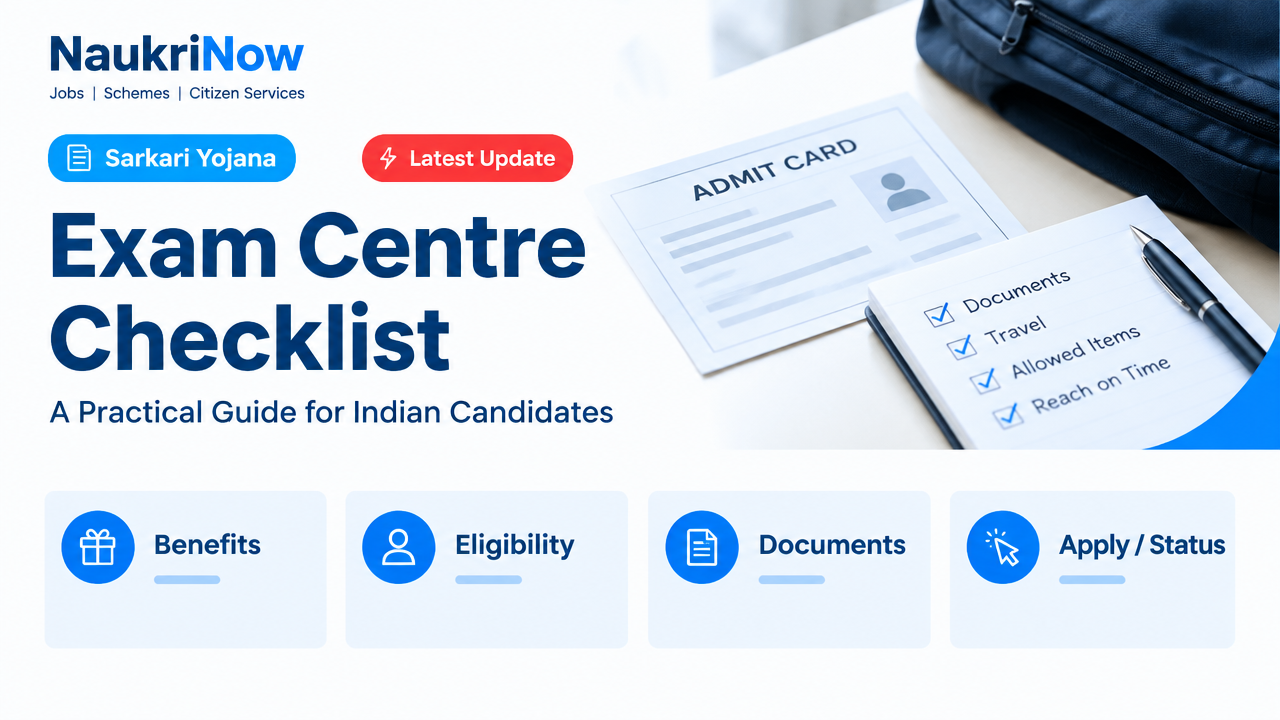
Exam Centre Checklist: A Practical Guide for Indian Candidates
Exam day is easier to manage when the important details are checked before you leave home. A missing document, a misunderstood venue address or an unplanned journey can create avoidable stress, even when you have prepared well for the exam itself.
This Exam Centre Checklist covers the practical steps to take before the day, what to verify in your exam instructions, how to plan your journey and what to do when you arrive. Exam rules differ between examinations and can change, so treat your admit card, information bulletin and the responsible exam authority’s official website as the final sources for current requirements.
Exam Centre Checklist: Start with the official instructions
Read the complete instructions issued for your specific exam, not just the candidate details on the front of your admit card. Look for a section on exam-day instructions, reporting time, entry, identification, permitted and prohibited items, and special arrangements. If the authority publishes a later notice or correction, check that too.
Make a short note of the details you must act on. These often include the reporting time, the latest permitted entry time if stated, the centre’s full address, the documents to show, and any rules for photographs or stationery. Do not assume that a rule from a previous year, another exam or a friend’s experience applies to your test.
- Confirm the exam date, shift and reporting time shown on your own documents.
- Check the exact centre name, building, address, locality and any landmark provided.
- Read whether documents must be original, printed, signed or accompanied by a photograph.
- Check the exam authority’s list of permitted and prohibited items.
- Note any separate instructions for a computer-based test, a written test or a special accommodation.
If an instruction is unclear, seek clarification through the contact or support route published by the exam authority. Avoid relying on unofficial social media posts or advice that does not identify the relevant exam and notice.
Documents to prepare
Documents are among the most important items to check because entry requirements are exam-specific. An admit card may ask you to bring a particular identity document, a photograph, a declaration or another item. One exam may accept options that another does not. Follow the exact list in your current instructions.
- Admit card or hall ticket: Check whether the instructions require a printed copy, a particular page or a specific format. If a printout is required, make it in advance and check that the text, photograph and other details are legible.
- Identity document: Carry the document or documents specified by the exam authority. Confirm the accepted type and whether an original is required. Do not assume a photocopy or digital version will be accepted unless the instructions say so.
- Photograph: Bring one only if requested, and check the size, format or other directions given for it. A photograph used for an application may not automatically satisfy a separate exam-day requirement.
- Additional forms or certificates: Check whether your exam requires a signed declaration, undertaking, category-related document or another supporting item for entry or verification. Do not bring sensitive paperwork unnecessarily if it is not requested.
Compare the name and other identifying details on your exam documents with your identification document. If you spot a mismatch, follow the authority’s published correction or clarification process before exam day where possible. Do not alter a document yourself. Keep papers flat and dry in a simple folder, and put them somewhere you can reach without unpacking your whole bag.
Take a moment to check every page of a printout. A faint image, cut-off text or missing page can be difficult to fix at the centre. Keep a separate copy or a securely stored digital record for your own reference if useful, but never treat it as a substitute for a required printed or original document.
Plan the journey, not just the route
Search the exact centre address shown on your exam document. Do not plan around the name of the city alone: a centre may be far from the station, bus terminal or area you know. If possible, check the location on a map and confirm that the pin matches the building or locality in the official address.
Estimate travel time for the relevant time of day and allow a reasonable buffer for traffic, transfers, queues or delays. A route that looks quick on a map may take longer during a busy period. If you are travelling from another town, consider reaching the area in advance rather than depending on a tight connection on the morning of the exam.
- Choose a main route and a practical backup route.
- Check the first and last connections you may need, including any transfers.
- Save the address and useful route details where you can access them offline.
- Arrange a meeting point or pickup plan if somebody is accompanying you.
- Know where you can get down or park without blocking the centre entrance.
Use the reporting and entry times printed in your own instructions to decide when to leave. Do not plan to arrive at the last possible minute: queues, security checks and finding the correct building can take time. At the same time, check whether the centre has any instructions about early arrival or waiting outside, rather than assuming it can accommodate candidates before a particular time.
Pack only what the instructions allow
Make a small packing list the night before and check each item against the official permitted-items list. Rules about pens, stationery, calculators, watches, bags, food, water bottles and electronic devices can differ. An item that is routine for one examination may be restricted in another.
Do not pack something just because you expect to leave it with a friend or at a counter. Storage may not be available, and some venues may not accept responsibility for personal belongings. If the instructions restrict an item, leave it at home unless the authority has explicitly approved it.
For a computer-based exam, do not assume you should bring personal computer accessories. For a written exam, do not assume that a particular pen or other stationery is permitted or supplied. Follow the exam-specific directions. The same principle applies to food, medicine and assistive devices: check how to request approval or what documentation to carry if the instructions call for it.
If you have a health need, disability-related requirement or other reason to request an adjustment, check the official process and deadlines in advance. Bring the approvals or supporting documents specifically requested. A last-minute explanation at the entrance may not be enough to arrange an accommodation.
The night-before and morning checklist
A final check can prevent a rushed search at the door. Place your documents together, set out suitable clothing and confirm your travel plan. Keep your preparations simple; the aim is to arrive ready, not to carry every item you might possibly need.
- [ ] I have checked the latest official instructions for my exam.
- [ ] I have confirmed the date, shift, reporting time and exact centre address.
- [ ] My required admit card, identification and other specified documents are ready.
- [ ] Required photographs, forms or certificates are prepared in the stated format.
- [ ] I have checked every item in my bag against the permitted-items list.
- [ ] I know my main route, a backup option and when I need to leave.
- [ ] My phone is charged for travel and directions, if needed; I know the centre’s rules about using or storing it.
- [ ] I have set an alarm and kept the documents somewhere easy to find.
On the morning, recheck the exam documents and the journey rather than relying only on memory. Eat and drink as you normally would, taking account of the exam instructions on food and drink. Wear comfortable, appropriate clothing and avoid accessories that the official instructions prohibit or that could slow a security check.
At the centre
When you arrive, follow the signs and instructions from authorised staff. Check that you are entering the correct building and venue, especially if a large institution has several gates or blocks. Keep your admit card and required identification accessible, but secure them when they are not being checked.
Expect identity verification or security procedures if they are part of the exam arrangements. Cooperate calmly and ask an authorised staff member if you are unsure where to go. Do not hand your documents to an unknown person offering unofficial help. If you notice a problem with your room, seat information or a document check, raise it with the designated staff promptly and politely.
Once inside, follow instructions about where to keep belongings, when to take your seat and what materials you may use. Do not photograph, copy or share exam content, and do not communicate with other candidates during the test unless the exam rules explicitly permit it. Centre staff can explain the process, but they may not be able to change an eligibility or document requirement set by the exam authority.
Mistakes to avoid
- Checking only the exam city: Verify the complete venue address and building details. A city or locality is not enough to plan a reliable journey.
- Assuming last year’s rules still apply: Use the current instructions for your own exam and session.
- Relying on a phone copy when a printout is required: Check the stated format and prepare any required hard copy in advance.
- Bringing extra items “just in case”: Unlisted belongings can cause delays or create problems at security. Pack only what the authority allows.
- Leaving a printout check until the morning: Check legibility and completeness early enough to arrange another copy if needed.
- Cutting travel time too close: Allow for delays, transfers and finding the entrance. Use the reporting time in your instructions as your planning reference.
- Trusting unofficial claims about exceptions: Verify any special allowance or change through an official notice or published support channel.
Useful examples
Example 1: The admit card names a school but the map shows several gates. Check the complete address and any landmark or gate information on the exam authority’s document. If it is still unclear, use the authority’s official clarification route. Do not guess based only on the school’s most familiar entrance.
Example 2: Your photo identification is available in an app. Do not assume that showing the app is enough. Read the instructions to see which identification documents are accepted and whether an original physical document is required. Carry the stated form, not merely the form you find most convenient.
Example 3: You need to carry prescribed medicine. Check the exam instructions for rules on medicine, packaging, declarations or prior approval. If approval is required, follow the published process and carry the requested supporting information. Avoid waiting until you reach the entrance to raise the issue.
Example 4: A friend says calculators are allowed. Check the rule for your own paper or exam session. Permission can vary by test, and a friend’s experience is not a substitute for the official permitted-items list.
Frequently Asked Questions
1. What should I carry to an exam centre?
Carry the documents and items listed in the current instructions for your particular exam. This may include an admit card, accepted identification, a photograph or specified stationery, but requirements vary. Check the official list before packing.
2. Is a digital admit card enough?
That depends on the exam authority’s instructions. If a printed copy is required, a phone image or downloaded file does not replace it. Confirm the required format on your admit card or the official exam website.
3. Can I bring my phone or smartwatch?
Do not assume either is permitted. Check the prohibited-items and belongings instructions for your exam. If an item is not allowed, leave it at home where possible rather than relying on storage at the centre.
4. How early should I reach the centre?
Use the reporting time and any entry instructions printed for your exam. Plan to allow enough time for travel, locating the venue and any checks, but follow official directions about when candidates may arrive and when entry closes.
5. What if my name differs slightly across documents?
Check the exam authority’s rules for identity verification and contact its published support route if you need clarification. Do not edit or alter documents yourself. Carry the documents specifically required and any supporting record the authority advises.
6. Can I bring my own pen or calculator?
Only if the instructions for your exam permit it. Rules vary, so verify the permitted-items list and any specifications. Do not rely on what was allowed at another exam centre or in a previous session.
7. What should I do if I reach the wrong building?
Stay calm, recheck the full address and ask an authorised staff member or the centre’s designated help point for directions. If you are still travelling, use the official address details rather than an unverified map pin or a guess based on the venue name.
Conclusion
A reliable exam centre plan comes down to a few careful checks: read the latest instructions, prepare the required documents, confirm the exact venue, allow time for travel and pack only permitted items. Use this checklist to organise yourself, but let the responsible exam authority’s current notice and your own admit card settle any exam-specific question. With the practical details handled in advance, you can focus more of your attention on the exam itself.


Comments