Table of ContentsClick to view all sections
- First, identify what kind of date change you need
- How to verify an official rescheduling notice
- Can you request an individual exam date change?
- Steps to make a request where the rules allow it
- What to do if the portal or admit card looks wrong
- Practical checklist after a date change
- Common mistakes to avoid
- Examples: how the guidance applies
- Conclusion
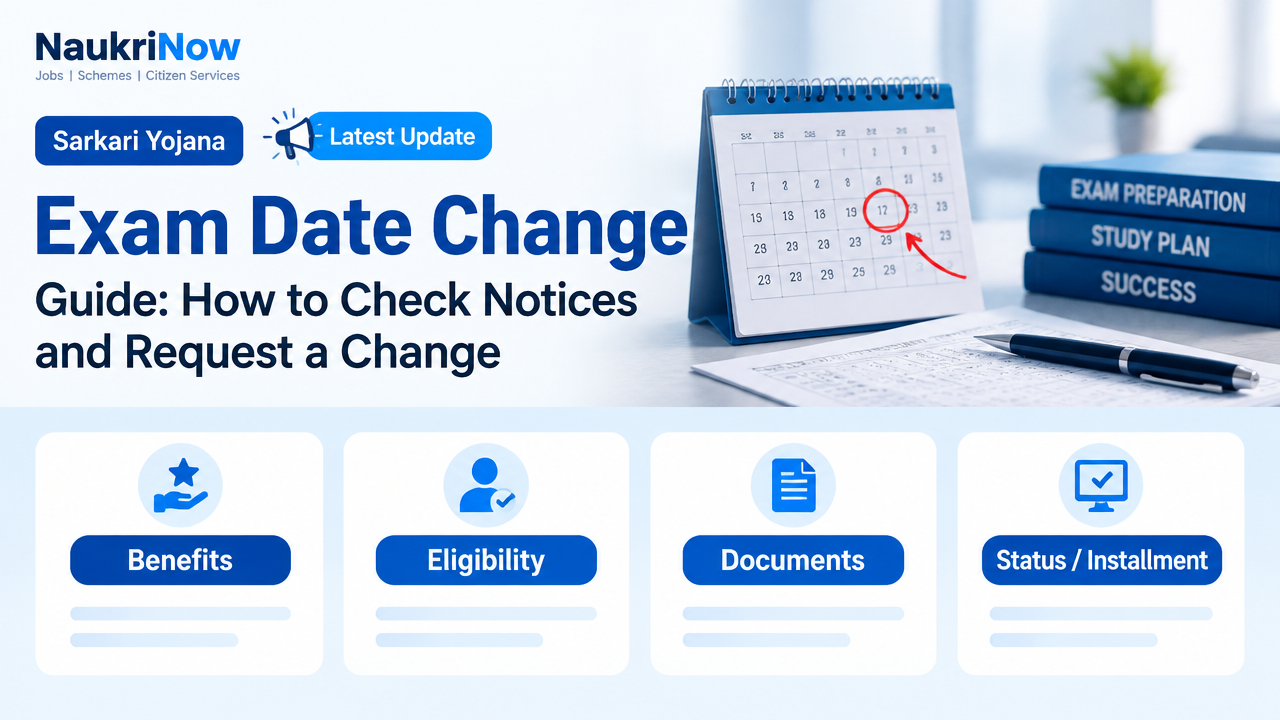
Exam Date Change — this guide explains the latest verified details, eligibility, benefits, application or status steps, and official resources relevant to this topic.
An exam date can change in two very different ways: the conducting authority may reschedule an examination for everyone or a group of candidates, or an individual candidate may want a different date or session. The steps and rules are not the same. In many recruitment and entrance examinations, candidates cannot choose or change their assigned date, shift or centre after allocation. Any exception depends on the examination’s current rules.
This guide explains how to verify an official change, check whether an individual request is permitted, and respond carefully if you cannot attend. Exam schedules and procedures vary, so use the latest notice and candidate instructions issued by the responsible examination authority as the final source of information.
First, identify what kind of date change you need
Before contacting anyone, be clear about the situation. This will help you find the correct instructions and avoid submitting the wrong kind of request.
- Official rescheduling: The authority changes the exam date, session or schedule for candidates. It may issue a notice, update the candidate portal, or publish revised instructions.
- Individual request: You want the authority to move your own examination because of a clash, travel difficulty, illness, personal commitment or another reason. This is allowed only if the relevant rules provide for it or the authority expressly accepts requests.
- Correction of an apparent error: Your portal or admit card shows information that seems inconsistent with an official notice or your application. This is not necessarily a request to choose a more convenient date. It should be raised through the designated correction or grievance process.
A request to change a date is also different from an application correction window. A correction facility usually applies to specified application details during a stated period; it does not automatically let you change an examination session, date or centre.
How to verify an official rescheduling notice
- Start with the examination authority’s official website. Use the site named in your application, confirmation page or earlier official notices. Check the examination’s dedicated page as well as the main announcements or notices section.
- Sign in to the candidate portal if one is provided. Look for a dashboard message, revised schedule, updated city intimation or admit card. A website notice and a candidate-specific portal update may serve different purposes, so check both.
- Read the complete notice. Confirm the examination name, stage, affected candidates, revised date or session, and any instructions about downloading documents. A notice for one paper, region or group may not apply to everyone.
- Check when the notice was issued and whether it replaces an earlier update. Authorities may publish more than one notice. Follow the latest applicable instruction, not a screenshot of an older announcement.
- Save a copy for reference. Download the notice or record its official webpage, publication date and relevant instructions. Keep it with your application details and admit card.
Search results, coaching websites, news reports, social media posts and messaging-group forwards can help you notice that an update may exist, but they are not a substitute for the authority’s notice. If a message claims that an exam has been postponed but the official website has no corresponding update, do not assume the date has changed. Keep following the schedule currently confirmed by the authority while you verify the claim.
Can you request an individual exam date change?
There is no single rule that applies to every examination. Some authorities assign dates and sessions centrally and do not offer individual changes. Others may specify a limited procedure for certain circumstances. The application instructions, examination notice, admit-card guidance and candidate portal should explain what is available.
Look specifically for wording about requests to change the date, shift, centre or examination city; exceptional circumstances; representations or grievances; and the deadline and channel for contacting the authority. Do not treat a general contact address or an open portal as proof that a change will be granted. An authority may review a request without approving it, and may be unable to respond before the examination.
If the instructions say changes are not permitted, or do not provide a process, do not assume that a personal email, phone call or visit will alter your assigned schedule. You can still ask for clarification through an officially listed channel, but plan on attending the examination as scheduled unless the authority confirms otherwise in writing or through an official portal update.
Steps to make a request where the rules allow it
- Read the relevant instructions before writing. Check whether the examination allows individual requests, who can make one, what reasons are considered, which channel to use and when the request must be received. Follow any prescribed format or portal process.
- Confirm your own examination details. Have the examination name, stage or paper, application or registration number, candidate name as registered, and assigned date, session and centre available. Copy these details from your official records rather than relying on memory.
- Explain the request briefly and specifically. State what information you want reviewed and why. If you are asking for a different date, make clear that you understand a change is subject to the authority’s rules and availability. Avoid sending long, emotional messages or unrelated personal information.
- Provide only the supporting material requested. The authority’s instructions determine whether evidence is needed and what type is acceptable. Depending on the circumstances, the rules may ask for relevant documentation, but there is no universal document list. Do not send sensitive records unless the official process requires them.
- Use the designated channel and meet the stated deadline. Submit through the official portal, form, email address or other method named in the instructions. Keep a submission receipt, acknowledgement number, sent-email copy or screenshot showing that the request was completed.
- Check for a response in the official place specified. Review the portal and the contact details you provided. If a follow-up is permitted, refer to your earlier submission and acknowledgement. Do not repeatedly submit the same request through unrelated channels.
- Keep preparing for the assigned date. Unless the authority confirms a change, treat the date on your latest valid official schedule or admit card as active. A submitted request is not an approval.
What to do if the portal or admit card looks wrong
Compare the information with your application confirmation and the authority’s latest notice. Check that you have selected the correct examination, stage and candidate account. Sometimes a schedule update applies only to a specified group, while other candidates retain their original details.
If the difference remains, contact the authority using the grievance or help process published for that examination. Include the minimum details needed to identify the issue, describe what you see, and attach a clear screenshot if the official process permits it. Hide unrelated personal information where possible. Note the date and time of your report and save any reference number.
If an admit card has been revised, check whether the authority tells candidates to use the revised version. Avoid relying on an old download or editing a document yourself. Never change an admit card image or PDF: altered documents may be rejected and could create a more serious problem than the original discrepancy.
Practical checklist after a date change
- Verify that the update applies to your examination, stage and candidate category.
- Recheck the date, reporting time, session, centre and any revised entry instructions.
- Download the latest required candidate document from the official portal, if instructed.
- Review whether the authority has changed any related instructions, such as permitted items or reporting arrangements.
- Update your calendar and reminders, and remove saved plans based on an outdated schedule.
- Reconsider travel and accommodation only after verifying the official details. Check relevant booking terms before cancelling or changing plans.
- Keep a copy of the notice and updated documents available in the format required by the authority.
A change to the exam date does not necessarily mean that every other detail has changed. Do not assume that your centre, shift, reporting time or document requirements remain the same—or have changed—without checking the latest instructions.
Common mistakes to avoid
- Trusting an unverified postponement message: A forwarded image can be old, edited or about another examination. Confirm it at the official source.
- Assuming that a request guarantees approval: Keep your original plan until an official confirmation says otherwise.
- Waiting until the last moment: If a genuine process exists, it may have a deadline. Check instructions as soon as the conflict becomes clear.
- Sending personal documents to unofficial contacts: Do not share identity documents, passwords, one-time codes or payment details with people claiming they can secure a new date.
- Using an unofficial agent: No outside person can reliably promise a change on behalf of the examination authority. Use only the procedure the authority publishes.
- Confusing a city preference with a confirmed centre: An application preference may not be the final venue. Follow the current candidate document and official instructions.
- Ignoring a revised admit card or notice: Recheck the portal close to the examination, especially when the authority has announced a schedule update.
- Failing to keep proof: Save notices, submitted forms and reference numbers in case you need to follow up through the official process.
Examples: how the guidance applies
Example 1: A forwarded postponement claim. A candidate sees a message in a group saying an examination has moved to a later date. The candidate checks the official examination page and portal but finds no applicable notice. The sensible response is to keep preparing for the confirmed date, monitor official updates and avoid changing travel plans based only on the message.
Example 2: A personal clash with an assigned session. A candidate has another commitment on the day shown on the admit card. The candidate checks the examination instructions and finds no individual date-change process. They may use an officially listed contact channel to ask for clarification, but should not assume an alternative session will be offered and should plan around the assigned date unless the authority confirms a change.
Example 3: Details differ between the portal and a saved admit card. A candidate notices that a portal update does not match an older downloaded document. They check the notice to see which document is current, download the latest version if instructed, and report any unresolved mismatch through the designated grievance channel. They do not edit the old file.
Frequently Asked Questions
Can I change my exam date after receiving my admit card?
Only if the examination authority’s current instructions allow it. Many examinations do not offer individual date or shift changes after allocation. Check the notice, admit-card guidance and candidate portal for the process, if any.
Will a medical or personal reason automatically qualify?
No reason should be treated as an automatic approval unless the authority’s rules expressly say so. Follow the stated process and provide evidence only if requested. The authority decides whether it can consider the request.
Is applying for a date change the same as changing my exam centre?
No. A date, session, city and centre are separate details, and the rules for each can differ. Make clear which detail is incorrect or which change you are requesting, and follow the instructions for that specific issue.
What if the exam is postponed but my admit card still shows the old date?
Read the official postponement notice for instructions about revised documents. Check the portal for an update and follow the latest applicable direction. If the conflict remains unclear, report it through the authority’s official grievance channel rather than altering the admit card.
Should I cancel travel after seeing a postponement rumour?
Do not make decisions based only on a rumour or an unverified post. Confirm that an official notice applies to your examination and candidate group, then review your booking terms and the authority’s revised instructions.
What details should I include when reporting an error?
Use the details requested by the official process. This may include your examination and application identifiers, a concise description of the mismatch, and a relevant screenshot or document if attachments are accepted. Do not include passwords or one-time codes.
Where can I find the correct contact details?
Use the contact information published on the examination authority’s official website, notice or candidate portal. Contact arrangements vary, so do not rely on a number or email address copied from an unofficial post.
Conclusion
When an exam date changes, first establish whether the authority has rescheduled the examination or whether you are asking for an individual exception. Verify notices and candidate-specific details through the responsible authority, follow its stated process, and keep proof of every official communication. Unless a change is confirmed through an authorised update, prepare for the date and session currently assigned to you. Careful verification can help you avoid missed instructions, unnecessary travel changes and misleading claims.


Comments