Table of ContentsClick to view all sections
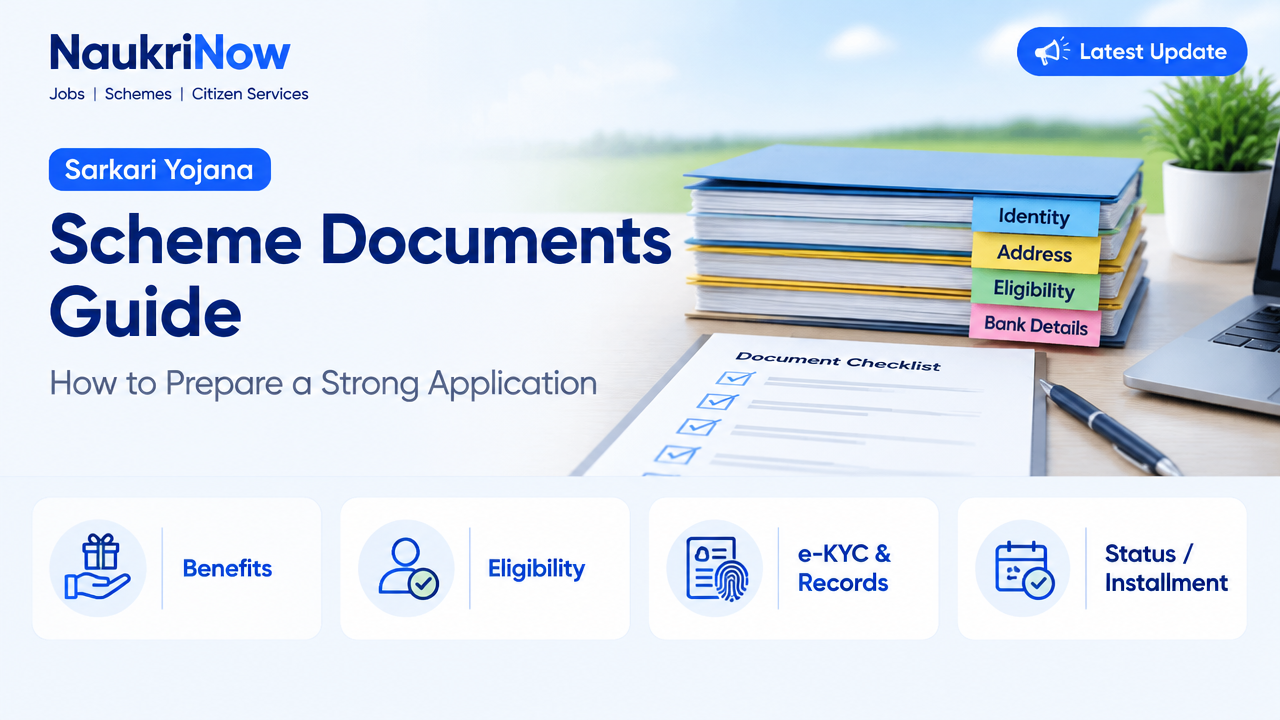
Scheme Documents Guide: How to Prepare a Strong Application
Applying for a government scheme can involve more than filling in a form. You may need to prove your identity, address, eligibility or bank details, and each document must match the scheme’s instructions. A missing page, an outdated certificate or a small difference in your name can delay an application or lead to a request for clarification.
This Scheme Documents Guide explains how to find the right checklist, prepare documents and submit them carefully. Requirements differ between central, state and local schemes, and can change. Use this guide for preparation, but confirm the latest rules, accepted formats and submission method with the official scheme portal or the responsible government department before applying.
Scheme Documents Guide: Start with the official document list
First identify the exact scheme and application route. Similar scheme names, separate state-level versions or different applicant categories can have different requirements. Search for the scheme through a government department’s official website or a government application portal. Check that the page identifies the responsible department and links to the relevant application form or instructions.
Read the instructions for your applicant category, not just a general summary. A student, farmer, pension applicant, business owner or household member may be asked for different evidence. Note whether each item is compulsory, required only in particular circumstances, or accepted as an alternative. Do not assume that a document requested for one scheme will automatically be required for another.
Before collecting papers, write down:
- The documents required from every applicant.
- Any additional documents for your category or circumstances.
- Whether an original, a copy, a self-attested copy or an online record is requested.
- Any stated rules for document validity, issuing authority, file type, size or image quality.
- How and where the application and supporting documents must be submitted.
If an instruction is unclear, check the department’s official clarification or contact route published on its own website. Do not rely on an old social media post, an unofficial checklist or a search-result snippet to settle an important requirement.
Common document categories
The following are examples of documents that schemes may ask applicants to provide. This is not a universal checklist: include an item only when the relevant scheme asks for it and accepts it.
| Purpose | Possible evidence | What to check |
|---|---|---|
| Identity | A government-issued identity document or another form named in the instructions | Name, date of birth and other details should be legible and consistent with the application. |
| Address or residence | An accepted address document, residence certificate or local record | Check which address and issuing authority the scheme recognises. |
| Eligibility or category | An income, community, disability, student, landholding or other certificate, where relevant | Confirm the exact certificate, issuer, validity conditions and applicant category required. |
| Bank details | Bank passbook page, account proof or another document specifically accepted | Check account-holder details and account information against the form. |
| Application-specific evidence | For example, an admission record, fee statement, work record or household document | Use evidence connected to the scheme’s stated purpose and period. |
Some applications may request a photograph, signature, declaration or consent. Others may use details verified through an online system. Do not treat any item in the table as automatically mandatory. In particular, identity systems and digital verification processes differ: follow the scheme’s stated process and do not share identity numbers or copies where they are not requested.
Build a reliable document file
- Collect the source documents. Gather the originals or official digital records you may need to refer to. Keep them in a secure place. Make copies only for the application or verification steps described by the responsible authority.
- Compare key details. Check spelling of names, date of birth, address and other identifying details against the application form. Look for initials, expanded names, different name order, transliteration differences and old addresses. A small discrepancy may require an explanation or supporting record.
- Check certificates carefully. Confirm that the certificate is for the correct person and purpose, bears the details and authentication required by the scheme, and meets any stated rules about issue date or validity. A certificate that seems broadly relevant may not be the specific certificate requested.
- Prepare readable copies. Scan or photograph the entire document in good light. Include all edges, text, stamps, signatures and pages. Avoid glare, shadows, blur, fingers over text or cropping. If the portal sets a file format or size limit, follow the published instructions rather than changing the document in a way that hides information.
- Use clear file names. For your own folder, labels such as address-proof or income-certificate make it easier to find files. Before uploading, use any naming convention required by the portal. Keep a separate, secure copy of the versions you submit.
- Review declarations before signing. Read every statement, check that it is true and complete, and sign or submit consent only where required. Do not alter a certificate or add information on an official document unless the issuing authority’s instructions allow it.
Check the form against your documents
Enter details as they appear in the supporting record unless the form gives a clear instruction to use a different format. Check that dates follow the form’s requested order and that you have selected the correct district, category or applicant type. Do not guess at a field you do not understand; consult the scheme instructions or the responsible department.
If details do not match, find out how the scheme handles the discrepancy before submitting. Depending on the case, the official instructions may explain how to correct a record, provide an additional document or enter a name variation. Do not create an explanation or supporting certificate yourself and present it as an official record.
Bank information deserves a separate review. Compare the account holder’s name and account details with the document requested by the scheme. Do not rely on memory or a message from an intermediary. Share banking information only through the official application route when the scheme asks for it, and never disclose a PIN, password or one-time verification code to someone claiming to help with an application.
Uploading or submitting documents
Use the submission channel specified by the responsible department. Depending on the scheme, that may be an official portal, a designated office or another authorised route. If the instructions name an assisted service, verify that it is officially recognised before handing over documents. Do not assume that a private website, messaging account or agent is authorised simply because it uses the scheme’s name or logo.
For an online application, upload each file in the correct field and open the preview if one is available. Check that the right document is attached, that all pages can be read and that the upload has completed. Save the confirmation or acknowledgement generated by the official system, along with the application reference if one is provided. For an in-person submission, follow the stated procedure for copies and originals; do not leave original documents behind unless the official process specifically requires them and explains how they will be handled.
Keep a record of what you submitted and when, without circulating sensitive documents unnecessarily. If an official request later asks for another document, verify the request through the scheme’s official channel before responding. Use the application reference or contact method published by the responsible authority to ask about a pending submission or correction.
Document mistakes to avoid
- Using a generic internet checklist: document rules are scheme- and category-specific. Confirm the list on the official application page.
- Uploading an incomplete copy: a missing reverse side, annexure or page can make an otherwise valid record difficult to assess.
- Sending an unclear image: a file that opens may still be unreadable. Check the preview at a comfortable zoom.
- Submitting an expired or unsuitable certificate: check any validity or issue-date condition stated for that scheme.
- Ignoring inconsistent details: do not assume the reviewer will infer that two different spellings or addresses refer to the same person.
- Changing a document to fit the form: never edit official details, dates, stamps or signatures. Ask the issuing authority about corrections.
- Sharing sensitive records through unofficial channels: avoid sending identity or bank documents to unknown contacts or uploading them to lookalike sites.
- Trusting guaranteed-approval claims: no outside person can promise an outcome merely in exchange for your documents or payment. Follow only the current instructions published by the responsible authority.
- Failing to keep proof of submission: save the acknowledgement or receipt provided through the authorised process.
Practical examples
Name variation: An applicant’s application form uses a full name, but one supporting record shows an initial. Rather than altering the record or submitting several unrelated identity documents, the applicant checks the scheme instructions for name discrepancies and asks the responsible department what evidence it accepts.
Certificate requested: A scheme asks for a particular eligibility certificate. The applicant has a document with a similar title issued for another purpose. Before uploading it, the applicant verifies the required certificate type, issuing authority and any validity condition from the official instructions.
Online file problem: A photograph of a document is accepted by the upload field but the text is blurred. The applicant makes a new, well-lit scan, checks every page in the preview and confirms the file meets the portal’s stated limits before submitting.
Frequently Asked Questions
Are the same documents required for every government scheme?
No. Requirements vary by scheme, department, state, applicant category and application route. Use the current official checklist for the exact scheme you are applying to.
Is an identity document such as Aadhaar always compulsory?
Do not assume that any one identity document is universally required. Check the scheme’s official instructions for the accepted proof and any verification or consent process. Provide sensitive identity information only where the official process asks for it.
Can I submit a scanned copy instead of an original?
That depends on the application route and its instructions. Online forms may ask for uploads, while an office may require copies or inspection of originals. Follow the scheme’s directions and keep originals safe.
What should I do if my name or address differs across documents?
Check the official guidance for discrepancies and ask the responsible department what it accepts. Do not edit an official record or assume that a particular affidavit or extra document will be accepted unless the scheme says so.
How do I know whether a certificate is still valid?
Look for validity, issue-date and issuing-authority rules in the current scheme instructions. If they are unclear, confirm them with the department or issuing authority before submitting.
Can I use a document checklist from an agent or social media?
You can use an unofficial list as a prompt for questions, but not as final authority. Verify every requirement through the official scheme portal or responsible department. Be cautious about anyone requesting original documents, passwords or verification codes.
What if the official website does not explain a requirement clearly?
Use the official contact or clarification route published by the responsible department. Keep a note of the guidance you receive and your application reference, if available. Avoid relying on an unverified answer when a document or eligibility decision is important.
Conclusion
Good document preparation starts with the right checklist, not with collecting every paper you own. Confirm the requirements for your exact scheme and applicant category, compare details across records, prepare clear and complete copies, and submit them only through the stated official route. Keep your acknowledgement and protect your personal information. Because government requirements can change, the responsible scheme portal or department remains the final source for current document rules and application instructions.
Comments