Table of ContentsClick to view all sections
- State PSC Jobs: What State PSC recruitment covers
- Where to find trustworthy notifications
- Check eligibility before you apply
- Understand the selection process
- A practical application checklist
- Plan preparation around the actual syllabus
- Common mistakes to avoid
- Illustrative examples: how to read different notices
- Conclusion
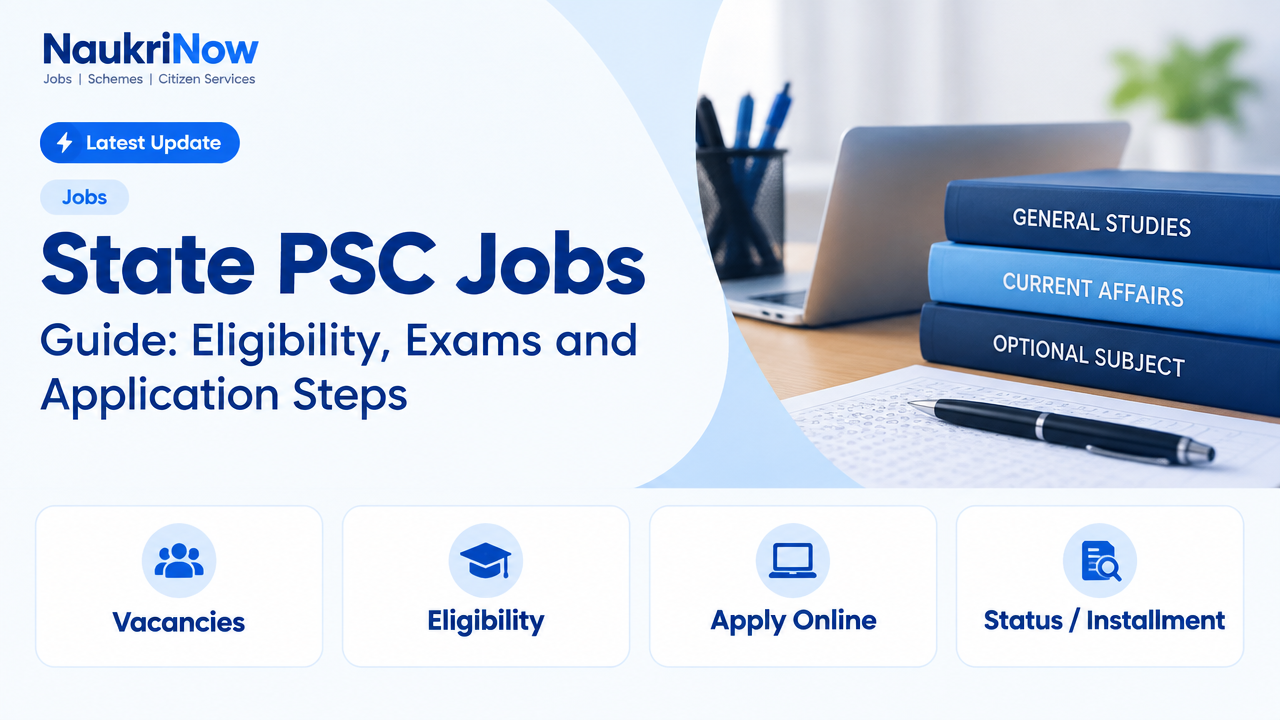
State PSC Jobs Guide: How to Find, Understand and Apply
State Public Service Commission (PSC) recruitment can lead to a wide range of public-sector careers, from administrative and revenue roles to specialist posts. Each state manages its own recruitment, so eligibility, exam structure, application rules and timelines are not uniform across India. A reliable approach starts with the official notification—not assumptions based on another state’s exam or an older recruitment cycle.
This guide explains how to identify the right opportunities, check whether you meet the requirements, plan your preparation and avoid common application errors. For changing details such as vacancies, dates, fees and results, always use the relevant commission’s official website and the recruitment notice for that specific post.
State PSC Jobs: What State PSC recruitment covers
A state PSC is responsible for recruitment to certain services and posts under that state’s public administration. The commission’s remit and the posts it advertises depend on the state and the recruitment. Some notices cover a combined or general competitive examination; others are for a particular department, profession or level of service.
Possible roles can include administrative, police, revenue, accounts, education, engineering, health or other specialist positions. These are examples, not a promise that every commission recruits for every category. Some government jobs are advertised directly by a department, board or other recruiting body rather than the PSC. Check who issued the notice before deciding how to apply.
Also distinguish a permanent post from a contractual, temporary or project-based role. Read the appointment terms in the notice rather than relying on a job title or a third-party summary.
Where to find trustworthy notifications
Start with the official website of the PSC responsible for the state and recruitment. If you are unsure which site is genuine, reach it through the state government’s official portal or a government directory. Look for the recruitment or examination section, and confirm that the notice identifies the issuing authority, post or examination, and the relevant application process.
Use a search result, newspaper report or job alert only as a lead. Before acting, open the original notice and check whether it has been updated. Later notices may correct eligibility details, change an examination schedule, extend a deadline or explain an application issue. Check the commission’s official announcements for corrigenda, addenda and other updates linked to the same recruitment.
Be cautious of sites or messages that promise selection, demand payment outside the stated process, or ask for passwords and one-time codes. A genuine application route and any permitted payment method should be described by the responsible authority. Never rely on a forwarded screenshot when the full notice is available from the official source.
Check eligibility before you apply
Read the eligibility section alongside the post description. A candidate can meet the broad education requirement but still fail another condition, such as age, subject specialisation, professional registration, experience, language ability or a physical standard. The conditions may differ between posts advertised in the same notice.
- Education: Confirm the required qualification, subject, recognised institution and any minimum marks or additional credential specified. Check whether the notice accepts an equivalent qualification and what proof it requires.
- Age: Identify the date on which age is calculated, the minimum and maximum limits, and any relaxation that may apply to your category or service history. Do not calculate eligibility using today’s date unless the notice tells you to.
- Category and reservation: Check the categories recognised for that recruitment, the certificate format, issuing authority and validity requirements. Rules and accepted documents can depend on the state and the particular notice.
- Domicile or local requirements: Some recruitments may include state-specific conditions, residence rules, language expectations or local-service provisions. Verify what is required and when evidence must be produced.
- Post-specific standards: For certain roles, requirements may include physical measurements, medical fitness, a driving licence, work experience or professional registration.
- Other conditions: Review nationality, number of attempts if specified, document verification rules and any declaration about employment or conduct.
Make a simple eligibility sheet for each post: requirement, your status, supporting document and any question to resolve. If the wording is unclear, look for an official clarification or contact route stated in the notice. Do not assume a qualification, category certificate or relaxation will be accepted because it was accepted in another recruitment.
Understand the selection process
There is no single selection pattern for all State PSC jobs. Depending on the post, recruitment may use one or more written examinations, an interview, a skill or practical test, document verification, a physical test or a medical examination. Some stages may be qualifying, while marks in other stages may contribute to the final merit list. The notification and its examination scheme are the authority on how that particular selection works.
For a multi-stage examination, read the full sequence before you begin preparing. Check the subjects, paper format, marks, duration, language options, negative-marking rules if any, and whether a stage is used for screening. Confirm which papers count toward the final result. These details affect how you divide study time and how you approach practice tests.
For specialist recruitment, examine the syllabus and test requirements for the actual post. A general guide to a state’s civil-service examination may not cover a separate technical or professional selection. Likewise, a previous year’s paper can help you understand question style, but it cannot replace the current scheme.
After each stage, rely on official notices for admit-card instructions, answer keys, objections, results and the next step. Keep copies of your application and relevant notices. Do not treat an unofficial answer-key estimate or social-media post as a result declaration.
A practical application checklist
- Save the complete notice. Download the notification and any linked syllabus, post-specific annexures and instructions. Note the recruitment name so you do not mix it up with a similar examination.
- Check every post you plan to select. A combined advertisement can list different qualifications, age limits or other conditions for different roles. Make sure your choices are consistent with your eligibility and preference.
- Prepare documents early. Gather identity, education, category or domicile evidence and other documents requested in the notice. Check names, dates and other details across records. If a document needs correction or renewal, find out the official requirements and allow time; do not alter a certificate yourself.
- Use the stated application portal. Follow the link or directions in the official notice. Enter personal and educational information exactly as required, and review every field before submission. A small mismatch can create difficulty at verification.
- Upload files to specification. Check the required file type, size, image quality and any signature or photograph instructions. Use a clear, recent image that meets the stated rules rather than resizing or editing files in a way that makes them unreadable.
- Pay only as instructed. Check whether a fee applies to you, the amount and permitted payment methods in the notice and official portal. Save the transaction confirmation if payment is required. Do not pay an agent to submit an application unless the authority explicitly provides an authorised service.
- Submit and keep proof. Confirm that the application reaches the final submitted status. Save or print the final form, application number and payment record where applicable. A saved draft or payment screenshot alone may not prove that the form was submitted.
- Monitor official updates. Check the recruitment page and the contact details stated in the notice for corrections, examination instructions and other updates. Keep your registered email and phone accessible, but treat official announcements—not rumours—as final.
Complete the form well before the closing time where possible. Portal congestion, payment delays or a last-minute document problem can leave little room to fix an error. The deadline and any extension must be verified from the official source; do not rely on an old calendar or an alert that has not been confirmed.
Plan preparation around the actual syllabus
Begin with the current notification and syllabus. Separate the material into common areas, state-specific topics and post-specific subjects. The balance varies: a general examination may require broad preparation, while a technical post may place greater weight on professional knowledge. Build your plan around the published scheme rather than a coaching advertisement or a generic study list.
- Map the syllabus: Turn each syllabus heading into smaller topics and mark what you already know, what needs revision and what requires new study.
- Use reliable material: Consult standard textbooks, official state publications and credible reference works. For state history, geography, administration or schemes, check publication dates and use authoritative sources for facts that can change.
- Practise deliberately: Use previous papers where available to learn question style and identify gaps. Take timed practice for relevant papers, then review errors instead of simply counting your score.
- Keep current affairs focused: Follow developments relevant to the syllabus and state. Verify changing facts from dependable official publications and note the date, since policies and figures can be revised.
- Revise and adapt: Schedule regular revision and short tests. If the commission issues an updated syllabus or examination scheme, adjust your plan to match the latest official version.
Do not try to cover every subject equally if the scheme assigns different weight or includes qualifying papers. Give extra attention to weak areas, but protect time for revision and mock practice. If you are working or studying alongside preparation, a realistic weekly routine that you can maintain is usually more useful than an ambitious timetable that repeatedly collapses.
Common mistakes to avoid
- Assuming rules are the same across states: Age limits, language conditions, certificates, paper patterns and application processes can differ. Read the notice for the commission and post you are applying to.
- Using an old notification as the rulebook: A past cycle is useful for context, not confirmation. Check current requirements and any later correction for the present recruitment.
- Checking only the headline eligibility: Read the post-wise conditions, cut-off date for age, document rules and selection scheme before paying or choosing posts.
- Waiting until the final day: A technical issue or missing certificate can become impossible to resolve close to the deadline. Prepare documents and submit with time to review.
- Entering inconsistent details: Carefully match names, dates and qualifications to your records. Do not guess at a field whose instructions are unclear; consult the official guidance.
- Trusting unofficial claims: Vacancy counts, exam dates, results and alleged answer keys can circulate before confirmation. Verify each changing fact on the commission’s official channel.
- Ignoring later instructions: Application submission is not the end of the process. Read admit-card, examination-day and verification directions when issued.
Illustrative examples: how to read different notices
These examples are hypothetical and do not describe a live vacancy. Imagine one notice advertises a general administrative examination and another advertises a technical post. A candidate interested in both should not assume the first notice’s degree requirement or written-paper pattern applies to the second. They should check each post’s qualification, syllabus and stages separately.
In another example, an applicant appears to meet an age limit but has a category certificate issued in a format from a different authority. The useful next step is not to assume it will be accepted or rejected. The applicant should check the notice’s certificate requirements and official clarifications, then arrange the evidence specified for that recruitment.
These habits also help when an advertisement is amended: identify which detail changed, check whether it affects your eligibility or application, and follow the updated instruction from the issuing authority.
Frequently Asked Questions
Are State PSC jobs the same as state government jobs?
No. A PSC recruits for certain services and posts within its remit, but departments, boards and other authorities may recruit separately. Check the issuing body named in each advertisement.
Can I apply to a PSC in a state where I do not live?
It depends on the specific recruitment. Some notices may set domicile, language or other state-related conditions, while others may not. Read the eligibility and reservation sections rather than assuming a general rule.
Do all State PSC examinations include an interview?
No universal selection pattern applies. A recruitment may include an interview, written papers, a practical or skill test, or other stages. Confirm the stages and their role in the current notification.
Where can I confirm a deadline or application fee?
Use the official notification and the commission’s official application page for that recruitment. If an amendment or extension is issued, follow the latest official notice. Do not rely on a third-party listing alone.
Can a previous year’s question paper predict the next examination?
It can help you practise and understand the style of questions, but it cannot guarantee the next paper’s topics or format. Check the current syllabus and scheme, then use past papers as one preparation tool.
What should I do if I spot an error after submitting?
First check the notice and portal instructions for any correction process or window. If no guidance is clear, use the official contact route stated for the recruitment. Do not submit duplicate forms unless the authority instructs you to do so.
How do I know whether a recruitment update is genuine?
Match it against the commission’s official website or another official channel identified in the notice. Check that it relates to the same recruitment and read the complete update, not just a forwarded image or a post quoting it.
Conclusion
A careful approach to State PSC Jobs starts with the right notification and continues through eligibility checks, accurate form submission and preparation based on the published syllabus. Because every recruitment can have its own conditions, treat official notices and updates as the final authority for current facts. Save your documents, verify claims before acting and keep checking the responsible commission’s official channel throughout the selection process.

Comments